| Piú votate - Saturn: the "Ringed Beauty" and His Moons |

SaturnStorm-PIA07789.jpgTurbulence... - detail mgnf (2)56 visiteNo lightning flashes are visible in the image (they would look like medium-sized bright spots, since the light would spread out before it reaches the cloud tops), but non-detection does not mean that lightnings are absent, however. Lightning might be too faint to stand out above background or too deep to be seen through the thick clouds. Bad luck is another possibility: the camera might have missed the strong flashes during the 10' that the shutter was open. A narrow-cloud band crosses the storm from left to right. It is illuminated by the Rings from the North and is brighter on that side. Cassini scientists are looking forward to an extensive Night Side image set, designed to look for lightning. That set will be collected during the first half of 2006.
The view was obtained in visible light with the Cassini spacecraft narrow-angle camera at a distance of approx. 3,5 MKM (about 2,2 MMs) from Saturn. The image scale is approx. 20 Km (about 12 miles) per pixel.
(5 voti)
|
|

SaturnStorm-PIA07788.jpgTurbulence... (1)57 visiteThis image shows a rare and powerful storm on the Night-Side of Saturn.
Light from Saturn's Rings (called "Ringshine") provided the illumination, allowing the storm and other cloud features to be seen.
The storm is a possible source of radio emissions believed to come from electrical discharges (lightning) deep in Saturn's atmosphere. Cassini began detecting the radio emissions, which are like those from lightning, on January 23, 2006. At about the same time, amateur astronomers reported that a storm had appeared in Saturn's Southern Hemisphere at Lat. - 35°. Cassini was in the wrong place to take good images of the storm on the day side, since the Planet showed only a thin crescent to the spacecraft, but night side imaging was possible using light from the Rings.
The image shows the storm as it appeared to the Cassini imaging system on January 27, 2006, and the storm's North-South dimension is about 3.500 Km (approx. 2.175 miles).
(5 voti)
|
|

Saturn-PIA07695.jpgDark Saturn, Bright Rings60 visiteCaption originale:"The Cassini spacecraft looked toward the darkened night side of Saturn to capture the eerie glow of the Rings, which, not being blocked by the Planet's bulk, remained brilliant in full Sunlight.
The image was taken in visible light with the Cassini spacecraft wide-angle camera on Dec. 24, 2005, at a distance of approx. 286.000 Km (roughly 178.000 miles) from Saturn.
The image scale is about 13 Km (approx. 8 miles) per pixel".
(5 voti)
|
|

Dione-PIA07692.jpgClosing-up on Dione58 visiteCaption originale:"This close-up of Dione's icy surface shows deeply shadowed craters near the Terminator, as well as a group of roughly linear faults above center.
The terrain shown here is on the moon's Leading Hemisphere. North on Dione is up and tilted 21° to the right.
The image was taken in visible green light with the Cassini spacecraft narrow-angle camera on Dec. 24, 2005 at a distance of approximately 152.000 Km (about 94.000 miles) from Dione and at a phase angle of 109°. Resolution in the original image was about 904 mt (roughly 2.965 feet) per pixel. The image has been magnified by a factor of two and contrast-enhanced to aid visibility".
(5 voti)
|
|

Rhea-N00049540.jpgRhea and Companions (2)58 visiteOriginal caption:"N00049540.jpg was taken on January 27, 2006 and received on Earth January 29, 2006. The camera was pointing toward Rhea that, at the time, was approximately 3.012.654 Km away, and the image was taken using the CL1 and CL2 filters".
(5 voti)
|
|

Saturn~0.jpgSaturn...from France60 visitePresently at opposition in planet Earth's sky, Saturn is well placed for telescopic observations. On Wednesday (Jan., 25, 2006) two Amateur Astronomers took full advantage of the situation from Melun, near Paris, France. With a 12" diameter telescope and web cam they recorded this sharp image of the ringed gas giant and made an exciting discovery: a new storm on Saturn. The storm appears as the white spot visible here in Saturn's Southern Hemisphere (bottom of the picture). In particular, the storm seems to correspond with an outburst of radio noise detected by the Cassini spacecraft. The phenomenon is likely similar to the Dragon Storm recorded by Cassini's instruments early last year. That storm is thought to be analogous to a terrestrial thunderstorm, with radio noise produced in high-voltage lightning discharges.
(5 voti)
|
|
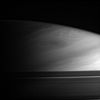
Saturn-PIA07674.jpgLooking for the "Hexagon"57 visiteOriginal caption:"As Northern Winter ends on Saturn and the Cassini spacecraft's view of the North Pole improves, the swirls and eddies visible until now only in the South are gradually coming into view in the Northern Hemisphere.
Scientists will be looking for the North Polar "Hexagon" that was seen by Voyager.
The Hexagon was a jet stream, deflected by a storm into a six-lobed pattern, that circled the Planet at 76° North Latitude.
This picture shows extensive storm activity and gives scientists hope that the Hexagon is still there. The shadows of the Rings of Saturn cut across the lower part of the image.
The image was taken in polarized infrared light with the Cassini spacecraft narrow-angle camera on Dec. 8, 2005, at a distance of app.x 3,2 MKM (about 2 MMs) from Saturn. The image scale is 37 Km (about 23 miles) per pixel".
(5 voti)
|
|
Enygma-W00012863.jpgEnygma (3)66 visiteOriginal caption:"W00012863.jpg was taken on January 05, 2006 and received on Earth January 06, 2006. The camera was pointing toward SKY, and the image was taken using the IR3 and CL2 filters. This image has not been validated or calibrated"
(5 voti)
|
|

Tethys-PIA07667.jpgTethys and Saturn, in "natural colors"56 visiteOriginal caption:"Tethys floats before the massive, golden-hued globe of Saturn in this natural color view. The thin, dark line of the Rings curves around the horizon at top.
Visible on Tethys are the huge craters Odysseus (top) and Melanthius (bottom). The view looks toward the anti-Saturn side of Tethys.
Images taken using red, green and blue spectral filters were combined to create this color view. Tethys is apparently darker than Saturn at these wavelengths. The edge of the Planet appears fuzzy, which may indicate that we are seeing haze layers that are separated from the main cloud deck.
The images were acquired by the Cassini spacecraft narrow-angle camera on Dec. 3, 2005, at a distance of approx. 2,5 MKM (about 1,6 MMs) from Saturn. The image scale is about 15 Km (app.x 9 miles) per pixel on Saturn and about 13 Km (app.x 8 miles) per pixel on Tethys".
(5 voti)
|
|

Janus-N00047441.jpgA "Hat-Trick" of Moons...59 visiteOriginal caption:"N00047441.jpg was taken on December 30, 2005 and received on Earth December 31, 2005. The camera was pointing toward JANUS that, at the time, was approximately 2.353.449 Km away and the image was taken using the CL1 and CL2 filters".
(5 voti)
|
|

Janus-PIA07663.jpgBrothers-in-arms, Brothers-in-light58 visiteEpimetheus (116 Km - about 72 miles - across, at right) and Janus (181 Km - about 113 miles - across, at left) are lit here by reflected "greylight" from Saturn. The Sun brightens only thin slivers of the moons' surfaces.
A few large craters on Janus are visible in the dim light of Saturn.
The image was taken in visible light with the Cassini spacecraft narrow-angle camera on Nov. 29, 2005 a distance of approximately 1,1 MKM (about 700.000 miles) from both moons. Resolution in the original image was 7 Km (about 4 miles) per pixel. The image has been magnified by a factor of two and contrast-enhanced to aid visibility.
(5 voti)
|
|

Enceladus-N00047261.jpgCrescent Enceladus56 visiteOriginal caption:"N00047261.jpg was taken on December 24, 2005 and received on Earth December 25, 2005. The camera was pointing toward ENCELADUS that, at the time, was approximately 108.349 Km away, and the image was taken using the RED and CL2 filters".
(5 voti)
|
|
| 2244 immagini su 187 pagina(e) |
 |
|
|
|
|
67 | |
|
|
|
|





