| Piú votate - Saturn: the "Ringed Beauty" and His Moons |

Rhea-PIA08208.jpgCrescent Rhea (Super HR)58 visiteCaption NASA originale:"Rhea's devastated surface creates a jagged terminator as mountains and crater rims break-up the line between day and night. Terrain on Rhea's night side is dimly lit by reflected light from Saturn.
The view looks toward the Southern Hemisphere on the moon's trailing side. North on Rhea is up.
The image was taken in visible green light with the Cassini spacecraft narrow-angle camera on May 22, 2006 at a distance of approximately 263.000 Km (about 164.000 miles) from Rhea and at a phase, angle of 138°. Image scale is approx. 2 Km (about 1,4 mile) per pixel".
(5 voti)
|
|

Enceladus and Titan-PIA07787-br500.jpgColors of the Saturnian System: Enceladus and Titan56 visiteMany denizens of the Saturn System wear a uniformly gray mantle of darkened ice, but not these 2 moons: the brightest body in the Solar System, Enceladus, is contrasted here against Titan's smoggy, golden murk. Ironically, what these 2 moons hold in common gives rise to their stark contrasting colors. Both bodies are, to varying degrees, geologically active. For Enceladus, its Southern Polar Vents emit a spray of icy particles that coats the small moon, giving it a clean, white veneer. On Titan, yet undefined processes are supplying the atmosphere with Methane and other chemicals that are broken down by sunlight. These chemicals are creating the thick yellow-orange haze that is spread through the atmosphere and, over geologic time, falls and coats the surface. The thin, bluish haze along Titan's limb is caused when sunlight is scattered by haze particles roughly the same size as the wavelength of blue light, or around 400 nnmts.
(5 voti)
|
|

Rhea-N00061862.jpgCrescent Rhea (2)63 visiteCaption NASA originale:"N00061862.jpg was taken on May 22, 2006 and received on Earth May 23, 2006. The camera was pointing toward Rhea that, at the time, was approximately 262.677 Km away.
The image was taken using the CL1 and GRN filters
(5 voti)
|
|

Rhea-N00061849.jpgCrescent Rhea (1)58 visiteCaption NASA originale:"N00061849.jpg was taken on May 22, 2006 and received on Earth May 23, 2006. The camera was pointing toward Rhea that, at the time, was approximately 265.985 Km away.
The image was taken using the CL1 and UV3 filters".
(5 voti)
|
|

Japetus-PIA08164.jpgThe unusual colors of Japetus60 visiteThese two views of Iapetus primarily show terrain in the Southern part of the moon's dark Leading Hemisphere - the side of Iapetus that is coated with dark material. The bright South Pole of Iapetus is visible, along with some terrain (at the bottom) that lies on the bright Trailing Hemisphere.
The dark terrain known as Cassini Regio is uniformly dark between the equator and about 30° South Lat. From there down to about 50 to 60° South Lat., the dark material looks "patchy" because south-facing crater walls are bright (being largely devoid of the dark material). South of this Region, only some northward-facing crater walls are still dark, while the bright terrain has a somewhat reddish color.
Beyond 90° South, the reddish color becomes white. The Region at the bottom of the color view presented here shows this "color boundary" in the bright terrain, which also marks the boundary between the Leading and Trailing Hemispheres.
The monochrome image on the left was taken using a filter sensitive to wavelengths of infrared light centered at 930 nanometers. The image was obtained with the Cassini spacecraft narrow-angle camera on April 8, 2006, at a distance of approximately 866,000 kilometers (538,000 miles) from Iapetus and at a Sun-Iapetus-spacecraft, or phase, angle of 88 degrees. The image scale is 5 kilometers (3 miles) per pixel.
The color view on the right was created by combining images taken in ultraviolet, green and infrared spectral filters. The images were acquired with the Cassini spacecraft narrow-angle camera on April 9, 2006, at a distance of approximately 692,000 kilometers (430,000 miles) from Iapetus and at a Sun-Iapetus-spacecraft, or phase, angle of 101 degrees. The image scale is 4 kilometers (2.5 miles) per pixel.
(5 voti)
|
|
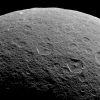
Rhea-PIA08173.jpgOld Rhea...57 visiteCaption NASA originale:"Cassini looks down upon Rhea, whose cratered surface was already ancient before any complex life developed on Earth. The terrain seen here has probably changed little in the past billion years (!). This view shows terrain on the Saturn-facing Hemisphere of Rhea. North is up.
The image was taken in visible light with the Cassini spacecraft narrow-angle camera on March 21, 2006 at a distance of approximately 94.000 Km (such as about 59.000 miles) from Rhea and at a phase angle of 109°. The image scale is about 558 mt (approx. 1.832 feet) per pixel".
(5 voti)
|
|

Janus-N00060306.jpgThe "Runners": Janus and Epimetheus58 visiteCaption NASA:"N00060306.jpg was taken on April 29, 2006 and received on Earth April 29, 2006. The camera was pointing toward Janus that, at the time, was approximately 217.624 Km away.
The image was taken using the CL1 and CL2 filters. This image has not been validated or calibrated".
(5 voti)
|
|

Dione&Janus-PIA08158.jpgSaturn, Dione and Janus55 visiteCaption originale:"The Cassini spacecraft looks toward the Saturnian horizon as Dione and Janus glide past.
A few craters are visible on Dione, while Janus is slightly blurred due to its motion during the exposure. The Rings appear essentially edge-on in this view, as the Cassini spacecraft continues its recent activities close to the Ring-Plane.
The image was taken with the Cassini spacecraft narrow-angle camera on March 10, 2006, using a filter sensitive to wavelengths of infrared light centered at 750 nnmts. The image was acquired at a distance of approx. 2,9 MKM (about 1,8 MMs) from Saturn.
The image scale is approx. 17 Km (roughly 11 miles) per pixel".
(5 voti)
|
|

Saturn-PIA08156.jpgCat's Eyes on Saturn!58 visiteCaption originale:"Bright, high altitude clouds, like those imaged here, often appear more filamentary or streak-like than clouds imaged at slightly deeper levels in Saturn's atmosphere. This view also shows one of the many sp-called 'Cat's Eye' vortices that swim through the Southern Latitudes.
The image was taken in polarized infrared light with the Cassini spacecraft narrow-angle camera on March 7, 2006, at a distance of approx. 2,9 MKM (about 1,8 MMs) from Saturn. The image scale is about 17 Km (roughly 10 miles) per pixel".
(5 voti)
|
|

Saturn-PIA08151.jpgSaturn's Southern Restlesness58 visiteThis view of high Southern Latitudes on Saturn shows very linear clouds at top, usually indicative of stable prevailing winds, and two turbulent, swirling features farther South. It is possible that these features merged some time after this image was taken.
The image was taken with the Cassini spacecraft narrow-angle camera on March 6, 2006, using a filter sensitive to wavelengths of infrared light centered at 750 nnmts. The image was acquired at a distance of approximately 2,8 MKM (about 1,8 MMs) from Saturn. The image scale is approx. 16 Km (roughly 10 miles) per pixel.
(5 voti)
|
|

Atlas-PIA08147.jpgAtlas57 visiteCaption NASA originale:"The Cassini spacecraft looks up from beneath the ringplane to spy Atlas, hugging the outer edge of the A-Ring, above center.
The image was taken in visible light with the Cassini spacecraft narrow-angle camera on Feb. 23, 2006, at a distance of approx. 1,1 MKM (such as about 700.000 miles) from Atlas (32 Km, or 20 miles across).
The image scale is roughly 7 Km (about 4 miles) per pixel on Atlas".
(5 voti)
|
|

Propellers-003-PIA07791.jpgThe "Propellers" of the Rings (4) - HR (detail mgnf)57 visiteThis magnified view illustrates the general orientation of the Propellers in Saturn's Rings, as they orbit around the Planet.
The two dashes of the Propeller are oriented in the direction of orbital motion. The "leading" dash is also slightly closer to Saturn; this "radial offset" is about 300 mt (about 1000 feet). The unseen moonlet lies in the center of the structure.
The grainy appearance of the image is due to magnification and the fact that the Propellers are very faint - just visible above the level of the back-ground noise. Consequently, the image enhancement procedures used to create this detail mgnf, have also enhanced the noise.
(5 voti)
|
|
| 2244 immagini su 187 pagina(e) |
 |
|
|
|
|
65 | |
|
|
|
|





