| Piú votate - Saturn: the "Ringed Beauty" and His Moons |
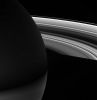
Saturn-PIA08252.jpgSaturnian Night58 visiteCaption NASA:"The night skies of Saturn are graced by the Planet's dazzling Rings, but as this image shows, one's view could be very different depending on the Season and from which Hemisphere one gazes up.
This point of view shows that the Southern Hemisphere is much brighter on the planet's night side than the Northern Hemisphere, owing to the brilliance of Sunlight reflecting off the Southern illuminated Rings. The Northern Hemisphere sees only the ghostly glow of the dim scattered light that manages to penetrate the Rings.
The Planet's shadow eclipses the Rings themselves in the lower half of this scene, but close inspection shows ringlets in the C-Ring silhouetted against the Southern Latitudes.
The image was taken in visible light with the Cassini spacecraft wide-angle camera on July 25, 2006 at a distance of approx. 952.000 Km (about 592.000 miles) from Saturn and at a Sun-Saturn-spacecraft, or phase, angle of 124°. Image scale is roughly 53 Km (about 33 miles) per pixel".
(5 voti)
|
|
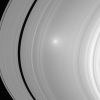
The Rings-PIA08247.jpgOpposition "Surge" on the A-Ring55 visiteThe Opposition Effect exists because of two contributing factors: one is due to the fact that the shadows of Ring particles directly opposite the Sun from Cassini - the Region of Opposition - fall completely behind the particles as seen from the spacecraft. These shadows are thus not visible to the spacecraft: all ring particle surfaces visible to the spacecraft in this image are in Sunlight and therefore bright. Much farther away from the Region of Opposition, the Ring particle shadows become more visible and the scene becomes less bright. The brightness falls off in a circular fashion around the Opposition Point. The main factor to the Opposition Surge in this image is an optical phenomenon called "coherent backscatter": here, the electromagnetic signal from the rays of scattered Sunlight making its way back to the spacecraft is enhanced near the Region of Opposition because, instead of canceling, the electric and magnetic fields comprising the scattered radiation fluctuate in unison.
(5 voti)
|
|

Mimas-N00064753.jpgMimas is "looking down"...58 visiteCaption NASA:"N00064753.jpg was taken on August 16, 2006 and received on Earth August 18, 2006. The camera was pointing toward Mimas that, at the time, was approximately 219.272 Km away.
The image was taken using the P120 and UV3 filters".
(5 voti)
|
|

Rhea-N00064852-A.jpgMoments of Rhea (7) - Squared Crater and anomalous "slope" (contex image)57 visiteLo stesso rilievo che abbiamo adocchiato nel quadro n. 1, si ripropone da un angolo visuale migliore, sebbene osservato e ripreso da una distanza maggiore (poco più di 191.000 Km rispetto ai 167.000 del quadro n.1): la regione Est del grande cratere (che qui ci appare ad ore 12 - essendo mutata la posizione di Cassini rispetto a Rhea) pare proprio aver subito un "trauma" di un qualche tipo, poichè la bianca parete del cratere, come poi vedrete meglio nel detail mgnf, effettivamente si interrompe e cambia tessitura e colore.
Difficile fare ipotesi, ma la sensazione che un evento cataclismico si sia (in epoche neppure troppo remote) verificato in quella regione di Rhea ci pare alquanto probabile (e per i Lettori più ferrati in Scienze Planetarie, suggeriamo di fare un raffronto tra questo cratere e le sue pareti ed il cratere Lunare "Jansen-B": le somiglianze, secondo noi, ci sono e sono molto nette).
(5 voti)
|
|

Rhea-N00064828.jpgMoments of Rhea (5)58 visitenessun commento
(5 voti)
|
|

Rhea-N00064815.jpgMoments of Rhea (4) - The "Terminator"74 visitenessun commento
(5 voti)
|
|

Saturn-PIA08242.jpg"Flat and Ringless" Saturn...58 visiteCaption NASA originale:"Saturn's low density and fast rotation combine to give it its characteristic oblate shape. The dramatic crescent seen here demonstrates how the Ringed Planet is much wider at the equator than at the poles.
The Rings (seem to) disappear near the center into the darkness of the Planet's shadow.
The image was taken in visible light with the Cassini spacecraft wide-angle camera on July 11, 2006 at a distance of approx. 2,9 MKM (such as about 1,8 MMs) from Saturn and at a Sun-Saturn-spacecraft, or phase, angle of 163°.
Image scale is approx. 169 Km (about 105 miles) per pixel".
(5 voti)
|
|

Rhea&Enceladus-PIA08229.jpgCrescent Moons...57 visiteCaption NASA originale:"Rhea and Enceladus shared the sky just before the smaller moon passed behind its larger, cratered sibling.
This image is part of a "mutual event" series in which one moon passes close to or in front of another. These sequences help scientists refine the orbits of Saturn's moons.
Cratered Rhea is 1.528 Km (about 949 miles) across and presumed to be geologically dead. While much smaller, Enceladus (505 Km, or about 314 miles across) is geologically active today.
The image was taken in visible light with the Cassini spacecraft narrow-angle camera on July 4, 2006 at a distance of approx. 1,4 MKM (such as about 800.000 miles) from Rhea and 1,9 MKM (such as about 1,2 MMs) from Enceladus. The view was obtained at a Sun-moon-spacecraft, or phase, angle of about 142°, relative to both moons.
Image scale is 8 roughly Km (about 5 miles) per pixel on Rhea and roughly 11 Km (about 7 miles) on Enceladus".
(5 voti)
|
|

Rhea-N00064136.jpgA rough slice of Rhea (2)57 visitenessun commento
(5 voti)
|
|

Rhea-N00064131.jpgA rough slice of Rhea (1)58 visitenessun commento
(5 voti)
|
|
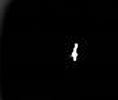
Hyperion-N00063147-2.jpgHyperion and a "Bright Companion" (2 - detail mgnf)73 visiteOsservate attentamente questo stretch estremo del frame precedente: l'effetto che osservate, a nostro avviso, è un effetto di saturazione, ossìa un artefatto che emerge quando l'oggetto fotografato (o una sua parte) é/sono troppo luminoso/i.
Su Marte, in svariati casi (dalle immagini degli Heat-Shields, a quelle di alcune componenti dei Rover illuminate direttamente dal Sole), il risultato della saturazione si esprimeva nel cd. "effetto goccia". Qui, nello spazio di Saturno, l'effetto della saturazione ci sembra molto simile a quanto si vede su Marte. Anzi: forse esso è ancora più eclatante.
Domanda: che cosa sarà mai, dunque (ed ovviamente ammettendo che la nostra costruzione sia almeno in parte esatta), quell'oggetto semi-cancellato, ma in parte ancora visibile - ad ore 9 della traccia luminosa - che si trova ad una distanza imprecisata dalla Sonda Cassini, e nelle vicinanze di Hyperion?
(5 voti)
|
|

Hyperion-N00063147-1.jpgHyperion and a "Bright Companion" (1 - context image)67 visiteUn'immagine bella ed ambigua: Hyperion, the "tumbling moon", sembra essere in compagnia di un altro oggetto il quale, forse perchè molto (si direbbe "troppo", a giudicare dal risultato fotografico ottenuto) luminoso, è stato "washed away".
Ma attenzione: il washing è stato solo parziale! Qualcosa, infatti, sembra che la si riesca a vedere...
(5 voti)
|
|
| 2244 immagini su 187 pagina(e) |
 |
|
|
|
|
64 | |
|
|
|
|





