| Piú votate - Saturn: the "Ringed Beauty" and His Moons |
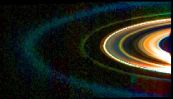
The Rings-PIA01940.jpgInfrared Rings56 visiteThis mosaic of Saturn's rings was acquired by Cassini's VIMS (Visual and Infrared Mapping Spectrometer) on Sept. 15, 2006, while the spacecraft was in the shadow of the Planet looking back towards the Rings from a distance of about 2,16 MKM (approx. 1,34 MMs).
Data at wavelengths of 1,0, 1,75 and 3,6 microns were combined in the blue, green and red channels to make the pseudo-color image shown here. The brightest feature in the mosaic is the F-Ring, located at the outer edge of the main Rings. The F-Ring is overexposed and appears white in this image. Of the main A, B and C Rings; the C-Ring is the most prominent and reddish in color, becoming saturated close to the Sun. The more opaque A and B Rings are muddy in color and very dark in this geometry.
By contrast, the normally faint D-Ring, located just interior to the C-Ring, is quite bright and blue, indicating the presence of very small ring particles. Similarly, a narrow, green ringlet in the Cassini Division, as well as the greenish G-Ring and blue E-Ring - located at increasing distances outside the F-Ring - are predominantly composed of small particles.
The faint reddish band immediately outside the F-Ring is likely to be an artifact caused by the extremely bright F-Ring.

(5 voti)
|
|
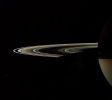
Saturn-PIA08282.jpgIn the darkness58 visiteSunlight filters through Saturn's Rings in sepia tones in this artful view from the Cassini spacecraft of the dark side of the Rings. Those rays from the Sun directly reflected from the lit side of the Rings onto the Planet strike and illuminate the night-side Southern Hemisphere.
The densely populated B-Ring blocks much of the Sun's light and thus looks quite dark and Tethys is a mere sliver below left.
Note that unprocessed wide-angle camera images taken in a high-phase viewing geometry generally contain stray light artifacts. These have largely been removed from this image by computer image processing.
Cassini was about 3° above the Ring-Plane when this image was obtained on Sept. 6, 2006. Images taken using red, green and blue spectral filters were combined to create this natural color view. The images were taken using the Cassini spacecraft wide-angle camera at a distance of approx. 1,8 MKM (about 1,1 MMs) from Saturn and at a phase angle of 154°. Image scale is roughly 106 Km/pixel.
(5 voti)
|
|

The Rings-PIA08288.jpgSpokes!56 visiteA group of bright spokes tightly cluster together in Saturn's B ring. The spokes seen here generally all exhibit the same degree of shearing, or tilting, but some deviations are apparent. In this image, the direction to Saturn is downward; orbital motion is to the left.
Ring scientists are eager for data to help them understand and eventually explain how these mysterious ring features are created. To that end, Cassini has been directed to acquire movie sequences, like the one this image is part of, that watch for these elusive radial structures.
This observation focused on the morning side of the rings, the side where the rings are rotating out from Saturn's shadow. Spokes appear most frequently at this location.
Also barely visible in this image are broader, much fainter but still bright radial regions that extend over larger radial distances than the spokes in the upper left. Where these fainter features cross ringlets in the lower part of the image, slight variations in brightness are apparent. These are probably due to tiny particles, possibly part of a former spoke, that haven't yet settled down onto the ring plane.
Although their formation is still a subject of inquiry, scientists are confident that the microscopic spoke particles are slightly electrically charged and therefore are influenced by Saturn's magnetic field.
The brightness of the spokes, when combined with viewing geometry information and estimates of their particle sizes can help researchers determine the amount of material in the spokes--a crucial quantity to constrain theories of spoke formation.
The image was taken in visible light with the Cassini spacecraft narrow-angle camera on Sept. 28, 2006, at a distance of approximately 1.3 million kilometers (800,000 miles) from Saturn and at a Sun-Saturn-spacecraft, or phase, angle of 147 degrees. Scale in the original image was about 32 kilometers (20 miles) per pixel. The view has been magnified by a factor of two.
(5 voti)
|
|

Mimas-PIA08278.jpgHerschel Crater on Mimas57 visiteCaption NASA:"The great basin that interrupts the contours of this moon's crescent identifies the satellite unmistakably as Mimas. The giant crater Herschel (about 130 Km, or 80 miles wide) is this moon's most obvious feature.
North on Mimas (approx. 397 Km, or 247 miles, across) is up and rotated 23° to the left.
The image was taken in visible light with the Cassini spacecraft narrow-angle camera on Sept. 8, 2006 at a distance of approx. 534.000 Km (about 331.000 miles) from Mimas and at a Sun-Mimas-spacecraft, or phase, angle of 115°. Image scale is roughly 3 Km (about 1,9 miles) per pixel".
(5 voti)
|
|

Saturn-W00018089.jpgWhat do some images show? (5)113 visitenessun commento
(5 voti)
|
|

The Rings-W00017896.jpgAn enormous "clump" in Saturn's Rings? No: that's Enceladus!57 visiteCaption NASA:"W00017896.jpg was taken on September 15, 2006 and received on Earth September 17, 2006. The camera was pointing toward the Rings of Saturn that, at the time, were approximately 2.227.319 Km away.
The image was taken using the CL1 and IRP90 filters. This image has not been validated or calibrated".
Wispy fingers of bright, icy material reach tens of thousands of kilometers outward from Saturn's moon Enceladus into the E-Ring, while the moon's active South Polar jets continue to fire away. This astonishing, never-before-seen structure is made visible with the Sun almost directly behind the Saturn System from Cassini's vantage point. The phase angle here is 175°, a viewing geometry in which structures made of tiny particles brighten substantially. These features are very likely the result of particles injected into Saturn orbit by the Enceladus geysers: those injected in the direction of the moon's orbital motion end up on larger, slower orbits and trail Enceladus in its orbit, and those injected into the opposite direction end up smaller, faster orbits and lead Enceladus. (Orbital motion is counter-clockwise.) In addition, the configuration of wisps may hint at an interaction between Saturn's magnetosphere and the torrent of particles issuing from Enceladus.
In addition to the wisps, another unexpected detail is the dark gore in the center of the ring, following the moon in its orbit, likely brought about by the sweeping action of Enceladus as it orbits in the center of the E ring.
The view looks down onto Enceladus (505 kilometers, or 314 miles across) from about 15 degrees above the ringplane. Tethys (1,071 kilometers, or 665 miles across) is visible to the left of Enceladus.
The image was taken in visible light with the Cassini spacecraft wide-angle camera on Sept. 15, 2006, at a distance of approximately 2.1 million kilometers (1.3 million miles) from Enceladus. Image scale is 128 kilometers (80 miles) per pixel.
(5 voti)
|
|

Japetus-3D2.jpgJapetus (3D)58 visitenessun commento
(5 voti)
|
|
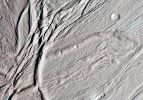
Enceladus-3D.jpgThe frozen canyons of Enceladus (3D)57 visitenessun commento
(5 voti)
|
|

The Rings-PIA08259.jpgGravitational Disturbances55 visiteCaption NASA originale:"The clumpy disturbed appearance of the brilliant F-Ring constantly changes. The irregular structure of the Ring is due, in large part, to the gravitational perturbations on the ring material by one of Saturn's moons, Prometheus (about 102 Km, or 63 miles across).
Interior to the F-Ring, the A-Ring bears a striking resemblance to a classic grooved, vinyl record. Visible here are the Keeler Gap (about 42 Km, or 26 miles wide) and the Encke Gap (about 325 Km, or 200 miles wide).
The image was taken using a spectral filter sensitive to wavelengths of infrared light centered at 862 nnmts. The view was acquired with the Cassini spacecraft narrow-angle camera on July 26, 2006 at a distance of approx. 1,5 MKM (about 900.000 miles) from Saturn and at a Sun-Saturn-spacecraft, or phase, angle of 141°. Image scale is roughly 8 Km (such as about 5 miles) per pixel".
(5 voti)
|
|

Dione-PIA08256-E.jpgThe "White (and Bright) Cliffs" of Dione (detail mgnf n. 5)95 visitenessun commento
(5 voti)
|
|

Dione-PIA08256-D.jpgThe "White (and Bright) Cliffs" of Dione (detail mgnf n. 4)58 visitenessun commento
(5 voti)
|
|
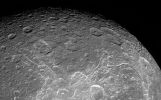
Dione-PIA08256-B.jpgThe "White (and Bright) Cliffs" of Dione (detail mgnf n. 2)58 visitenessun commento
(5 voti)
|
|
| 2244 immagini su 187 pagina(e) |
 |
|
|
|
|
63 | |
|
|
|
|





