| Piú votate - Saturn: the "Ringed Beauty" and His Moons |

Prometheus-PIA08849.jpgThe "Wave-Maker"...74 visiteCaption NASA:"Prometheus dips into the inner F-Ring at its farthest point from Saturn in its orbit, creating a dark gore and a corresponding bright streamer. Gores created during previous apoapsis (the name for the farthest point in an orbit) passes, are seen above. The older gores are farther behind the moon in its orbit of Saturn. This view looks toward the unlit side of the Rings from about 31° above the Ring-Plane.
The image was taken in visible light with the Cassini spacecraft narrow-angle camera on Nov. 1, 2006 at a distance of approx. 1,7 MKM (about 1,1 MMs) from Saturn and at a Sun-Saturn-spacecraft, or phase, angle of 162°.
Image scale is roughly 10 Km (a little more than 6 miles) per pixel".
Nota: si tratta di una elaborazione Lunexit in falsi colori che abbiamo realizzato per evidenziare non solo la reale forma di Prometheus ma anche la presenza, sia internamente, sia esternamente all'Anello "F", di una debolissima luminosità (che appare di colore rosso scuro) la quale, a nostro parere, NON è un semplice effetto ottico - tipo luce diffusa dall'Anello "F" - bensì è vero e proprio materiale: la porzione più estrema (esterna ed interna) dell'Anello "F" stesso la quale è formata, con ogni probabilità, solo da polveri.MareKromium
(5 voti)
|
|

Prometheus-PIA08847.jpgPrometheus' trail63 visiteCaption NASA:"Prometheus interacts gravitationally with the inner flanking ringlets of the F-Ring, creating dark channels as it passes.
This image was taken in a complete azimuthal scan of the Rings, during which Cassini followed Prometheus (102 Km, or 63 miles across) around the Rings for one complete orbit, or about 14 hours. This view looks toward the unlit side of the Rings from about 41° above the Ring-Plane. The moon is partly lit by Sunlight (at left) and elsewhere lit by reflected light from Saturn.
The image was taken in visible light with the Cassini spacecraft narrow-angle camera on Nov. 23, 2006 at a distance of approx. 1,5 MKM (900.000 miles) from Prometheus and at a Sun-Prometheus-spacecraft, or phase, angle of 152°. Image scale is roughly 9 Km (a little more than 5 miles) per pixel".
(5 voti)
|
|

The_Rings-PIA08846.jpgLights through the Rings...55 visiteCaption NASA:"With the Sun directly behind Cassini, the spacecraft spies the Opposition Surge in Saturn's inner A-Ring. The opposition effect becomes visible from this special viewing geometry. (...)
This view looks toward the Rings from about 11° below the Ring-Plane.
The image was taken in visible light with the Cassini spacecraft wide-angle camera on Dec. 2, 2006 at a distance of approx. 287.000 Km (178.000 miles) from Saturn. Image scale is roughly 17 Km (about 11 miles) per pixel".
(5 voti)
|
|

Helene-PIA08335-00.jpgHelene (HR and False Colors)58 visiteCaption NASA:"Cassini came close to Saturn's small moon Helene on Feb. 25, 2006, acquiring this High-Resolution (HR) view. This object seems to be buried in its own crater debris, like another Saturnian moon, Telesto.
Helene (32 Km, or 20 miles across) orbits 60° ahead of Dione in the larger moon's orbit, making it a "trojan" moon of Dione. Trojan moons are named for the Trojan group of asteroids that orbit 60° ahead of and behind Jupiter as it circles the Sun.
This image was taken in visible light with the Cassini spacecraft narrow-angle camera at a distance of approx. 68.000 Km (42.000 miles) from Helene and at a Sun-Helene-spacecraft, or phase, angle of 99°. Image scale is roughly 406 mt (1.334 feet) per pixel".
(5 voti)
|
|

The_Rings-PIA08825.jpgBright "things" in the Sky of Saturn56 visiteCaption NASA:"Saturn's shadow cloaks the faint D-Ring at the bottom of this image. Observations of the shadow boundary, like this one, enable scientists to clearly detect and measure the brightness of diffuse and faint Ring features like the inner part of the D-Ring. Such brightness measurements are often difficult to make, but the shadow region provides a very dark standard against which to compare the D-Ring, as the only brightness in the shadow is provided by the background of space.
The bright specks across the scene, both in the bright Rings and in the shadow, are either stars or cosmic ray hits on the camera's detector. This view looks toward the unlit side of the rings from about 42° above the Ring-Plane.
The image was taken in visible light with the Cassini spacecraft wide-angle camera on Nov. 12, 2006. Cassini was then at a distance of approx. 1,4 MKM (about 900.000 miles) from Saturn and at a phase angle of 152°.
Image scale is roughly 8 Km (5 miles) per pixel".MareKromium
(5 voti)
|
|

Enceladus-PIA06581_modest.jpgEnceladus (natural colors)56 visitePrimo esperimento di elaborazione/colorizzazione Lunar Explorer Italia su Enceladus (la "Luna di Neve").
A diversa colorazione corrisponde diversa albedo; la dominante scelta è celeste, con sub-toni grigi, azzurri e bianchi.MareKromium
(5 voti)
|
|

Prometheus-PIA08311.jpgPrometheus' streamers61 visiteCaption NASA:"This view shows Prometheus with a streamer it has created in the inner edge of the F-Ring. Prometheus comes close to the inner edge of the Ring once per orbit, perturbing the Ring particles there.
In 2009, the moon's orbit is expected to carry it repeatedly into the F-Ring core, an event that ring scientists are eagerly awaiting.
Prometheus is 102 Km (approx. 63 miles) across. This view looks toward the unlit side of the Rings, from about 40° above the Ring-Plane.
The image was taken in visible light with the Cassini spacecraft narrow-angle camera on Oct. 16, 2006 at a distance of approx. 1,8 MKM (1,1 MMs) from Prometheus and at a Sun-Prometheus-spacecraft, or phase, angle of 150°.
Scale in the original image was roughly 11 Km (about 7 miles) per pixel.
The image has been magnified by a factor of two".MareKromium
(5 voti)
|
|
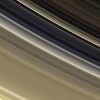
The_Rings-PIA08306.jpgThe A and B-Rings (and the Cassini Division) in natural colors (Credits: NASA/JPL/Space Science Institute)64 visiteThe Rings are awash in subtle tones of gold and cream in this view which shows the outer B-Ring, the Cassini Division and the inner part of the A-Ring. In this viewing geometry, the brightest feature in the Cassini Division is the recently discovered diffuse Ringlet near the outer edge of the Division.
The diffuse Ringlet has a distinctive bluish cast.
The color of the Rings appears more golden than earlier in the mission because of the viewing geometry here - increased scattering in the Rings is brought about by the high phase angle and the view being toward the Rings' unlit side. This view looks toward the unlit side of the rings from about 30° above the Ring-Plane.
Images taken using red, green and blue spectral filters were combined to create this natural color view. The images were acquired by the Cassini spacecraft narrow-angle camera on Sept. 29, 2006 at a distance of approx. 1,8 MKM (about 1,13 MMs) from Saturn. Image scale is roughly 11 Km (about 7 miles) per pixel.
(5 voti)
|
|
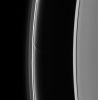
Saturn-PIA08303.jpgMore "Streamers" on sight!58 visiteA shepherd moon can do more to define ring structures than just keep the flock of particles in line, as Cassini spacecraft images such as this have shown.
Prometheus is seen here with two long streamers of material that it has pulled out of the F-Ring. When Prometheus comes close to the F-Ring in its orbit, the moon's gravity tugs on the ring particles. The disturbed particles, now pulled into orbits slightly closer to Saturn and therefore faster, shear out during successive orbits, creating the long and delicate streamers seen here.
This view looks toward the unlit side of the Rings from about 31° above the Ring-Plane.
The image was taken in visible light with the Cassini spacecraft narrow-angle camera on Sept. 29, 2006 at a distance of approx. 1,7 MKM (a little more than 1 MMs) from Prometheus and at a Sun-Prometheus-spacecraft, or phase, angle of 160°.
Image scale is roughly 10 Km (about 6 miles) per pixel.
(5 voti)
|
|
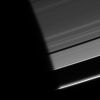
Saturn-PIA08297.jpgOut of the Dark...56 visiteCaption NASA:"As Ring particles emerge from the darkness of Saturn's shadow, they pass through a region of twilight. The Sun's light, refracted by the Planet's atmosphere, peeks around the limb, followed shortly by the Sun itself.
The "penumbra" is the narrow fringe Region of the Planet's shadow where part (but not all) of the Sun is visible around the side of the Planet, creating only a partial shadow there and making the shadow edge look fuzzy.
The A and F-Rings are captured here. This view looks toward the unlit side of the Rings from about 20° above the Ring-Plane. Two faint ringlets can be seen within the Encke Gap, which stretches out of the blackness at center and toward right.
The image was taken in visible light with the Cassini spacecraft narrow-angle camera on Sept. 12, 2006 at a distance of approx. 1,5 MKM (about 900.000 miles) from Saturn and at a phase angle of 163°. Image scale is roughly 9 Km (about 5 miles)".
(5 voti)
|
|

Janus-PIA08296.jpgJanus, from VERY close!58 visiteCaption NASA:"The Cassini spacecraft provides this dramatic portrait of Janus against the cloud-streaked backdrop of Saturn.
Like many small bodies in the Solar System, Janus (about 181 Km, such as approx. 113 miles across) is potato-shaped with many craters, and the moon has a surface that looks as though it has been smoothed by some process.
Like Pandora and Telesto, Janus may be covered with a mantle of fine dust-sized, icy material.
The image was taken using a spectral filter sensitive to wavelengths of infrared light centered at 930 nanometers.
This view was acquired with the Cassini spacecraft narrow-angle camera on Sept. 25, 2006 at a distance of approx. 145.000 Km (such as about 90.000 miles) from Janus and at a Sun-Janus-spacecraft, or phase, angle of 62°. North on Saturn is up. Image scale is roughly 871 mt (about 2.858 feet) per pixel".
(5 voti)
|
|

Dione-PIA08293.jpgThe "wrinkled Face" of Dione57 visiteCaption NASA:"Bright fractures creep across the surface of icy Dione. This extensive canyon system is centered on a region of terrain that is significantly darker than the rest of the moon. Part of the darker terrain is visible at right.
Lit terrain in this view is on the Saturn-Facing Hemisphere of Dione.
North is up and rotated 8° to the left.
The image was taken in visible light with the Cassini spacecraft narrow-angle camera on Sept. 25, 2006 at a distance of approx. 677.000 Km (such as 421.000 miles) from Dione and at a Sun-Dione-spacecraft, or phase, angle of 62°.
Image scale is roughly 4 Km (about 2,5 miles) per pixel".
(5 voti)
|
|
| 2244 immagini su 187 pagina(e) |
 |
|
|
|
|
62 | |
|
|
|
|





