| Piú votate - Saturn: the "Ringed Beauty" and His Moons |
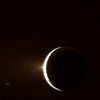
Enceladus-N00081664.jpgFountains in the Darkness (3) - natural colors, elab. Lunexit62 visiteCaption NASA:"N00081664.jpg was taken on April 24, 2007 and received on Earth April 25, 2007.
The camera was pointing toward ENCELADUS that, at the time, was approx. 189.299 Km away, and the image was taken using the CL1 and CL2 filters.
This image has not been validated or calibrated".MareKromium
(5 voti)
|
|
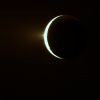
Enceladus-N00081671.jpgFountains in the Darkness (4) - natural colors, elab. Lunexit65 visiteCaption NASA:"N00081671.jpg was taken on April 24, 2007 and received on Earth April 25, 2007.
The camera was pointing toward ENCELADUS that, at the time, was approx. 190.884 Km, and the image was taken using the CL1 and CL2 filters.
This image has not been validated or calibrated".MareKromium
(5 voti)
|
|

Prometheus-PIA08910.jpgRestless Prometheus...66 visiteCaption NASA:"Prometheus draws a fresh streamer of material from the F-Ring as it passes the Ring's interior edge. The streamer will continuously shear out as it orbits the planet, becoming more elongated and increasingly aligned with the F-Ring with time.
A single large crater is the principle feature visible on Prometheus (102 Km, or about 63 miles across) in this view. The moon is lit partly by bright Sunlight and partly by reflected light from Saturn.
This view looks toward the unlit side of the rings from about 57° above the Ring-Plane.
The image was taken in visible light with the Cassini spacecraft narrow-angle camera on Feb. 11, 2007 at a distance of approx. 1,7 MKM (about 1,1 MMs) from Prometheus and at a Sun-Prometheus-spacecraft, or phase, angle of 130°.
Image scale is roughly 10 Km (about 6 miles) per pixel".
(5 voti)
|
|

Atlas-PIA08906.jpgAtlas and the F-Ring55 visiteCaption NASA:"The Cassini spacecraft gazes toward the multiple strands of the ever-changing F-Ring, also sighting Atlas at its station just beyond the A-Ring edge.
A few faint background stars are visible in the image. Atlas, which appears left of center, is 32 kilometers (20 miles across).
This view looks toward the unlit side of the Rings from about 58 degrees above the ringplane.
The image was taken in visible light with the Cassini spacecraft narrow-angle camera on Feb. 10, 2007 at a distance of approx. 1,7 MKM (such as about 1,1 MMs) from Atlas and at a Sun-Atlas-spacecraft, or phase, angle of 128°. Image scale is roughly 10 Km (such as about 6 miles) per pixel".MareKromium
(5 voti)
|
|

Saturn-PIA08366.jpgSaturn and Rhea58 visiteCaption NASA:"A serene orb of ice is set against the gentle pastel clouds of giant Saturn. Rhea transits the face of the gas giant, whose darkened Rings and their planet-hugging shadows appear near upper right.
Rhea is the second largest of Saturn's moons.
This view looks toward the unilluminated side of the Rings from about 3° above the Ring-Plane.
Images taken using red, green and blue spectral filters were combined to create this natural color view. The view was acquired with the wide-angle camera on Feb. 4, 2007. Cassini acquired the view at a distance of approx. 1,2 MKM (about 700.000 miles) from Saturn and approx. 679.000 Km (about 422.000 miles) from Rhea.
Image scale is roughly 68 Km (about 42 miles) per pixel on Saturn and about 40 Km (about 25 miles) per pixel on Rhea".
(5 voti)
|
|

Saturn-PIA09186.jpgNight view of the "Hexagon"60 visiteThis nighttime view of Saturn's north pole by the visual and infrared mapping spectrometer onboard NASA's Cassini orbiter clearly shows a bizarre six-sided hexagon feature encircling the entire north pole. This is one of the first clear images taken of the north polar region ever acquired from a unique polar perspective.
In this image, the red color indicates the amount of 5-micron wavelength radiation, or heat, generated in the warm interior of Saturn that escapes the planet. Clouds near 3-bar (about 100 kilometers or 62 miles deeper than seen in visible wavelengths) block the light, revealing them in silhouette against the background thermal glow of Saturn. The bluish color shows sunlight striking the far limb (edge) of the planet, showing that the entire north pole is under the nighttime conditions characteristic of polar winter, as on Earth.
This image is the first to capture the entire feature and north polar region in one shot, and is also the first polar view using Saturn's thermal glow at 5 microns (seven times the wavelength visible to the human eye) as the light source. This allows the pole to be revealed during the persistent nighttime conditions under way during winter. The hexagon feature was originally discovered by NASA's Voyager spacecraft in 1980, but those historic images and subsequent ground-based telescope images suffered from poor viewing perspectives, which placed the feature and the north pole at the extreme northern limb (edge) in those images.
In the new infrared images, the strong brightness of the hexagon feature indicates that it is primarily a clearing in the clouds, which extends deep into the atmosphere, at least some 75 kilometers (47 miles) underneath the typical upper hazes and clouds seen in the daytime imagery by Voyager. Thick clouds border both sides of the narrow feature, as indicated by the adjacent dark lanes paralleling the bright hexagon. This and other images acquired over a 12-day period between Oct. 30 and Nov. 11, 2006, show that the feature is nearly stationary, and likely is an unusually strong pole-encircling planetary wave that extends deep into the atmosphere.
This image was acquired with the Cassini visual and infrared mapping spectrometer on Oct. 30, 2006, from an average distance of 1.3 million kilometers (807,782 miles).
Nota Lunexit: ed ora, quanto ci scommettiamo che, entro (al massimo) 48 ore, il Prof. Hoagland e la Sua Scuola (e, probabilmente, tanti altri Guru della Scienza di Confine) inizieranno a parlare - con estrema saccenza - di "artificialità" dell'Esagono e (perchè no?) della probabile natura artificiale di tutto il Gigante Anellato?
Stay tuned!
(5 voti)
|
|

Saturn-PIA09187.gifWatch the "Hexagon" rotate! (GIF-Movie)57 visiteThis nighttime movie of the depths of the North Pole of Saturn taken by the VIMS onboard NASA's Cassini Orbiter reveals a dynamic, active planet lurking underneath the ubiquitous cover of upper-level hazes. The defining feature of Saturn's North Polar Regions -- the six-sided hexagon feature -- is clearly visible in the image.
Here, brightness indicates the amount of 5-micron (seven times the wavelength visible to the human eye) radiation, or heat, generated in the depths of the warm interior of Saturn that escapes the planet. Clouds at a depth equivalent to 3-Earth-atmospheres pressure block the light radiating from below, revealing themselves in dark silhouette against the background thermal glow of the Planet. These deep clouds lie some 75 Km (about 47 miles) underneath the typical ammonia hazes and clouds seen in visual imagery and are likely composed of ammonia-hydrosulfide, although some may be composed of water, as on Earth.
A prominent feature seen in this polar view is a strange hexagon wave feature circumscribing the north pole.
This nighttime movie was acquired over a one-hour period on Nov. 10, 2006, from an average distance of 1.03 million kilometers (621,000 miles) above Saturn's clouds.
(5 voti)
|
|

Saturn-PIA08357.jpgCrescent Saturn57 visiteCaption NASA:"Cassini coasts beneath giant Saturn, staring upward at its gleaming crescent and icy rings.
A great bull's-eye pattern is centered on the South Pole, where a vast, hurricane-like storm spins.
This view looks toward the lit side of the Rings from about 26° below the Ring-Plane. The view was acquired about 2 hours prior to "The Lore of Saturn".
Images taken using red, green and blue spectral filters were combined to create this natural-color view.
The images were obtained with the Cassini spacecraft wide-angle camera on Jan. 30, 2007, from a distance of approx. 1,1 MKM (about 700.000 miles) from Saturn.
Image scale is roughly 61 Km (about 38 miles) per pixel".MareKromium
(5 voti)
|
|
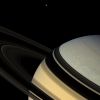
Saturn-PIA08358.jpgThe Northern Regions of Saturn59 visiteCaption NASA:"Magnificent blue and gold Saturn floats obliquely as one of its gravity-bound companions, Dione, hangs in the distance. The darkened Rings seem to nearly touch their shadowy reverse images on the planet below.
This view looks toward the unlit side of the Rings from about 9° above the Ring-Plane. The Rings glow feebly in the scattered light that filters through them.
The image was taken in visible light with the Cassini spacecraft wide-angle camera on Feb. 4, 2007, at a distance of approx. 1,2 MKM (about 800.000 miles) from Saturn.
Image scale is roughly 75 Km (about 47 miles) per pixel".MareKromium
(5 voti)
|
|

Saturn-PIA08359.jpgThe Southern Regions of Saturn58 visiteCaption NASA:"With pastel blues, pinks, greens and golds, Saturn displays a dazzling diversity of colors and hues.
Here, Cassini looks upward at, and through, the sunlit side of the Rings from about 19° below the Ring-Plane. The small moon Janus can be spotted off the Planet's Western Limb (edge) near the image bottom.
Images taken using red, green and blue spectral filters were combined to create this natural-color view. The images were obtained with the Cassini spacecraft wide-angle camera on Feb. 3, 2007, at a distance of approx. 1,1 MKM (about 700.000 miles) from Saturn.
Image scale is roughly 60 Km (about 38 miles) per pixel".MareKromium
(5 voti)
|
|

Tethys-PIA07693.jpgOdysseus (elab. Lunexit)57 visitenessun commentoMareKromium
(5 voti)
|
|

Mimas-N00077789.jpgOccultation? (8)57 visiteCaption NASA:"(...) The camera was pointing toward Mimas that, at the time, was at approximately 1.344.003 Km away, and the image was taken using the CL1 and CL2 filters (...)".
(5 voti)
|
|
| 2244 immagini su 187 pagina(e) |
 |
|
|
|
|
61 | |
|
|
|
|





