| Piú votate - Saturn: the "Ringed Beauty" and His Moons |
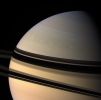
Saturn-PIA09793.jpgThe Northern Hemisphere of Saturn (natural colors; credits: NASA/Space Science Inst.)58 visiteCaption NASA:"Dark ring shadows adorn the Northern Hemisphere of Saturn.
The shadows have loosened their grip on the North compared to when Cassini arrived in 2004, and presently continue to slide farther South.
This view looks toward the unilluminated side of the rings from about 5° above the Ring-Plane. Images taken using red, green and blue spectral filters were combined to create this Natural Color View. The view was acquired with the Cassini spacecraft wide-angle camera on Oct. 22, 2007, at a distance of approx. 1,3 MKM (such as about 839.000 miles) from Saturn.
Image scale is roughly 77 Km (about 48 miles) per pixel".MareKromium
(5 voti)
|
|

Atlas_Pan-PIA08405.jpgJust like Flying Saucers: Atlas and Pan59 visiteCaption NASA:"These HR images of Pan and Atlas reveal distinctive "flying saucer" shapes created by prominent Equatorial Ridges not seen on the other small moons of Saturn.
From left to right: a view of Atlas' Trailing Hemisphere, with North up, at a spatial scale of about 1 Km (0,6 mile) per pixel; Atlas seen at about 250 meters (820 feet) per pixel from Mid-Southern Latitudes, with the Sub-Saturn Hemisphere at the top and Leading Hemisphere to the left; Pan's Trailing Hemisphere seen at about 3 Km (about 2 miles) per pixel from low Southern Latitudes; an Equatorial view, with Saturn in the background, of Pan's Anti-Saturn Hemisphere at about 1 Km (0.6 mile) per pixel.
On Atlas, the ridge extends 20 to 30° in latitude on either side of the Equator; on Pan, its latitudinal extent is 15 to 20°. Atlas shows more asymmetry than Pan in having a more rounded ridge in the Leading and Sub-Saturn Quadrants.
The heights of the Ridges can be crudely estimated by assuming (ellipsoidal) shapes that lack ridges and vary smoothly cross the Equator. Heights of Atlas' Ridge range from about 3 Km (about 2 miles) at 270° West Long. to 5 Km (approx. 3 miles) at 180 and 0°. Pan's Ridge reaches about 4 Km (about 2,5 miles) at 0° West Long. and is about 1,5 Km (0,9 mile) high over most of the rest of the Equator.
The ridges represent about 27% of Atlas' volume and 10% of Pan's volume.
The images were acquired with the Cassini Spacecraft narrow-angle camera between 2005 and 2007. Pan is about 33 Km (apprx. 20,5 miles) across at its Equator and about 21 Km (approx. 13 miles) across at its Poles; Atlas is 39 Km (such as about 24 miles) across at its Equator and 18 Km (approx. 11 miles) across at its Poles".MareKromium
(5 voti)
|
|

Enceladus-PIA09761.jpgThe "Fountains" of Enceladus (again)58 visiteCaption NASA:"With Enceladus nearly in front of the Sun from Cassini's viewpoint, its icy jets become clearly visible against the background.
The view here is roughly perpendicular to the direction of the linear "tiger stripe" fractures, or sulci, from which the jets emanate. The jets here provide the extra glow at the bottom of the moon. The general brightness of the sky around the moon is the diffuse glow of Saturn's E-Ring, which is an end product of the jets' material being spread into a "torus", or doughnut shape, around Saturn.
North on Enceladus is up and rotated 20° to the left.
The image was taken in visible light with the Cassini spacecraft narrow-angle camera on Sept. 30, 2007. The view was obtained at a distance of approx. 187.000 Km (such as about 116,000 miles) from Enceladus and at a Sun-Enceladus-spacecraft, or phase, angle of 157°.
Image scale is about 1 Km (apprx. 0,6 mile) per pixel".MareKromium
(5 voti)
|
|

Japetus-N00091967-1.jpgImage-Artifact or a New Tower on Japetus?57 visiteUn nuovo e bellissimo esempio di quanto sia importante avere degli Amici Lettori i quali non si limitano a "guardare", ma che "cercano": in questo frame CASSINI, infatti, il bravissimo Antonio Fedele ha individuato due dettagli sui quali ha chiesto il nostro parere. Ebbene, se il dettaglio visibile sulla Dx del frame è, a nostro avviso, la traccia di un semplice Raggio Cosmico, il dettaglio di Sx è MOLTO più intrigante!
Osservate bene: nel frame originale NASA in b/n, la carenza di contrasto e la scarsa raffinazione del frame non permettevano grandi osservazioni; ma nel frame risultante da nostro coloring ed additional processing, il Sig. Fedele ha visto qualcosa che a noi era completamente sfuggita: ha visto un qualcosa che sembra essere una sorta di "Torre". Noi, allora, abbiamo ripreso il frame originale e tentato una verifica: ebbene la "Torre" non è il prodotto del nostro additional processing: essa, infatti, era già (sia pure solo appena) visibile nel frame di partenza.
Che cos'è? E' il Secondo Monolito di Giapeto (il primo venne individuato, ci pare, dal Prof. Hoagland, qualche anno fa)?
E' una Struttura Colonnare affine alle Blair Cuspids? E' qualcosa di simile al Monolito di Phobos? O forse è una Struttura Effimera o, magari, solo un image-artifact?
A noi non sembra un image-artifact (anche se non possiamo escluderlo al 100%). Poi, per quanto attiene la natura di questo (se reale) incredibile rilievo Giapetiano, non ci sentiamo di esprimerci: abbiate pazienza, ma gli elementi che abbiamo sono davvero troppo pochi e l'immagine, in sè, non è sufficiente per risolvere i nostri dubbi.
Un GRANDE complimento al Sig. Fedele e, per il resto, provate Voi stessi a guardare, analizzare e speculare...Se volete. Noi siamo qui, per condividere e commentare le Vostre (eventuali) scoperte!MareKromium
(5 voti)
|
|

Enceladus-N00093907.jpgThe Gem in the Sky of Saturn... (possible true colors; elab. Lunexit)56 visitenessun commentoMareKromium
(5 voti)
|
|

Japetus-PIA08376-1.jpgRising Japetus (false colors - elab. NASA)57 visiteThe slim crescent of Iapetus looms before the Cassini spacecraft as it approaches the mysterious moon.
Iapetus, 1,468 kilometers (912 miles) across, seen here in false color, is unique in its dramatic variation in brightness between the northern polar region and the middle and low latitudes. Equally prominent is the moon's equatorial ridge of towering mountains. The profile of the ridge against the darkness of space reveals that it is topped by a cratered plateau approximately 15 kilometers (9 miles) wide. Further west, the profile of the ridge changes from a long plateau to discrete peaks.
The mosaic consists of four image footprints across the surface of Iapetus and has a resolution of 489 meters (0.3 miles) per pixel.
A full-resolution clear filter image was combined with half-resolution images taken with infrared, green and ultraviolet spectral filters (centered at 752, 568 and 338 nanometers, respectively) to create this full-resolution false color mosaic.
The color seen in this view represents an expansion of the wavelength region of the electromagnetic spectrum visible to human eyes. The intense reddish-brown hue of the dark material is far less pronounced in true color images. The use of enhanced color makes the reddish character of the dark material more visible than it would be to the naked eye. In addition, the scene has been brightened to improve the visibility of surface features.
This view was acquired with the Cassini spacecraft narrow-angle camera on Sept. 10, 2007, at a distance of about 83,000 kilometers (51,600 miles) from Iapetus.
MareKromium
(5 voti)
|
|

Japetus-Orbit-01.jpgPolar view of Japetus's orbit56 visitenessun commentoMareKromium
(5 voti)
|
|

Japetus-PIA08374.jpgThe "Transition Region" of Japetus56 visiteCaption NASA:"Dark material splatters the walls and floors of craters in the surreal, frozen wastelands of Japetus. This image shows terrain in the Transition Region between the moon's dark Leading Hemisphere and its bright Trailing Hemisphere.
The view was acquired during Cassini's only close flyby of the two-toned Saturn moon.
The image was taken on Sept. 10, 2007, with the Cassini spacecraft narrow-angle camera at a distance of approximately 6.030 Km (3.750 miles) from Japetus. Image scale is 36 meters (118 feet) per pixel".MareKromium
(5 voti)
|
|
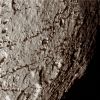
Japetus-N00092247.jpgDeep Canyons and Craters (possible natural colors; elab. Lunexit)56 visiteCaption NASA:"N00092247.jpg was taken on September 10, 2007 and received on Earth September 12, 2007. The camera was pointing toward Japetus that, at the time, was approximately 23.824 Km away, and the image was taken using the CL1 and CL2 filters. This image has not been validated or calibrated".MareKromium
(5 voti)
|
|
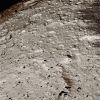
Japetus-N00092254.jpgStill the "Cassini Regio" of Japetus - possible natural colors; elab. Lunexit56 visiteCaption NASA:"N00092254.jpg was taken on September 10, 2007 and received on Earth September 12, 2007. The camera was pointing toward Japetus that, at the time, was approximately 39.965 Km away, and the image was taken using the CL1 and CL2 filters. This image has not been validated or calibrated".MareKromium
(5 voti)
|
|

Japetus-N00091975.jpgThe Mountains of Japetus (Transition Zone; possible natural colors - elab. Lunexit)56 visiteCaption NASA:"N00091975.jpg was taken on September 10, 2007 and received on Earth September 11, 2007. The camera was pointing toward Japetus that, at the time, was approximately 1651 Km away, and the image was taken using the CL1 and CL2 filters. This image has not been validated or calibrated".MareKromium
(5 voti)
|
|

Japetus-N00091976.jpgThe Mountains of Japetus (Transition Zone; possible natural colors - elab. Lunexit)77 visiteCaption NASA:"N00091976.jpg was taken on September 10, 2007 and received on Earth September 11, 2007. The camera was pointing toward Japetus that, at the time, was approx. 1722 Km away, and the image was taken using the CL1 and CL2 filters. This image has not been validated or calibrated".MareKromium
(5 voti)
|
|
| 2244 immagini su 187 pagina(e) |
 |
|
|
|
|
57 | |
|
|
|
|





