| |

| Piú votate - Saturn: the "Ringed Beauty" and His Moons |
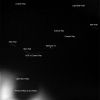
Methone-N00111976-1.jpgLook and Learn!59 visiteUn frame dedicato a tanti personaggi i quali, come è di recente accaduto su due diversi Forum Italiani (ahinoi!...), pensano che qui, su Lunar Explorer Italia, si "speculi sulla Credulità Popolare" e sulla "voglia di impressionare e di far scalpore".
NO. Qui non si specula su nulla. Qui si fa Divulgazione, nel senso più puro del termine.
Gli "speculatori" li trovate in altri Siti (USA e non) e, se volete, anche in edicole e librerie.
Ma NON qui.
Se poi quelli che blaterano a vanvera sono incapaci di riconoscere ciò che i "Frames from Space" mostrano, la colpa non è nostra. La colpa è loro, che parlano solo per fare i saccenti e per disfare e screditare il Lavoro altrui, pur avendo zero cultura e zero credenziali (anche perchè, se le avessero, non si nasconderebbero dietro patetici e tristissimi nick-names...).
In questo frame, un piccolo "a,b,c" (e non è il primo che pubblichiamo...) di Analisi dell'Immagine, in cui si vedono alcuni artefatti fotografici, un pò di raggi cosmici, svariate star-trails, un qualcosa di non identificabile ed una minuscola Luna Saturniana.
E per concludere, una nota: quando noi "sparliamo" della Scienza Convenzionale, lo facciamo - e scusate il gioco di parole - "ex informata scientia". Lo sappiamo benissimo che è la Scienza, oggi, ad aiutarci a vivere di più e meglio (si, certo, ma fino ad un certo punto...) e sappiamo benissimo che quello che abbiamo noi, oggi, è il Top-del-Top (si, certo, idem c.s. ... due volte), se ragguagliato a ciò che avevano i nostri Nonni (e forse anche i nostri Padri).
Ma noi sappiamo (in parte abbiamo imparato, diciamo così...) anche a distinguere fra una "Scienza che Insegna" ed una "(Pseudo)Scienza che Sforma e Disinforma".
Ed una parte essenziale del nostro Lavoro è proprio qui: nel tentativo di far vedere dove finisce l'una e dove comincia l'altra. Peccato che solo pochi (ma BUONI!) se ne sìano resi conto...MareKromium
(5 voti)
|
|

The_Rings-PIA10408.jpg"Spiral Density Wave" in the B-Ring (MULTISPECTRUM; credits: Lunexit)84 visiteCaption NASA:"This High-Resolution view shows, at left, a Spiral Density Wave (SDW) in Saturn's inner B-Ring. A SDW is a spiral-shaped massing of particles that tightly winds many times around the Planet. These waves decrease in wavelength with increasing distance from the Planet.
Scientists use images like this one to understand the mass of the Rings and the collisional dynamics of the Ring Particles.
The view looks toward the sunlit side of the Rings from about 50° below the Ring-Plane. The image was taken in visible light with the Cassini Spacecraft narrow-angle camera on May 10, 2008. The view was obtained at a distance of approx. 279.000 Km (sich as about 173.000 miles) from Saturn.
Image scale is roughly 1 Km (0,6 mile) per pixel".MareKromium
(5 voti)
|
|

Alpha_Centauri-PIA10406.jpgStellar Horizon (MULTISPECTRUM; credits: Lunexit)57 visiteCaption NASA:"The nearest Star System, the Trinary Star Alpha Centauri, hangs above the horizon of Saturn. Both Alpha Centauri A and B -- stars very similar to our own -- are clearly distinguishable in this image. (The third star in the Alpha Centauri System, the red dwarf Proxima Centauri, is not visible here).
From the orbit of Saturn, light (as well as Cassini's radio signal) takes a little more than an hour travel to Earth. The distance to Alpha Centauri is so great that light from these stars takes more than 4 years to reach our Solar System.
Thus, although Saturn seems a distant frontier, the nearest star is almost 30.000 times farther away.
This image is part of a stellar occultation sequence, during which Cassini watches as a star (or stars) as it passes behind Saturn. Light from the stars is attenuated by the uppermost reaches of Saturn's gaseous envelope, revealing information about the structure and composition of the Planet's Atmosphere.
The view was captured from about 66° above the Ring-Plane and faces southward on Saturn. Ring shadows mask the Planet's Northern Latitudes at bottom.
The image was taken in visible red light with the Cassini spacecraft narrow-angle camera on May 17, 2008. The view was obtained at a distance of approx. 534.000 Km (such as about 332000 miles) from Saturn. Image scale on Saturn is about 3 Km (approx. 2 miles) per pixel".MareKromium
(5 voti)
|
|

Tethys-PIA09915-0.jpgTethys (MULTISPECTRUM-2; credits: Lunexit)68 visiteCaption NASA:"From a highly inclined orbit, the Cassini Spacecraft looks toward far Northern Latitudes on Tethys.
Here, the spacecraft was above a position about 45° North of the moon's Equator.
This vantage point afforded a view of the moon's three most recognizable features: the Ithaca Chasma Canyon System (at lower right), Odysseus Crater (at upper left) and the Equatorial Band of Darker Terrain (at lower left).
Lit terrain seen here is on the Leading Hemisphere of Tethys (1062 Km, or approx. 660 miles across). North is up.
The image was taken in visible light with the Cassini spacecraft narrow-angle camera on April 29, 2008. The view was obtained at a distance of approx. 991.000 Km (such as about 616.000 miles) from Tethys and at Phase Angle of 73°.
Image scale is roughly 6 Km (about 4 miles) per pixel".MareKromium
(5 voti)
|
|

Unknown-N00111005.jpgStar-Trails? (1)57 visiteOnde evitare spiacevoli malintesi, precisiamo che gli oggetti puntiformi i quali disegnano un piccolo segmento d'arco e che, a nostro avviso, potrebbero e dovrebbero essere degli "Star-Trails", sono a Dx dell'Osservatore, in alto (il più luminoso) ed a Sx dell'Osservatore, uno in alto ed uno in basso (molto deboli). La loro incredibile somiglianza ci ha fatto anche pensare all'ipotesi per cui si tratti di un solo Star-Trail (quello luminoso a Dx) e di due riflessi del medesimo attraverso le ottiche di Cassini (i due di Sx).
L'Anomalìa del frame, infine - sia che gli Star-Trails sìano tre, sia che si tratti di uno solo -, è data dalla circostanza per cui la forma dello/degli Star-Trail/s è il chiaro indice di un movimento della Sonda Cassini. Un movimento che è avvenuto DURANTE la ripresa. Ora, a nostro avviso, è curioso che il brusco cambio di traiettoria della Sonda abbia prodotto la distorsione di un dettaglio (la stella - o le stelle - che è diventata una striscia curva) e non del corpo principale ripreso (una porzione degli Anelli di Saturno).
E' stata questa specifica considerazione che ci ha lasciati un pò perplessi sulla natura dei tre segmenti luminosi curvi (i quali, ribadiamo e chiudiamo, potrebbero e dovrebbero COMUNQUE essere delle semplici Star-Trails).
E Voi che ne pensate?
Caption NASA:"N00111005.jpg was taken on May 10, 2008 and received on Earth on May 11, 2008. The camera was pointing toward the F-RING of Saturn which, at the time that the picture was taken, was about 387.626 Km away.
This image was taken using the CL1 and CL2 filters and it has not been validated or calibrated".MareKromium
(5 voti)
|
|
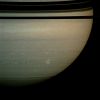
Saturn-PIA09900.jpgContinuing or Perpetual Storm? (MULTISPECTRUM; credits: Lunexit)56 visiteCaption NASA:"The longest-lived continuously monitored electrical storm ever observed on Saturn continues to churn through the tempest-tossed region nicknamed "Storm Alley" because of its preponderance of storm activity. This image of the storm was taken about 5 months after it was first detected by Cassini's Imaging Cameras and the Radio and Plasma Wave Science Experiment.
This view looks toward the unilluminated side of the Rings from about 1° above the Ring-Plane. The bands of the Ring shadows blanket the Planet at the top of the scene.
The image was taken with the Cassini spacecraft wide-angle camera on April 23, 2008 using a combination of spectral filters sensitive to wavelengths of polarized infrared light centered at 752 nanometers. The view was acquired at a distance of approx. 1,2 MKM (such as about 760.000 miles) from Saturn.
Image scale is roughly 70 Km (about 43 miles) per pixel".MareKromium
(5 voti)
|
|

Rhea-PIA09898.jpgThe South Polar Region of Rhea57 visiteCaption NASA:"The Cassini Spacecraft surveys the South Polar Region of icy Rhea.
Cassini flybys have shown that Rhea is not differentiated, or separated into distinct layers; instead, it appears to be a mixture of approx. 75% ices and 25% rock and metal. Saturn's second-largest moon, Rhea, is about 1528 Km (approx. 949 miles) wide.
The image was taken with the Cassini Spacecraft narrow-angle camera on April 12, 2008 using a spectral filter sensitive to wavelengths of ultraviolet light centered at 338 nanometers. The view was acquired at a distance of approx. 345.000 Km (such as about 214.000 miles) from Rhea and at a Sun-Rhea-Spacecraft, or Phase, angle of 73°.
Image scale is roughly 2 Km (a little more than 1 mile) per pixel".MareKromium
(5 voti)
|
|

Saturn-PIA10358.jpgSaturn's Infrared Temperature Snapshot (Labeled)61 visiteCaption NASA:"Scientists have discovered a wave pattern, or oscillation, in Saturn's atmosphere only visible from Earth every 15 years. The pattern ripples back and forth like a wave within Saturn's upper atmosphere. In this region, temperatures switch from one altitude to the next in a candy cane-like, striped, hot-cold pattern.
The temperature "snapshot" shown in these two images captures two different phases of this wave oscillation: the temperature at Saturn's Equator switches from hot to cold, and temperatures on either side of the Equator switch from cold to hot every Saturn half-year.
The image on the left was taken in 1997 and shows the temperature at the equator is colder than the temperature at 13° South Latitude. Conversely, the image on the right taken in 2006 shows the temperature at the Equator is warmer.
These images were taken with NASA's Infrared Telescope Facility in Mauna Kea, Hawaii".MareKromium
(5 voti)
|
|

Sun-N00107153.jpgSunshine through the Rings... (natural colors; credits: Lunexit)58 visiteCaption NASA:"N00107153.jpg was taken on April 10, 2008 and received on Earth on April 11, 2008. The camera was pointing toward SATURN, F-RING that, at the time, was approx. 609.375 Km away, and the image was taken using the CL1 and CL2 filters. This image has not been validated or calibrated".MareKromium
(5 voti)
|
|

Enceladus-Cassini_big.jpgIs there "Life" underneath Enceladus?!?58 visiteCaption NASA:"Could life exist beneath Enceladus?
A recent flyby of Saturn's icy moon has bolstered this fascinating idea. Two years ago, images from the Cassini Spacecraft led astronomers to the undeniable conclusion that Saturn's moon Enceladus was spewing fountains of gas and ice crystals through cracks in its surface (the "Tiger Stripes").
Last month (February 2008), Cassini dove through some of these plumes and determined that they contained Water Vapor laced with small amounts of Methane as well as simple and complex organic molecules. Surprisingly, the plumes of Enceladus appear similar in make-up to many comets.
What's more, the temperature and density of the plumes indicate they might have originated from a warmer source - possibly a liquid source - beneath the surface.
A liquid water sea containing organic molecules is a good place to look for life.
Pictured above is a vertically exaggerated close-up of some long, venting Tiger Stripes. The computer composite was generated from images and shadows taken during the recent Cassini flyby.
Nine more flybys of Enceladus by Cassini are planned".MareKromium
(5 voti)
|
|
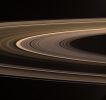
The_Rings-PIA09860.jpgRings Aglow (natural colors; credits: NASA)58 visiteCaption NASA:"Saturn's softly glowing Rings shine in scattered Sunlight. The B-Ring presents a remarkable difference in brightness between the near and far arms (bottom and top of the image, respectively). The strong variation in brightness could be due to the presence of wake-like features in the B-Ring.
This view looks toward the unilluminated side of the Rings from about 5° above the Ring-Plane. Images taken using red, green and blue spectral filters were combined to create this natural color view. The images were acquired at a distance of approx. 574.000 Km (about 357.000 miles) from Saturn.
At the center of the image, the Sun-Ring-Spacecraft Angle - or Phase Angle - is 114°, and the image scale is roughly 34 Km (about 21 miles) per pixel in the radial, or outward from Saturn, direction".
Nota Lunexit: ATTENZIONE! La NASA, riteniamo con questo frame, ha finalmente iniziato a fornire qualche dettaglio in più allorchè vengono comunicate al Pubblico delle info le quali, in sè, e laddove non adeguatamente precisate, finivano con il dire poco: si tratta del punto di riferimento del frame considerato per il calcolo dell'Angolo di Fase (che è il suo centro) e la direzione di riferimento del frame in ordine alla Scala pixel/Km. Non male, considerato che avevamo iniziato proprio noi, circa tre anni fa, a dare informazioni contestuali di supporto a svariati frames NASA-CASSINI (non queste info, comunque).MareKromium
(5 voti)
|
|
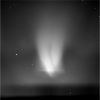
W00041312.jpgReflections in the Space of Saturn59 visitenessun commentoMareKromium
(5 voti)
|
|
| 2244 immagini su 187 pagina(e) |
|
|
|
|
|
56 | |
|
|
|
|
|
|





