| Piú votate - Saturn: the "Ringed Beauty" and His Moons |

Enceladus-00063371.jpgHiding behind the Rings... (3D - credits: Dr M. Faccin)57 visitenessun commentoMareKromium
(5 voti)
|
|

Pallene-N00119642.jpgPallene57 visitePallene è un satellite naturale minore del pianeta Saturno, la cui orbita è situata fra quelle di Mimas ed Encelado. Pallene è stata scoperta nel 2004 da Sébastien Charnoz del Cassini Imaging Team, il gruppo scientifico responsabile dell'analisi delle immagini scattate dalla Sonda Cassini, guidato da Carolyn Porco.
Dopo aver ricevuto la designazione provvisoria S/2004 S 2, il satellite fu successivamente battezzato dall'Unione Astronomica Internazionale con il nome di Pallene, una Ninfa della mitologia greca. Si rilevò inoltre che il satellite coincideva con un oggetto avvistato il 23 agosto 1981 in una singola fotografia scattata dalla sonda spaziale Voyager 2, con una distanza stimata da Saturno di circa 200.000 km; al satellite, di cui non fu possibile stabilire l'orbita esatta, venne allora attribuita la designazione S/1981 J 14.
L'orbita di Pallene è visibilmente influenzata da una Risonanza Orbitale con Encelado, molto più grande, anche se l'effetto è meno intenso rispetto alle perturbazioni esercitate da Mimas sulla vicina Metone. Il fenomeno è all'origine delle oscillazioni periodiche nel semiasse maggiore di circa 4 Km, e della longitudine del Nodo Ascendente di 0,02° (pari a circa 75 Km). Anche l'Eccentricità Orbitale di Pallene varia (fra 0,002 a 0,006), mentre la sua Inclinazione oscilla fra 0,178° e 0,184°.MareKromium
(5 voti)
|
|

The_Rings-AtoG-PIA10505.jpgThe Rings (natural colors; credits: Lunexit)59 visitenessun commentoMareKromium
(5 voti)
|
|

Dione-PIA10500.jpgCross-Worlds: the Answer!60 visiteRicordate la sequenza (intitolata, appunto, Cross-Worlds) che pubblicammo qualche settimana fa (era il 14 Settembre 2008, per l'esattezza) e che ci mostrava (ovviamente nell'ottica di CASSINI) Dione mentre eclissava un'altra Luna non identificata?
Noi ipotizzammo che si potesse trattare di Mimas o di Encelado. La NASA, oggi, tramite il suo Planetary Photojournal, ci ha risposto: si trattava di Encelado.
Un grazie alla NASA (che, quando vuole, sa anche rispondere) ed un 6+ a noi perchè, anche se non siamo riusciti ad identificare con sicurezza assoluta la seconda luna "misteriosa" in transito, siamo stati comunque abbastanza bravi dal ridurre la rosa dei "candidati" a due soli Corpi Celesti.
Insomma...Non male!MareKromium
(5 voti)
|
|
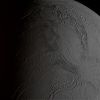
Enceladus-9_cassini_big.jpgEnceladus (natural colors; credits: Lunexit)74 visiteCaption NASA:"What telling impurities taint the ice plumes of Enceladus? To help answer this question, the robotic Cassini spacecraft dove last week to within 30 kilometers of Saturn's ice-plume emitting moon. At this closest-ever approach, Cassini attempted to sniff and obtain chemical data on particles ejected from Enceladus' regular surface, while at other times Cassini flew right through -- and sampled -- ice geysers directly. Searches in the data for impurity clues in the water-ice dominated plumes and surface ejecta are progressing. Although the main purpose of this flyby was particle analysis, several interesting images are emerging. Visible in the above image, for example, is an unusual gray sheen running vertically up the image center that might be water vapor escaping from surface canyons. Other notable features visible above include vast plains of craterless icy grooves, the day-night terminator across the image left, and an area near the top comparatively rich in craters. Cassini is scheduled to buzz by Enceladus in an imaging run near the end of this month".MareKromium
(5 voti)
|
|
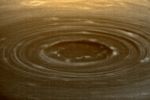
Saturn-SP-PIA11103.jpgSouthern Turbulence (natural colors; credits: Lunexit)59 visiteCaption NASA:"Shadows reveal the topography of Saturn's South Polar Vortex. At high resolution, a new, inner ring of isolated, bright clouds is seen. These clouds are localized regions of convective upwelling, an important clue to understanding how heat energy is transported in Saturn's Atmosphere.
See PIA11104 for a high-resolution Cassini view that looks more directly down onto the vortex, compared to this oblique perspective. Sunlight illuminates the scene from upper right, and the higher altitude rings of clouds surrounding the pole cast shadows toward lower left. North on Saturn is up.
The image was taken with the Cassini Spacecraft narrow-angle camera on July 15, 2008, with a combination of spectral filters sensitive to wavelengths of polarized infrared light centered at 746 and 938 nanometers. The grainy quality of the image is due primarily to the low signal-to-noise ratio of images taken with the 938 nanometer spectral filter, which is near the upper limit of the wavelength range the camera can see. "Signal-to-noise" is a term scientists use to refer to the amount of meaningful or useful information (signal) in their data versus the amount of background noise. A higher signal-to-noise ratio yields sharper, clearer views of features in the atmosphere.
The view was acquired from 24° below the Ring-Plane, at a distance of approx. 778.000 Km (about 483.000 miles) from Saturn.
The Sun-Saturn-Spacecraft, or Phase, Angle is about 30°.
Image scale is 4 Km (about 3 miles) per pixel".MareKromium
(5 voti)
|
|

Saturn-PIA10476.jpgSaturn in the Ringshine (natural colors; credits: NASA)59 visiteCaption NASA:"Large regions of Saturn's night side are illuminated by the Planet's gleaming Rings. Except for a sliver of the sunlit crescent at left, this view shows a part of the Planet lit almost entirely by "Ringshine".
The Southern Hemisphere, at bottom, receives its illumination from sunlight that strikes the Rings' southern face and is reflected onto the Planet. The Northern Hemisphere, at top, is lit by the feeble light that wends its way through countless ring particles to emerge on the Rings' north face. Despite the dim lighting on the northern part of the Planet, many cloud features can be seen there nevertheless.
This view was acquired from about 44° above the Ring-Plane. At bottom, the Planet's shadow stretches across the D and C-Rings.
Images taken using red, green and blue spectral filters were combined to create this natural color view. The images were obtained with the Cassini Spacecraft wide-angle camera on April 23, 2007 at a distance of approx. 901.000 Km (about 560.000 miles) from Saturn.
Image scale is roughly 50 Km (about 31 miles) per pixel".MareKromium
(5 voti)
|
|

Rhea-PIA10474.jpgRhea58 visiteCaption NASA:"The sun's low angle near the Terminator highlights the topography of craters within Rhea's wispy terrain. (...)
This view looks toward the Trailing Hemisphere of Rhea (approx. 1528 Km, or 949 miles across). North is toward the top of the image.
The image was taken in visible light with the Cassini Spacecraft narrow-angle camera on June 10, 2008. The view was acquired at a distance of approx. 758.000 Km (such as about 471.000 miles) from Rhea and at a Phase Angle of 51°.
Image scale is roughly 5 Km (a little more than 3 miles) per pixel".MareKromium
(5 voti)
|
|

Enceladus-N00118469.jpgStars?57 visitenessun commentoMareKromium
(5 voti)
|
|

Reflections-N00119726.jpgReflections, in the Space of Saturn58 visiteEffetti prismatici (ancora una volta causati dalla ripresa - sovraesposta - di Encelado) nel Cielo di Saturno: immagini suggestive ed affascinanti, da guardare e da comprendere, le quali, però, NON RAPPRESENTANO astronavi aliene in transito o altri fenomeni "esotici".MareKromium
(5 voti)
|
|

Dione-N00119795.jpgCross-Worlds! (11)59 visitenessun commentoMareKromium
(5 voti)
|
|
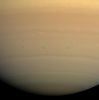
Saturn-PIA10457.jpgSouthern Turbulence (natural colors; credits: NASA)58 visiteCaption NASA:"A line of vortices rolls through the turbulent region on Saturn nicknamed "Storm Alley" by Cassini scientists. This latitude band, centered around 35° South, has displayed persistent, intensive storm activity since Cassini began its approach to Saturn in early 2004.
Images taken using red, green and blue spectral filters were combined to create this natural color view. The images were obtained with the Cassini Spacecraft wide-angle camera on July 23, 2008 at a distance of approximately 1 MKM (such as about 622.000 miles) from Saturn.
Image scale is roughly 56 Km (about 35 miles) per pixel".MareKromium
(5 voti)
|
|
| 2244 immagini su 187 pagina(e) |
 |
|
|
|
|
54 | |
|
|
|
|





