| Piú votate - Saturn: the "Ringed Beauty" and His Moons |
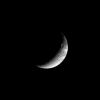
Dione-PIA10577.jpgCrescent Dione58 visiteCaption NASA:"This high-phase view of Dione shows the great contrast between the highly reflective "wisps" and the surrounding terrain. These wispy lines are geologically young fractures exposing the icy surface of the moon.
Lit terrain seen here is on the Trailing Hemisphere of Dione (about 1123 Km, or approx. 698 miles, across). North on Dione is up.
The view was acquired from a position 39° South of the moon's Equator. The image was taken in Visible Light with the Cassini Spacecraft narrow-angle camera on Dec. 26, 2008. The view was obtained at a distance of approx. 789.000 Km (about 490.000 miles) from Dione and at a Sun-Dione-spacecraft, or Phase, Angle of 124°
Image scale is roughly 5 Km (about 3 miles) per pixel".MareKromium
(5 voti)
|
|

TheRings-PIA10581.jpgBright Spokes (Natural Colors; credits: Lunar Explorer Italia)58 visiteCaption NASA:"Signaling a return to the bright Spokes first encountered by the Cassini Spacecraft in 2005, three large white Spokes stretch out across the B-Ring. Throughout most of the last year, Cassini captured views of dark Spokes.
This image of bright Spokes was taken Jan. 14, 2009 in Visible Light with the Spacecraft's wide-angle camera.
The small moon Atlas (about 30 Km, or approx. 19 miles across) has been brightened by 30% but still appears as a faint dot between the A and F Rings in the top right quadrant of the image.
This view looks toward the sunlit side of the Rings from about 6° below the Ring-Plane. The view was acquired at a distance of approx. 551.000 Km (about 342.000 miles) from Saturn and at a Sun-Saturn-Spacecraft, or Phase, Angle of 155°. Image scale is roughly 29 Km (such as about 18 miles) per pixel".MareKromium
(5 voti)
|
|

The_Rings-PIA10561.jpgSpokes in the Rings of Saturn (Natural Colors; credits: Lunar Explorer Italia)60 visiteCaption NASA:"On November 2008 Cassini snapshot showcases a classic view of the triangular shape typical of many of the spokes in Saturn's outer B-Ring. Small particles in the Ring compose the Spokes and these wedge-shaped patterns seem to be appearing more often as Saturn approaches Equinox.
The moons Pan, Pandora and Janus are also visible. Janus is the farthest outside the Rings. Pandora orbits outside the faint F-Ring. Pan is near the top right of the image and can be seen as a faint sphere cutting a path in the thin black strip of the Encke Gap in the A-Ring.
This view looks toward the sunlit side of the rings from about 12° below the Ring-Plane.The image was taken in visible light with the Cassini Spacecraft wide-angle camera on Nov. 10, 2008 at a distance of approx. 1 MKM (about 639.000 miles) from Saturn and at a Phase Angle of 29°.
Image scale is roughly 58 Km (about 36 miles) per pixel".MareKromium
(5 voti)
|
|

The_RingsPIA11142.jpgSaturn's Rings: the whole System (natural colors; credits: NASA)59 visiteCaption NASA:"Details of Saturn's icy Rings are visible in this sweeping view from Cassini of the Planet's glorious Ring System.
This natural color mosaic, taken from 10° below the illuminated side of the Rings, shows, from left to right, radially outward from Saturn, the C-Ring (with its Colombo and Maxwell Gaps); the B-Ring and the Cassini Division beyond, with the intervening Huygens Gap; the A-Ring (with its Encke and Keeler Gaps); and, on the far right, the narrow F-Ring. The total span covers approx. 65.700 Km (such as about 40.800 miles).
Although it is too faint to be seen here, the D-Ring is located just to the left of the C-Ring.
It is interesting to compare this view with PIA08389, which shows the unilluminated side of the Rings. The difference in brightness of the B-Ring relative to the other Rings is striking. When illuminated directly by the Sun, the B-Ring appears brighter than the adjacent A and C-Rings; however, when viewing the unlit side of the B-Ring, the A and C-Rings appear brighter.
This phenomenon occurs because the density of the B-Ring is greater than that of the A or C-Rings.
The mosaic was constructed from 45 narrow-angle-camera images — 15 separate sets of red, green and blue images — taken over the course of about four hours, as Cassini scanned across the Rings. The images in this view were obtained by NASA's Cassini Spacecraft on Nov. 26, 2008, at a distance of approx. 1,1 MKM (such as about 700.000 miles) from Saturn and at a Phase Angle of 28°.
Image scale in the radial (horizontal) direction is about 7 Km (4,3 miles) per pixel".MareKromium
(5 voti)
|
|

Saturn-W00052086.jpgUnusual Saturn Image61 visiteSapreste spiegare, in un massimo di tre righe, il contenuto visivo di questo frame?... Provateci, se volete, utilizzando la funzione "commenti"!MareKromium
(5 voti)
|
|

Saturn-PIA10539-M.jpgSpokes (natural - but enhanced - colors; credits: Lunar Explorer Italia)70 visiteCaption NASA:"A large group of Spokes emerges from Saturn's shadow in this image taken of the morning side of the Rings. Such groupings may hold clues to the manner in which these features are formed.
The image was taken in visible light with the Cassini spacecraft wide-angle camera on Nov. 2, 2008 at a distance of approx. 869.000 Km (such as about 540.000 miles) from Saturn and at a Phase angle of 37°.
Image scale is approx. 48 Km (such about 30 miles) per pixel".MareKromium
(5 voti)
|
|

Tethys-PIA10527.jpgThe Odyssey on Tethys...58 visiteCaption NASA:"This Cassini Spacecraft image provides a view of the southern portion of Tethys' Trailing Hemisphere.
Prominent features include the huge canyon, Ithaca Chasma, approximately centered in this view, as well as Demodocus and Telemus, large basins just to the right of the rift.
Features on Tethys are named for characters in Homer's Odyssey.
The image was taken in visible green light with the Cassini Spacecraft narrow-angle camera on Oct. 10, 2008 at a distance of approx. 417.000 Km (about 259.000 miles) from Tethys and at a Sun-Tethys-Spacecraft, or Phase, angle of 55°.
Image scale is roughly 2 Km (a little more than 1 mile) per pixel".MareKromium
(5 voti)
|
|

TITAN-2.jpgCrescent Titan (possible True Colors; credits: Calvin J. Hamilton)59 visiteVi invitiamo a leggere, sul nostro blog TruePlanets, la prima parte della Monografia su Titano "Oltre la Nebbia", scritta dal Dr Paolo C. Fienga.
Un tentativo - si spera riuscito - di riassumere in un quantitativo ragionevole di pagine le ultime scoperte relative alla Luna Nebbiosa.
Nella prima parte, un pò di Storia, di Geografia e di Meteorologia, ed una serie di riflessioni dedicate ai "Colori di Titano" (perchè non esistono solo i "Colori di Marte"...).
In seguito (parte seconda), la Geografia di dettaglio di Titano, con cenni alla sua Storia Geologica ed alla possibile evoluzione; nella parte terza, infine - pubblicazione prevista nel Marzo 2009 - qualche ipotesi sugli scopi e le modalità di colonizzazione dello Spazio Profondo...
Buona Lettura!MareKromium
(5 voti)
|
|

TITAN-1.jpgCrescent Titan (possible True Colors; credits: Calvin J. Hamilton)57 visiteVi invitiamo a leggere, sul nostro blog TruePlanets, la prima parte della Monografia su Titano "Oltre la Nebbia", scritta dal Dr Paolo C. Fienga.
Un tentativo - si spera riuscito - di riassumere in un quantitativo ragionevole di pagine le ultime scoperte relative alla Luna Nebbiosa.
Nella prima parte, un pò di Storia, di Geografia e di Meteorologia, ed una serie di riflessioni dedicate ai "Colori di Titano" (perchè non esistono solo i "Colori di Marte"...).
In seguito (parte seconda), la Geografia di dettaglio di Titano, con cenni alla sua Storia Geologica ed alla possibile evoluzione; nella parte terza, infine - pubblicazione prevista nel Marzo 2009 - qualche ipotesi sugli scopi e le modalità di colonizzazione dello Spazio Profondo...
Buona Lettura!MareKromium
(5 voti)
|
|

The_Rings-PIA10524.jpgFaint Ring Arcs in the G-Ring (possible True Colors; credits: Lunar Explorer Italia)101 visiteCaption NASA:"This low elevation image shows the G-Ring Arc recently discovered by Cassini. This faint arc of material is maintained by a gravitational interaction with the moon Mimas.
The image was taken in Visible Light with the Cassini Spacecraft narrow-angle camera on Oct. 20, 2008 at a distance of approx. 1,2 MKM (about 736.000 miles) from Saturn and at a Sun-Saturn-Spacecraft angle of 23°. Image scale is roughly 7 Km (such as about 4 miles) per pixel".
Nota Lunexit: il chiarore che si percepisce sulla Sx del frame è un effetto dovuto alla luce intensa che proviene da Saturno stesso (per riprendere con simile dettaglio il debole Anello "G", infatti, l'obiettivo di Cassini è - molto probabilmente - stato tenuto aperto per un tempo superiore ai 10 secondi, così leggermente sovraesponendo il frame sul suo lato più prossimo a Saturno; un altro elemento che ci permette di dire che la "posa" è stata pari o superiore alla decina di secondi la potete trovare nelle numerose "star-trails", che costellano il cielo intorno all'Anello "G").MareKromium
(5 voti)
|
|

Mimas___Prometheus-PIA10523.jpgThe "Ring-Masters" of Saturn57 visiteCaption NASA:"Two moons that have profound impacts on the Rings of Saturn, Mimas and Prometheus, are seen here with the F-Ring.
Mimas (approx, 396 Km, or about 246 miles across), the larger and much more distant of the moons, creates the Cassini Division: between the A and B-Rings.
Prometheus (approx. 86 Km, or about 53 miles across), although much smaller than Mimas, is half of a duo responsible for maintaining the narrow FRing".MareKromium
(5 voti)
|
|

The_Rings-PIA10518.jpgJust like a "Ribbon"...61 visiteCaption NASA:"The ever-changing F-Ring appears as wisps of smoke in this image taken downstream of the Shepherd Moon, Prometheus.
The image was taken in Visible Light with the Cassini Spacecraft narrow-angle camera on Oct. 23, 2008 at a distance of approx. 437.000 Km (about 272.000 miles) from Saturn and at a Sun-Saturn-Spacecraft Angle of 89°.
Image scale is roughly 2 Km (a little more than 1 mile) per pixel".
Nota Lunexit: un sincero Grazie alla NASA per aver pubblicato questa immagine la quale risolve - diremmo in via definitiva - il dubbio che era nato a proposito del possibile fenomeno di distorsione ottica imputabile ad un campo gravitazionale (e/o magnetico) di grande portata ed estremamente vicino a Cassini.MareKromium
(5 voti)
|
|
| 2244 immagini su 187 pagina(e) |
 |
|
|
|
|
53 | |
|
|
|
|





