| Piú votate - Saturn: the "Ringed Beauty" and His Moons |
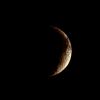
Japetus-PIA11620.jpgJapetus, from far away... (Natural Colors; credits: Lunexit)58 visiteCaption NASA:"A crescent Japetus shows, at the top right of this image, some of the dark terrain characterizing this unusual Saturnian moon.
Scientists continue to investigate the nature of the moon's surface.
Lit Terrain seen here is on the Saturn-facing side of Japetus (about 1471 KM, or approx. 914 miles across). North on Japetus is up and rotated 5° to the left.
Scale in the original image was 7 Km (about 4,5 miles) per pixel. The image has been magnified by a factor of two and contrast-enhanced to aid visibility.The image was taken in Visible Green Light with the Cassini Spacecraft narrow-angle camera on Sept. 11, 2009.
The view was acquired at a distance of approx. 1,2 MKM (about 746.000 miles) from Japetus and at Phase Angle of 125°".MareKromium
(5 voti)
|
|
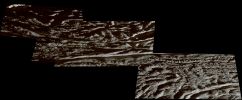
Enceladus-N00118361to64-MF.jpgEnceladus: South Polar Panorama (Image-Mosaic; credits: Dr M. Faccin - Natural Colors; credits: Lunexit)57 visitenessun commentoMareKromium
(5 voti)
|
|
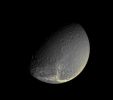
Dione-PIA11565.jpgDione59 visiteCaption NASA:"The Cassini Spacecraft looks down on the North Pole of Dione and the fine fractures that cross its Trailing Hemisphere.
The North Pole of Dione lies on the Terminator between shadow and light, about halfway down the left side of the image. This view is centered at 66° North Lat. and 224° West Long.
Lit terrain seen here is on the Trailing Hemisphere and anti-Saturn side of Dione. To learn more about Dione's fractures, see PIA09764.
The image was taken in Visible Light with the Cassini Spacecraft narrow-angle camera on July 11, 2009. The view was obtained at a distance of approx. 429.000 Km (such as about 267.000 miles) from Dione and at a Sun-Dione-Spacecraft, or Phase, Angle of 67°.
Image scale is roughly 3 Km (a little less than 2 miles) per pixel".MareKromium
(5 voti)
|
|
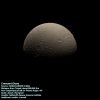
Dione-PIA11546.jpgCrescent Dione (Natural Colors; credits: Lunexit)58 visiteCaption NASA:"A large Impact Basin dominates the high Southern Latitudes of Saturn's moon Dione (see also PIA09821 to learn more from a similar image). Lit Terrain seen here is on the anti-Saturn side of Dione (such as the side that never faces Saturn). North on Dione is on the left and rotated 14° towards the upper side of the moon.
The image was taken in Visible Green Light with the Cassini Spacecraft narrow-angle camera on May 25, 2009.
The view was acquired at a distance of approx. 680.000 Km (such as about 420.000 miles) from Dione and at a Sun-Dione-Spacecraft, or Phase, Angle of 68°.
Image scale is 4 Km (about 2,5 miles) per pixel".MareKromium
(5 voti)
|
|

Rhea-PIA11537.jpgRhea and two "Possible Companions"59 visiteCaption NASA:"A couple of craters share a crescent of Lit Terrain on Saturn's moon Rhea.
Lit Terrain seen here is on the Trailing Hemisphere of Rhea. This view is centered on 48° North Latitude, 234° West Longitude. The North Pole is on the Terminator, about one-quarter of the way inward from the top of the image.
The image was taken in Visible Violet Light with the Cassini Spacecraft narrow-angle camera on June 3, 2009. The view was obtained at a distance of approx. 1,4 MKM (such as about 870.000 miles) from Rhea and at a Sun-Rhea-Spacecraft, or Phase, Angle of 121°.
Image scale is roughly 8 Km (about 5 miles) per pixel".MareKromium
(5 voti)
|
|

Janus-PIA11534.jpgCraters on Janus (possible Natural Colors; credits: Lunexit)58 visiteCaption NASA:"From hundreds of thousands of kilometers away, the Cassini Spacecraft spies craters on the Surface of the moon Janus.
This view looks toward the Saturn-facing side of Janus (about 179 Km, or approx. 111 miles across). North on Janus is up and rotated 27° to the right. The image was taken in Green Light with the Cassini Spacecraft narrow-angle camera on May 25, 2009.
Scale in the original image was roughly 4 Km (approx. 2,5 miles) per pixel. The image has been magnified by a factor of two and contrast-enhanced to aid visibility.
The view was acquired from a distance of approx. 730.000 Km (such as about 454.000 miles) from Janus and at a Sun-Janus-Spacecraft, or Phase, Angle of 38°".MareKromium
(5 voti)
|
|

Mimas-PIA11661.jpgEclipsing Mimas58 visiteCaption NASA:"As the moon Enceladus eclipses its neighbor Mimas, Cassini records a scene possible only around the time of Saturn's approaching Equinox.
Seven images, each taken about 30" apart, were combined to create a movie which shows the shadow of Enceladus (about 504 Km, or approx. 313 miles, across) darkening Mimas (about 396 Km, or approx. 246 miles, across).
Although Saturn has eclipsed moons in previous images (see PIA11143 and PIA11508), this is the first time that Cassini has imaged one of Saturn's moons being eclipsed by another moon rather than the Planet.
The novel illumination geometry created as the Saturnian System approaches Equinox means that during this time moons orbiting in or near the plane of Saturn's Equatorial Rings can cast shadows onto the Rings and onto each other.
This image was taken in Visible Light with the Cassini Spacecraft narrow-angle camera on May 13, 2009. The view was obtained at a distance of approx. 1,3 MKM (about 808.000 miles) from Mimas and at a Phase Angle of 43°.
Image scale is roughly 8 Km (about 5 miles) per pixel".MareKromium
(5 voti)
|
|
Eclipse-N00136236.gifEclipse... (GIF-Movie; credits: Dr G. Barca)58 visiteUno spettacolare GIF-Movie realizzato dal nostro (sempre più bravo) Dr Barca il quale ci mostra una stupenda eclissi mentre si materializza davanti agli "occhi elettronici" dell'Orbiter CASSINI.
Un "commento"? Ecco lo Spazio: l'Ultima Frontiera. La VERA e l'UNICA Ultima Frontiera.MareKromium
(5 voti)
|
|

Startrail1-N00135035.gifStartrail or UFO in-transit? (GIF-Movie; credits: Dr G. Barca)71 visitenessun commentoMareKromium
(5 voti)
|
|

Tethys-PIA10597.jpgBetween Sunshine and Saturnshine (Natural Colors; credits: Lunar Explorer Italia)58 visiteCaption NASA:"The huge Odysseus Crater is clearly illuminated by the Sun on the Western Limb (Sx) of Tethys, but Saturn - shining from the right - makes the smaller craters on the Eastern part of the moon also visible.
The ancient Odysseus Crater is 450 Km, or about 280 miles, across and covers a sizable chunk of the moon. North on Tethys is up and rotated 31° to the left.
This view looks toward the Saturn-facing side of the moon.
The image was taken in visible light with the Cassini Spacecraft narrow-angle camera on Jan. 22, 2009. The view was acquired at a distance of approx. 793.000 Km (such as about 493.000 miles) from Tethys and at a Sun-Tethys-Spacecraft, or Phase, Angle of 112°.
Image scale is roughly 5 Km (a little more than 3 miles) per pixel".MareKromium
(5 voti)
|
|
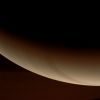
Saturn-PIA10591.jpgHigh Southern Latitudes (Natural Colors; credits: Lunar Explorer Italia)58 visiteCaption NASA:"Intricate curlicues and circular patterns of storms swirl through the High Latitudes near Saturn's South Pole in this image from the Cassini Spacecraft.
The view was obtained at a distance of approx. 588.000 Km (such as abpout 365.000 miles) from Saturn and at a Sun-Saturn-Spacecraft, or Phase, Angle of 140°. At this High Phase Angle, the Sun is illuminating the limb of the Planet from almost the opposite side of Saturn from the Spacecraft.The image was taken with the Cassini Spacecraft wide-angle camera on Jan. 5, 2009 using a spectral filter sensitive to wavelengths of near-InfraRed Light centered at 752 nanometers.
Image scale is roughly 32 Km (about 20 miles) per pixel".MareKromium
(5 voti)
|
|

Saturn-PIA10585.jpgSaturnian Terminator (Natural Colors; credits: Lunar Explorer Italia)59 visiteCaption NASA:"The Terminator nearly covers the South Pole of Saturn and its stormy vortex in darkness.
As the Southern Hemisphere moves toward Winter in the Planet's 29-year orbit, darkness eventually will consume the vortex. But this seasonal change also will bring the North Pole into the light.
This view looks toward the sunlit side of the Rings from about 69° below the Ring-Plane.
The image was taken with the Cassini Spacecraft wide-angle camera on Jan. 6, 2009 using a spectral filter sensitive to wavelengths of near-InfraRed Light centered at 752 nanometers. The view was acquired at a distance of approx. 761.000 Km (about 473.000 miles) from Saturn and at a Phase Angle of 96°.
Image scale is roughly 42 Km (approx. 26 miles) per pixel.MareKromium
(5 voti)
|
|
| 2244 immagini su 187 pagina(e) |
 |
|
|
|
|
52 | |
|
|
|
|





