| |

| Piú votate - Saturn: the "Ringed Beauty" and His Moons |
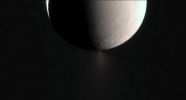
Enceladus-PIA18328-PCF-LXTT-IPF.jpgIn the Saturnshine... (Absolute Natural Colors; credits for the additional process. and color.: Dr Paolo C. Fienga/Lunar Explorer Italia/Italian Planetary Foundation)126 visiteThe Saturnian moon Enceladus looks as if it is half lit by Sunlight in this view from the NASA - Cassini Spacecraft; but looks, as you know, can be (as they often are) deceiving.
In fact, the kind of pinkish area of Enceladus visible on the right (Dx) of the frame, where MANY Surface Features can be made out (---> seen/identified), is actually illuminated by the light reflected off of Saturn (such as the so-called "Saturnshine"). On the other hand, a sliver of the Enceladian Surface that is actually illuminated by direct Sunlight is visible - and also highly overexposed! - on the left (Sx) of the picture. Images like this one are designed to capture the extended Plumes of Icy Materials spraying from huge cracks located the moon's South Polar Region. Such images need to be taken with the NASA - Cassini Spacecraft looking toward the Icy moon's Night Side, since the small particles that form the Plumes (however, just barely visible in this picture) are most easily seen when backlit by the Sun.
This view looks toward the Leading Hemisphere of Enceladus; North is up. The image was taken in Visible Light with the NASA - Cassini Spacecraft's Narrow-Angle Camera on May 10, 2015. Enceladus is roughly 313 miles (such as about 503,72 Km) across. The view was acquired at a distance of approximately 226.000 miles (such as approx. 363.7210,84 Km) from Enceladus and at a Sun-Enceladus-Cassini Spacecraft, or Phase, Angle of 152°. Image scale is roughly 1,4 miles (about 2,2530 Km) per pixel.
This frame (which is an Original NASA - CASSINI Spacecraft's b/w and NON Map-Projected image published on the NASA - Planetary Photojournal with the ID n. PIA 18328) has been additionally processed, contrast enhanced, magnified, in order to allow the vision of the slightest details of the Surface, Gamma corrected and then re-colorized - according to an educated guess (or, if you wish, an informed speculation) carried out by Dr Paolo C. Fienga - in Absolute Natural Colors (such as the colors that a human eye would actually perceive if someone were onboard the NASA - Cassini Spacecraft and then looked outside, toward the Saturnian moon "Enceladus"), by using an original technique created - and, in time, dramatically improved - by the Lunar Explorer Italia Team. Different colors, as well as different shades of the same color, mean, among other things, the existence of different Elements (Minerals) present on the Surface of Enceladus, each having a different Albedo (---> Reflectivity) and Chemical Composition.
Note: it is possible (but we, as IPF, have no way to be one-hundred-percent sure of such a circumstance), that the actual luminosity of Enceladus - as it is in this frame - would appear, to an average human eye, a little bit lower than it has been shown (or, better yet: interpreted) here.MareKromium
(5 voti)
|
|

Hyperion-PIA17194-PCF-LXTT-IPF.jpgFarewell Hyperion! Part II (Absolute Natural Colors; credits for the additional process. and color.: Dr Paolo C. Fienga/Lunar Explorer Italia/Italian Planetary Foundation)85 visiteThe NASA - Cassini Spacecraft's Imaging Scientists processed this view of Saturn's so-called "spongy" moon Hyperion, which was taken - just like yesterday's one - during a close Fly-By that occurred on May 31, 2015. This Fly-By marks the Mission's Final Close Approach to this Saturnian highly irregularly shaped moon. North on Hyperion is up and rotated 34° to the left (Sx).
The image was taken in Visible Light, with the NASA - Cassini Spacecraft's Narrow-Angle Camera - as we wrote herebefore - on May 31, 2015. The view was acquired at a distance of approximately 24.000 miles (such as about 38.624,159 Km) from Hyperion and at a Sun-Hyperion-Cassini Spacecraft, or Phase, Angle of 46°. Image scale is roughly 145 feet (such as approx. 44,196 meters) per pixel. l.
This frame (which is an Original NASA - CASSINI Spacecraft's b/w and NON Map-Projected image published on the NASA - Planetary Photojournal with the ID n. PIA 17194) has been additionally processed, contrast enhanced, magnified to help the visibility of the Surface details, Gamma corrected and then re-colorized - according to an educated guess (or, if you wish, an informed speculation) carried out by Dr Paolo C. Fienga - in Absolute Natural Colors (such as the colors that a human eye would actually perceive if someone were onboard the NASA - Cassini Spacecraft and then looked outside, towards the Saturnian moon "Hyperion"), by using an original technique created - and, in time, dramatically improved - by the Lunar Explorer Italia Team. Different colors, as well as different shades of the same color, mean, among other things, the existence of different Elements (Minerals) present on the Surface of Hyperion, each having a different Albedo (---> Reflectivity) and Chemical Composition.
Note: it is possible (but we, as IPF, have no way to be one-hundred-percent sure of such a circumstance), that the actual luminosity of Hyperion - as it is in this frame - would appear, to an average human eye, a little bit lower than it has been shown (or, better yet: interpreted) here.MareKromium
(5 voti)
|
|

Hyperion-PIA17193-PCF-LXTT-IPF.jpgFarewell Hyperion! Part I (Absolute Natural Colors; credits for the additional process. and color.: Dr Paolo C. Fienga/Lunar Explorer Italia/Italian Planetary Foundation)94 visiteThe NASA - Cassini Spacecraft's Imaging Scientists processed this view of Saturn's so-called "spongy" moon Hyperion, which was taken during a close Fly-By that occurred on May 31, 2015. This Fly-By marks the Mission's Final Close Approach to this Saturnian highly irregularly shaped moon. North on Hyperion is up and rotated 37° to the right (Dx).
The image was taken with the NASA - Cassini Spacecraft's Narrow-Angle Camera - as we wrote herebefore - on May 31, 2015, by using a Spectral Filter which preferentially admits Wavelengths of Near-InfraRed Light, centered at 862 nanometers. The view was acquired at a distance of approx. 37.000 miles (such as about 59.545,58 Km) from Hyperion, and at a Sun-Hyperion-Cassini Spacecraft, or Phase, Angle of 20°. The Image Scale is roughly 1180 feet (such as approx. 359,664 meters) per pixel.
This frame (which is an Original NASA - CASSINI Spacecraft's b/w and NON Map-Projected image published on the NASA - Planetary Photojournal with the ID n. PIA 17193) has been additionally processed, contrast enhanced, magnified to help the visibility of the Surface details, Gamma corrected and then re-colorized - according to an educated guess (or, if you wish, an informed speculation) carried out by Dr Paolo C. Fienga - in Absolute Natural Colors (such as the colors that a human eye would actually perceive if someone were onboard the NASA - Cassini Spacecraft and then looked outside, towards the Saturnian moon "Hyperion"), by using an original technique created - and, in time, dramatically improved - by the Lunar Explorer Italia Team. Different colors, as well as different shades of the same color, mean, among other things, the existence of different Elements (Minerals) present on the Surface of Hyperion, each having a different Albedo (---> Reflectivity) and Chemical Composition.
Note: it is possible (but we, as IPF, have no way to be one-hundred-percent sure of such a circumstance), that the actual luminosity of Hyperion - as it is in this frame - would appear, to an average human eye, a little bit lower than it has been shown (or, better yet: interpreted) here.MareKromium
(5 voti)
|
|

Helene-PCF-LXTT-IPF.jpgHelene (Absolute Natural Colors; credits for the additional process. and color.: Dr Paolo C. Fienga - Lunexit Team) 126 visiteHelene (one of the many moons of the Giant Gas-Planet Saturn) was discovered by the French Astronomers Pierre Laques and Jean Lecacheux in 1980, from ground-based observations carried out at the "Pic du Midi" Observatory; at first, it was designated S/1980 S 6. Afterwards, in 1988, it was officially named Helene (after Helen of Troy, who was the granddaughter of Cronus - Saturn -, according to Greek mythology).
This small moon (we are talking about a Celestial Body, mostly made of Ice and Rock, which is approx. 30 Km across) is also designated as Saturn XII, a number which it received in 1982, under the designation of Dione B (since Helene is co-orbital with Dione and located in its Leading Lagrangian Point - L4). Helene is one of 4 (four) known so-called "Trojan Moons" of the Saturnian System.
For sake of clarity, please remember that:
A) the Saturnian System contains two sets of Trojan Moons. Both Tethys and Dione have, in fact, two Trojan Moons: Telesto and Calypso, which are located in Tethys' L4 and L5 Lagrangian Points, respectively, and Helene with Polydeuces, which are located in Dione's L4 and L5 Lagrangian Points, respectively;
B) in Astronomy, a co-orbital configuration refers to 2 (two) or more Celestial Objects - such as Asteroids, Moons, or even Planets - that orbit at the same, or very similar, distance from their Parent Object as well as from each other. In other words, they are in a 1:1 (one-to-one) mean Motion Resonance;
C) there are several Classes of co-orbital Objects, depending on their Point of Libration. The most common and best-known Class, is the Trojan, which librate around one of the two stable Lagrangian Points (also known as "Trojan Points"), L4 and L5, 60° ahead of, and behind, the larger Parent Body, respectively. Another class is the so-called "Horseshoe Orbit", in which the Celestial co-Orbital Objects librate around 180° from the larger Parent Body. Objects librating around 0° are called, instead, "Quasi-Satellites".
When two co-Orbital Objects are of similar masses (and thus they exert a non-negligible - i.e.: meaningful - Gravitational Influence on each other) they can even arrive to exchange their orbits. For instance, talking about Janus and Epimetheus, we know that the Timing and Magnitude of their Momenta exchange in such a way that the two moons actually "trade" their orbits, while never getting closer (---> approaching each other) than about 10.000 Km. The exchange takes place about once every 4 years; the last close approaches occurred on January 21, 2006, and in 2010, when Janus' Orbital Radius increased by ~20 Km, while Epimetheus' decreased by ~80 Km. However, Janus' orbit is less affected by the swop, because Janus itself is about 4 times more massive than Epimetheus. As far as it is currently known, this "arrangement" is unique in the Solar System.
As we already said hereabove, Helene was initially observed from Earth in 1980 but, when the NASA - Voyager Probes passed through the Saturnian System, they allowed us to get much closer views of it. Afterwards, the NASA - Cassini Spacecraft, which went into orbit around Saturn in 2004, provided still better views and allowed more in-depth analysis of this moon, including views of its Surface under different lighting conditions. Although conventional Impact Craters and Hills do appear, this image also shows Terrain that looks unusually smooth and streaked. Some of the closest images of Helene to date are from the Cassini Spacecraft's 1800 Km Fly-By that occurred on March 3, 2010, and another very successful imaging sequence which was obtained in June 2011.
There have been many other approaches over the course of the Cassini mission, and future Fly-Bys may yield additional data.This frame has been colorized in Natural Colors (such as the colors that a perfect human eye would actually perceive if someone were onboard the NASA - Cassini Spacecraft and then looked outside, towards the Saturnian moon Helene), by using an original technique created - and, in time, dramatically emproved - by the Lunar Explorer Italia Team.MareKromium
(5 voti)
|
|

Janus-MF-EB-LXTT.jpgJanus (RAW Natural Colors; credits for the additional process. and color.: Elisabetta Bonora and Marco Faccin - Lunexit Team)150 visiteJanus - apparently, and according to our Readers, one of the most interesting Celestial Bodies that we have shown and talked about on our APOD in the past - is one of the so-called "Inner Natural Satellites" of the Giant Gas-Planet Saturn; it is also called and known, sometimes, as Saturn X, and it occupies (better yet: shares) the same orbit as the Saturnian Inner Minor moon Epimetheus. This (now we know NOT infrequent) circumstance, however caused, in the past, some confusion to many astronomers which, at the time of Janus' discovery - and according to their different observations - assumed that there should have been only one Celestial Body in the orbit where Janus was spotted.
For a long time, in fact, the Astronomical Community struggled to figure out what was going on, until they realized that what they were trying to solve, was (let us use this expression) an "impossible equation": in other words, they were trying to reconcile (so-called "reductio ad unum") different observations of different and distinct Objects, on the wrong assumption that what they all were looking at, was just a single Celestial Body.
The discovery of Janus is attributed to its first observer, such as the French Astronomer Audouin Dollfus, who spotted Janus on December 15, 1966. The newly discovered Object was given the temporary designation of "S/1966 S 2". Previously, though, another Astronomer (Jean Texereau) had also photographed the very same Celestial Body (to be exact, on October 29, 1966), but without realizing the discovery! On December 18 of the same year, then, Richard Walker made a similar observation which is now credited as the discovery of Epimetheus.
Twelve years later, in October 1978, Stephen M. Larson and John W. Fountain finally realized that the 1966 observations would have been better explained by assuming that they were relative NOT to one, BUT to two distinct Objects (as we said, Janus and Epimetheus), sharing very similar (or perhaps the same, as we know now) orbits. Finally, in the AD 1980, the NASA - Voyager 1 Spacecraft confirmed that this "controversial moon" was, in fact, a couple of co-orbital Celestial Bodies.
Afterwards, Janus was observed on other occasions and given different provisional designations. It was observed, for instance, by the NASA - Pioneer 11 Probe when it passed near Saturn on September 1st, 1979. Janus was also observed by Dan Pascu on February 19, 1980 (and then provisionally designed as "S/1980 S 1") and then by John W. Fountain (once again), Stephen M. Larson (again), Harold J. Reitsema and Bradford A. Smith on the 23rd (and, this time, the observed object was, always provisionally, recorded as "S/1980 S 2").
All these Scientists, in a way and in the end, should therefore share, to various degrees, the title of Discoverer of Janus, but this "fair dispute", so far (and as far as we know), has not been solved.
As far as the physical characteristics of Janus are concerned, we can say that this relatively small moon (whose dimensions are approx. 203 × 185 × 153 Km) is extensively cratered, and a few of these craters are more than 30 Km across. The Janian Surface, as we already wrote in the past, appears to be older than Prometheus' one, but younger than Pandora's. Furthermore, if you consideri its oval (or, if you prefer, its "non-spherical") shape, its (very) low Density and relatively high Albedo, it seems logic to conclude, for the time being, that Janus should just be a porous and icy "rubble pile" (such as the final result of a cloud of Cosmic Debris that have coalesced under the influence of gravity).
The so-called Rubble Piles-type Celestial Bodies have a low density because there are, we believe, large cavities between the various "chunks" - such as fragments - of rocky material that made them up; Rubble Piles may also form when an Asteroid or a moon (which may originally be monolithic - such as "one single piece of rock") is smashed by an impact, and the shattered pieces left over by the impact, in time, fall back together, primarily due to self-gravitation (---> mutual attraction). In other words: a Celestial Body like Janus is formed, in our opinion, by a mass of different materials that cohered over time (we repeat: something like a "cloud" of Cosmic Debris - rocks, boulders, dust etc. - which, in time, due to a mutual gravitational attraction, got together until they became one - yet extremely fragile - Celestial Body).
In the light of the above considerations and assumptions, we, as IPF, believe that Janus can reasonably be assimilated, for instance (and among others), to Asteroid 25143 Itokawa or 433 Eros.MareKromium
(5 voti)
|
|

Enceladus-PIA14588-PCF-LXTT.jpgCrescent Enceladus (Absolute Natural Colors; credits for the additional process. and color.: Dr Paolo C. Fienga - Lunexit Team)219 visiteCaption NASA:"The Cassini Spacecraft looks at a brightly illuminated Enceladus and examines the Surface of its Leading Hemisphere. North on Enceladus is up and rotated 21° to the right.
The image was taken in Visible Light with the Cassini Spacecraft narrow-angle camera on Nov. 6, 2011. The view was obtained at a distance of approx. 67.700 miles (such as about 109.000 Km) from Enceladus and at a Phase Angle of 21°. Image scale is 2130 feet (649 meters) per pixel".MareKromium
(5 voti)
|
|

Tethys-PIA14581-PCF-LXTT-1.jpgTethys (Sx: False b/w - credits for the additional process.: Dr Paolo C. Fienga - Lunexit Team - Dx: Original NASA b/w RAW Frame)250 visitenessun commentoMareKromium
(5 voti)
|
|

Tethys-PIA14581-PCF-LXTT-0.jpgTethys (False b/w - credits for the additional process.: Dr Paolo C. Fienga - Lunexit Team)198 visiteCaption NASA:"Saturn's moon Tethys shows off its tortured Surface in this Cassini Spacecraft image. On the top left of the image there is huge Odysseus Crater. On the bottom right, instead, there is Ithaca Chasma: a series of Scarps that run North-to-South across the moon for more than 620 miles (approx. 1000 Km). North on Tethys is up and rotated 25° to the right. This view looks toward the area between the Leading Hemisphere and Saturn-facing side of Tethys.
The image was taken in Visible Green Light with the Cassini Spacecraft narrow-angle camera on Sept. 14, 2011. The view was acquired at a distance of approximately 178.000 miles (approx. 287.000 Km) from Tethys and at a Sun-Tethys-Spacecraft, or Phase, Angle of 11°. Image scale is about 1 mile (1,6 Km) per pixel". MareKromium
(5 voti)
|
|

Enceladus-PIA14858-PCF-LXTT.jpgFountains of Light (Absolute Natural Colors; credits for the additional process. and color.: Dr Paolo C. Fienga - Lunexit Team) 154 visiteCaption NASA:"NASA's Cassini Spacecraft successfully completed its Oct. 1st Fly-By of Saturn's moon Enceladus and its Jets of Water Vapor and Ice. At its closest approach, the Spacecraft flew approx. 62 miles (about 100 Km) above the moon's Surface. The close approach was designed to give some of Cassini's instruments, including the Ion and Neutral Mass Spectrometer, the chance to "taste" the Jets themselves.
At a higher vantage point during the encounter, Cassini's high-resolution camera captured pictures of the jets emanating from the moon's South Polar Region. The latest raw images of Enceladus are online at:
http://saturn.jpl.nasa.gov/photos/raw/.
The images of the Surface include previously seen Leading-Hemisphere Terrain. However, during this encounter, multi-spectral imaging of these Terrains extended farther into the UV Region of the Spectrum than had previously been achieved at this resolution.
By looking at the Surface at UV wavelengths, scientists can better detect the difference between surface materials and shadows than they can at visible wavelengths, where icy materials are highly reflective and shadows are washed out. With both UV and Visible Light images of the same Terrain available to them, scientists will better understand how the Surface coverage of icy particles coming from the Vents and Plumes changes with Terrain type and age. Cassini's next pass of this fascinating moon will be Oct. 19, 2011, when the Spacecraft shall fly-by at an altitude of approximately 765 miles (such as about 1231 Km)".MareKromium
(5 voti)
|
|

Janus-PIA09872-PCF-LXTT.jpgCrescent Janus (Natural Colors; credits for the additional process. and color.: Dr Paolo C. Fienga - Lunar Explorer Italia)222 visiteCaption NASA:"The Cassini Spacecraft snapped this exquisite, close-up view of Saturn's moon Janus, looking toward the South Polar Region, on Feb. 20, 2008.
Janus is about 181 Km (approx. 113 miles) across.
The image was taken in visible light with the Cassini spacecraft narrow-angle camera. The view was acquired at a distance of approx. 169.000 Km (such as about 105.000 miles) from Janus and at a Sun-Janus-Spacecraft, or phase, angle of 71°. Image scale is roughly 1 Km (about 0,6 mile) per pixel".
MareKromium
(5 voti)
|
|

Rhea-PIA14574-PCF-LXTT.jpgRhea in the Saturnshine (Enhanced Absolute Natural Colors; credits for the additional process. and color: Dr Paolo C. Fienga - Lunexit Team)144 visiteCaption NASA:"Southern Terrain on Saturn's moon Rhea is dimly illuminated by Saturnshine in this Cassini Spacecraft view of the dark side of the moon. The Spacecraft's camera is looking toward the night side of Rhea, but sunlight reflected off the day side of immense Saturn is bright enough to illuminate the Craters seen here. This view is centered on Terrain located at about 23° South Latitude and 315° West Longitude. A few background stars are visible.
The image was taken in Visible Light with the Cassini Spacecraft wide-angle camera on Aug. 1, 2011. The view was obtained at a distance of approx. 6000 Km (such as about 3700 miles) from Rhea and at a Sun-Rhea-Spacecraft, or Phase, Angle of 113°. Scale in the original image was 800 meters (2600 feet) per pixel. The image was contrast enhanced and magnified by a factor of 1.5 to enhance the visibility of the surface features".MareKromium
(5 voti)
|
|

Helene-N00172899_900.jpgHelene (High-Def-3D; credits for the additional process.: Dr Marco Faccin - Lunexit Team)208 visitenessun commentoMareKromium
(5 voti)
|
|
| 2244 immagini su 187 pagina(e) |
|
|
|
|
|
47 | |
|
|
|
|
|
|





