| Piú votate - Saturn: the "Ringed Beauty" and His Moons |

Saturn-N00021916.jpgSaturn from about 4.000.000 Km58 visiteSaturno è sempre più vicino ed i dettagli che caratterizzano i suoi anelli si fanno sempre più chiari. Purtroppo non siamo in grado di dire se le sorgenti luminose puntiformi visibili in questa immagine sono degli oggetti reali o dei difetti emersi durante l'attività di processo dei dati. Si tratta comunque di "punti luminosi ripetitivi" (ossìa essi appaiono, più o meno allo stesso punto, in più frames) e questo ci fa propendere per l'ipotesi che si tratti di oggetti reali. La seconda domanda attiene la natura di questi oggetti: si tratta di corpi appartenenti al Sistema di Saturno o di stelle fisse che si vedono in campo lungo? La risposta, in questo caso - tenendo ferma la premessa secondo cui siamo davanti ad oggetti reali -, è relativamente semplice: si dovrebbe trattare di oggetti appartenenti al Sistema di Saturno. Le stelle, infatti (anche le più luminose), dovrebbero essere cancellate (washed-away) dalla elevata luminosità (glare) che promana dal disco stesso di Saturno.
(6 voti)
|
|
Mimas-N00021469.jpgRings and Mimas59 visitenessun commento
(6 voti)
|
|

Prometheus-N00021331.jpgRings and Prometheus58 visiteForse lo avevamo già suggerito e forse no, comunque non è un problema ripetersi quando la materia lo richiede: provate ad osservare e studiare, anche solo visivamente, gli anelli di Saturno in rapporto a quelli di Giove, Urano e Nettuno. Secondo noi la differenza non deve essere vista solo nella "estensione" degli anelli (ossìa nel "quantitativo" di materiale che li forma): essa è anche nella loro intrinseca struttura. Il che vuol dire, a nostro parere, che la/e causa/e degli anelli di Saturno è/sono diversa/e dalla/e causa/e che ha/hanno prodotto gli anelli di Giove, Urano e Nettuno.
(6 voti)
|
|

Prometheus-PIA06488_modest.jpgPrometheus: one of the Ring-Masters77 visiteCaption NASA originale:"In its own way, the shepherd moon Prometheus is one of the Master of Saturn's rings. That's because the little moon maintains the inner edge of Saturn's thin, knotted, F-Ring, while its slightly smaller cohort Pandora (84 Km across) guards the ring's outer edge.
This view is a composite of nine raw images combined in a way that improves resolution and reduces noise. The final image was magnified by a factor of five.
The image clearly shows that Prometheus is not round, but instead has an oblong, potato-like shape.
The moon was discovered during the Voyager mission, and scientists then noted ridges, valleys and craters on its surface. Hints of its varied topography are present in this view, although Cassini will likely obtain much better images of Prometheus later in the mission".
(6 voti)
|
|
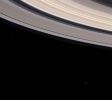
Saturn-PIA06485_modest.jpgSaturn, Janus and Mimas (in natural colors)59 visiteCaption NASA originale:"Looking something like the fibrous bow of a violin, Saturn's colorful rings sweep through this spectacular natural color view while two small moons look on.
From left, the moons visible here are Janus (181 Km across) and Mimas (398 Km across). Cassini's view in this image is from beneath the ring plane; the moons are on the far side of Saturn. Janus leads Mimas as the two moons orbit the planet. Nearly the entire ring system can be seen in this view. The diaphanous C-Ring appears at the upper right, followed by the multi-hued B-Ring. Next, the famous Cassini division (4.800 Km wide) separates the A and B rings. The outer edge of the B-Ring which forms the inner boundary of the Cassini division is maintained by a gravitational resonance with Mimas. Near the outer edge of the A-Ring are the Encke Gap (325 Km wide) and the barely visible Keeler Gap (35 Km wide). The faint, thread-like F-Ring is slightly discernible just beyond the main rings".
(6 voti)
|
|

Saturn & family-PIA06475_modest.jpgSaturn and Family62 visiteCaption NASA originale:"Satellites visible in this image are (clockwise from upper left): Dione (1.118 Km or 695 miles wide), Enceladus (499 Km or 310 miles wide), Tethys (1.060 Km or 659 miles wide), Mimas (398 Km or 247 miles wide) and Rhea (1.528 Km or 949 miles wide).
The image was taken in visible red light on Aug. 1, 2004, at a distance of 7.8 MKm (4.8 million miles) from Saturn. The image scale is 464 Km (288 miles) per pixel".
(6 voti)
|
|

Saturn-N00016134.jpgSaturn: clouds and rings from about 8.866.000 Km58 visitenessun commento
(6 voti)
|
|

Saturn-N00016277.jpgSaturn, Moons and Stars57 visitenessun commento
(6 voti)
|
|

Japetus from 2.900.000 Km - PIA06466_modest.jpgTwo-faced Japetus56 visiteCaption NASA originale:"The dark material that coats one hemisphere of Saturn's moon Iapetus is very dark, as these two processed views of the same frame can demonstrate.
The image on the left has been cleaned of cosmic rays and magnified; in this otherwise un-enhanced view, only a small part of the moon's surface, at the bottom, is visible because it is part of the bright side of Iapetus. (Only the right hand side of Iapetus is illuminated by sunlight.) The same image, shown on the right, has been contrast-enhanced to make visible the part of the illuminated side of Iapetus that is coated with dark material".
(6 voti)
|
|

Saturn-HST-Oct1999-PIA03161_modest.jpgSaturn from Hubble Space Telescope (Oct. 1999)58 visitenessun commento
(6 voti)
|
|

Saturn-HST-PIA05982_modest.jpgSaturn from Hubble Space Telescope60 visiteCaption NASA originale:"...The subtle pastel colors of ammonia-methane clouds trace a variety of atmospheric dynamics. Saturn displays its familiar banded structure, with haze and clouds at various altitudes. Like Jupiter, all bands are parallel to Saturn's equator. The magnificent rings, at nearly their maximum tilt toward Earth, show subtle hues which indicate the trace chemical differences in their icy composition..."
(6 voti)
|
|

Saturn and 2 Companions-N00015014.jpgSaturn and some Companion from about 9.000.000 Km71 visitenessun commento
(6 voti)
|
|
| 2244 immagini su 187 pagina(e) |
 |
|
|
|
|
45 | |
|
|
|
|





