| Piú votate - Saturn: the "Ringed Beauty" and His Moons |

Huygens-IMG001254-br500.jpgThe "Huygens Probe" - detail mgnf138 visiteCaption NASA originale: "The European Space Agency's Huygens Probe appears shining as it coasts away from Cassini in this close-up of an image taken on Dec. 26, 2004, just two days after it successfully detached from the Cassini spacecraft.
Shown here side-by-side is a close-up of the Huygens probe. The image on the left shows the relative size of the probe. The bright spots in both images are probably due to light reflecting off the blanketing material that covers the probe".
(6 voti)
|
|

Dione-PIA06156_modest.jpgDione: close-up (1) - HR66 visiteCaption NASA originale:"This incredible, HR view of Saturn's moon Dione was taken during Cassini's first close approach to the icy moon on Dec. 14, 2004. The view shows linear, curving features within the region of the bright wispy terrain Dione is known for.
The image was obtained in visible light with the Cassini spacecraft narrow angle camera at a distance of approximately 156.000 Km (97.000 miles) from Dione. The Sun-Dione-spacecraft, or phase, angle is 34°. The image scale is about 1 Km (0.6 miles) per pixel".
(6 voti)
|
|
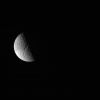
Tethys-N00025970.jpgTethys from approx. 564.000 Km58 visiteUn'ottima immagine di Tethys la quale, nonostante la grande distanza che ancora separa la Sonda Cassini/Huygens da questa luna, è già capace di rivelarci alcune delle tante caratteristiche superficiali di questa luna. Notiamo, in particolare, all'altezza dell'equatore di Tethys, a ridosso del terminatore (e con riflessi su una larga parte della sua superficie illuminata), la presenza di una profondissima cicatrice la quale, probabilmente, è la prova di un catastrofico impatto - occorso qualche milione di anni orsono - fra questa luna ed uno o più corpi vaganti di notevoli dimensioni. Le note oggettive della cicatrice più grande suggeriscono un angolo di impatto piuttosto basso. Non è neppure da escludersi la possibilità che Tethys sia stata colpita nella medesima area da (almeno) tre corpi celesti ed in epoche diverse e lontane fra loro (osservate infatti i 2 solchi quasi paralleli fra loro - ad ore 8 di Tethys - che intersecano, sovrapponendosi, il solco più grande che giunge sino al terminatore).
(6 voti)
|
|

Japetus in the darkness-PIA06146_modest.jpgThe night-side of Japetus (from 1,6 MKMs)58 visiteCaption NASA originale:"Japetus, as it has been already said, is mainly famous for some dramatic contrasts in brightness on its surface: the leading hemisphere is as dark as a freshly-tarred street while the trailing hemisphere and poles are almost as bright as fresh snow. Many impact craters can be seen in the bright terrain and in the transition zone between bright and dark and for the first time in parts of the dark terrain. Also visible is a line of mountains that appear as a string of bright dots (see the color images "Sharp views of Japetus"). These mountains were originally detected in Voyager images and might compete in height with the tallest mountains on Earth, Jupiter's moon Io and possibly even Mars. Further observations will be required to precisely determine their heights. Interestingly, the line of peaks is aligned remarkably close to the equator of Japetus".
(6 voti)
|
|

Saturn_s Rings-PIA06533_modest.jpgSaturn's Rings from about 631.000 Km61 visiteCaption NASA originale:"The usually bright B-Ring (at center) appears very dim in this view of the rings taken on the side of the rings that is not illuminated. The scene resembles a photographic negative, with bright and dark areas reversed (although in some places in the rings, the blackness of space is seen). From this viewing angle, the rings are lit from below: both dense and empty regions are dark, and regions of intermediate particle density are bright.
The image was taken with the Cassini spacecraft wide angle camera on Oct. 27, 2004, at a distance of about 631.000 Km from Saturn through a filter sensitive to wavelengths of visible violet light. The image scale is 34 Km per pixel".
(6 voti)
|
|

Saturn-W00002930.jpgSaturn's Rings overexposed (2)58 visiteQuesto è il frame più ambiguo in quanto la sovra-esposizione è tale da cancellare ogni possibile punto di riferimento (almeno adoperando i mezzi di cui disponiamo).
Ma andate ora a guardare il terzo...
(6 voti)
|
|
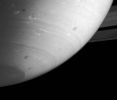
Saturn Storms.jpgStorms on Saturn (refined)60 visiteCaption originale da "NASA - Picture of the Day" del giorno 02.11.2004:
"(...) scientists commanded the Cassini spacecraft (...) to inspect a circulating band of clouds nicknamed "Storm Alley". This westwardly moving cloud ring has been unusually active since the beginning of 2004, spawning white swirling storms and dark storms ringed by sprawling white clouds all cascading around the gas giant. The rogue band, as well as part other parts of south Saturn, were imaged in stunning detail in a very specific band of infrared light that passes through Saturn's upper haze relatively unblurred. The result was then digitally sharpened, showing more cloud detail but creating fake image artifacts such as a surrounding ring. Speculation on the nature of past Saturn storms included convective motions of small amounts of ammonia and water, seasons and shadowing effects of the Great Ring System. Although the above image provides data and clues, the power behind Saturn's storms still remains a mystery".
(6 voti)
|
|
The E-Ring - W00002645.jpgThe "E-Ring" from approx. 415.000 Km57 visitenessun commento
(6 voti)
|
|
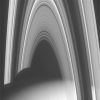
Saturn-W00002482.jpgSaturn from approx. 600.000 Km58 visitenessun commento
(6 voti)
|
|

Rings and Moons-PIA06501_modest.jpgRings and Moons (detail - x4 mgnf)59 visiteCaption NASA originale:"This image captures several important targets of the Cassini mission: icy moons, rings and the gaps in the rings that may contain small undiscovered moons. Mimas (398 Km across) is easily seen near lower right. Epimetheus (116 Km across) is visible left of center. The 4.800 Km wide Cassini division is the dark swath at upper left. The Encke Gap (325 Km wide) is visible as a dark curve near the edge of the A-Ring. The thin F-Ring is seen here, exterior to the main rings.
The image was taken in visible light with the Cassini spacecraft narrow angle camera on Sept. 10, 2004, at a distance of 8.9 MKm(5.5 million miles) from Mimas and at a Sun-Mimas-spacecraft (or "phase") angle of 84°. The image scale is 53 Km per pixel.
The image was magnified by a factor of four to aid visibility".
(6 voti)
|
|
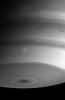
Saturn-South Pole~0.jpgThe South Pole of Saturn57 visiteQuesta immagine, pubblicata sul Sito "NASA Picture of the Day" del 18.10.2004 ci sembra interessante perchè presenta - a nostro parere - una Anomalia. Innanzitutto eccoVi la caption originale:"...Visible in the above image of Saturn are bright bands, dark belts and a dark spot right over the South Pole. The above image in infrared light spans over 30.000 Km and was taken early last month (Sept.) by the Cassini spacecraft. Saturn's atmosphere is about 75% H, 25% He and small amounts of heavier compounds including water vapor, methane, and ammonia. The relatively low gravity at Saturn's cloud tops result in a thicker haze layer, which in turn makes atmospheric features blurrier than Jupiter". I dati sull'atmosfera di Saturno sono interessanti e le indicazioni relative ad alcune surface features corrette. Ma che cosa possiamo dire di quell'area circolare, luminescente, biancastra, ben visibile, perpendicolare al Polo Sud, a circa centro immagine?!? E' un difetto di processo? Un artifact? Una nuvola sferica?
(6 voti)
|
|

Japetus-N00022199.jpgJapetus from approx. 1.218.000 Km60 visiteLa Sonda Cassini-Huygens si è sensibilmente avvicinata non solo a Saturno, ma anche ad alcune delle sue Lune interne. Questa immagine (una delle tantissime) di Giapeto, è stata ripresa da una distanza di poco superiore al milione di Km e ci fa già vedere molti dettagli della superficie di questo mondo ghiacciato e ricoperto di crateri da impatto. Il gioco di luci ed ombre che sembra caratterizzare la "faccia" di Giapeto rende l'immagine ancora più "aliena" ed affascinante.
(6 voti)
|
|
| 2244 immagini su 187 pagina(e) |
 |
|
|
|
|
44 | |
|
|
|
|





