| Piú votate - Saturn: the "Ringed Beauty" and His Moons |

Saturn_s Rings-PIA06237.jpgS/2005 S1: The "Wave-Maker" (1)59 visiteLa NASA conferma che le curiose ed enigmatiche "onde" le quali caratterizzano il margine esterno dell'Anello "A" di Saturno, proprio a ridosso della "Divisione Keeler" sono, con ogni probabilità, causate da una piccola luna del diametro di circa 7 Km, dotata di una discreta albedo (al pari delle particelle che formano il vicino Anello) e che è stata temporaneamente chiamata S/2005 S1.
Caption NASA originale:"Imaging scientists predicted the moon's presence and its orbital distance from Saturn after July 2004, when they saw a set of peculiar spiky and wispy features in the Keeler Gap's outer edge. The similarities of the Keeler Gap features to those noted in Saturn's F-Ring and the Encke Gap led the scientists to conclude that a small body, a few Km across, was lurking in the center of the Keeler Gap, awaiting discovery".
(6 voti)
|
|
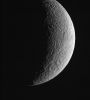
Tethys-PIA06633.jpgTethys (ultraviolet vision) from 200.000 Km55 visiteCaption NASA originale:"This view of Saturn's moon Tethys shows the contrast between the more heavily cratered region near the top and the more lightly cratered (and presumably younger) plains toward the bottom part of the image and near the limb. Some of the larger craters in the latter region appear to be somewhat subdued or filled in. This view shows principally the anti-Saturn hemisphere on Tethys; North is up and tilted 20° to the left.
The image was taken with the Cassini spacecraft narrow-angle camera on March 9, 2005, through a filter sensitive to wavelengths of ultraviolet light centered at 338 nnmts. The view was obtained at a distance of approximately 200.000 Km from Tethys and at a phase angle of 120°. Resolution in the image is 1 Km (approx. 0,6 mile) per pixel".
(6 voti)
|
|

Rhea-PIA06630.jpgRhea, from 1,8 MKM58 visiteCaption NASA originale:"The ancient and battered surface of Saturn's moon Rhea shows a notable dark swath of territory near the eastern limb in this image from Cassini.
This view shows principally the Saturn-facing hemisphere on Rhea (1.528 Km across). North is up and tilted 40° to the right.
The image was taken with the Cassini spacecraft narrow-angle camera on March 7, 2005, through a filter sensitive to wavelengths of ultraviolet light centered at 338 nnmts. The view was acquired at a distance of approx. 1,8 MKM (approx. 1,1 MMs) from Rhea and at a phase angle of 30°. Resolution in the original image was 10 Km per pixel.
The image has been contrast-enhanced and magnified by a factor of two to aid visibility".
(6 voti)
|
|

Dione&Tethys-PIA06629.jpgDione and Tethys58 visiteCaption NASA originale:"Cassini offers this lovely comparison between two of Saturn's satellites, Dione and Tethys, which are similar in size but have very different surfaces.
Extensive systems of bright fractures carve the surface of Dione. The double-pronged feature Carthage Linea points toward the crater Turnus at the nine o'clock position near the terminator and Palatine Linea runs toward the moon's bottom limb near the five o'clock position.
In contrast, the surface of Tethys appears brighter and more heavily cratered. The large crater Penelope is near the eastern limb. The huge rift zone Ithaca Chasma, which is 3 to 5 Km deep and extends for about 2.000 Km from north to south across Tethys, is hidden in shadow just beyond the terminator. For comparison, the Grand Canyon in Arizona is about 1,5 Km deep and about 450 Km long.
The image was taken in visible light from a distance of approx. 1,5 MKM from Tethys and 1,6 MKM from Dione. The image scale is 9 Km/pixel on Tethys and 10 Km/pixel on Dione".
(6 voti)
|
|

Dione-PIA06626.jpgSaturnshine61 visiteCaption NASA originale:"This Cassini image shows the night side of Saturn's moon Dione, dimly lit by "Saturnshine": that is, reflected light from the planet lying off to the left in Cassini's field of view when this image was taken.
The image was taken in visible green light with the Cassini spacecraft narrow-angle camera on Feb. 18, 2005, at a distance of about 1,3 MKM (approx. 808.000 miles) from Dione and at a phase angle of 118°. The image scale is 8 Km (approx. 5 miles) per pixel".
(6 voti)
|
|

Tethys in natural colors-V2.jpgTethys in natural colors60 visiteCaption NASA originale:"Voyager 2 obtained this image of Tethys on Aug. 25, when the spacecraft was 594.000 Km from this moon of Saturn. This photograph was compiled from images taken through the violet, clear and green filters of Voyager's narrow-angle camera. Tethys shows two distinct types of terrain - bright, densely cratered regions and relatively dark, lightly cratered planes that extend in a broad belt across the satellite. The densely cratered terrain is believed to be part of the ancient crust of the satellite; the lightly cratered planes are thought to have been formed later by internal processes. Also clearly seen is a trough that runs parallel to the terminator (the day-night boundary, seen at right). This trough is an extension of the huge canyon system that also Voyager 1 saw and photographed . This system extends nearly 2/3rds the distance around Tethys".
(6 voti)
|
|

The Rings-PIA06195.jpgGravitational Anomalies and Interferences in the Rings67 visiteCaption NASA originale:"Image A displays an unusual mottled-looking narrow region, with a radial width varying with longitude from 5 to 10 Km, seen for the first time about 60 Km inside the outer edge of Saturn's A-Ring.
Image B is a close-up of this region, mapped into a longitude-radius system and contrast enhanced, that is characterized by blotchy light and dark areas about 30/40 Km in longitudinal extent.
The mottled regions also are probably caused by particle clumping brought about by gravitational disturbances. The outer A-Ring edge is sculpted into a 7-lobed pattern called a Lindblad resonance (a type of dynamical resonance that occurs in rings systems) with the co-orbital satellites Janus and Epimetheus. The resonant perturbations in this region are complicated by the presence of these 2 moons whose orbits are within 50 Km of each other.
Image C is a dark-side image of the outer edge of the Encke gap, with a resolution of about 270 meters per pixel".
(6 voti)
|
|

Phoebe-2-PIA06117.jpgPhoebe: names, features and details59 visitevedi il commento al frame che precede
(6 voti)
|
|

Japetus-A-U-The Wall.jpgThe "Wall" of Japetus (detail mgnf)86 visiteOsserviamo bene questo "muro" e cerchiamo di svolgere delle considerazioni: si tratta, se usiamo la logica convenzionale, di un semplice rilievo montuoso, alto circa 19 Km e largo altrettanti, che circonda il pianeta quasi completamente. E' "inusuale", certo, ma che cosa c'è di "usuale" nello Spazio? Questa spettacolare increspatura potrebbe aver avuto origine durante la fase di raffreddamento di Giapeto, agli albori della sua storia, così come potrebbe essere, invece, il residuo visibile di un crack di dimensioni planetarie (causato da eventi sismici di portata - per noi - inimmaginabile, o magari da un impatto particolarmente violento e/o da entrambi questi fattori) il quale, con il tempo, si è "cicatrizzato", generando quello che vediamo oggi. Il rilievo, inoltre, è fortemente craterizzato: lo è al pari di tutta la superficie di questa luna. Ebbene, un simile dato può farci pensare che l'ipotesi della sua formazione (contemporanea o quasi) con la "nascita" di Giapeto, sia - tutto sommato - accettabile.
(6 voti)
|
|

Tethys-N00028723.jpgTethys, Epimetheus and the Rings from approx. 1.226.000 Km73 visitenessun commento
(6 voti)
|
|
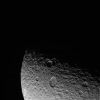
Rhea-N00026669.jpgRhea's craters (HD)57 visiteTralasciando l'intrinseca bellezza di questo frame - ottenuta grazie anche alla elevatissima definizione dell'immagine -, Vi suggeriamo di guardare con molta attenzione alcuni dei crateri inquadrati dalla telecamera posta a bordo di Cassini. Si tratta di un gruppo di 4 crateri, posti in posizione centrale ed in cui i tre maggiori sembrano formare un triangolo. Se non riuscite a notarli non importa: abbiamo predisposto il dettaglio nel prossimo frame.
Comunque sia, una volta che li avrete localizzati, espandete l'immagine sino al full-size e poi cercate di guardare "dentro" a questi crateri.
(6 voti)
|
|
Mimas-N00026522.jpgMimas: the Ring-Master59 visitenessun commento
(6 voti)
|
|
| 2244 immagini su 187 pagina(e) |
 |
|
|
|
|
43 | |
|
|
|
|





