| Piú votate - Saturn: the "Ringed Beauty" and His Moons |

Mimas-N00037684.jpgMimas, from approx. 63.000 Km67 visitenessun commento
(6 voti)
|
|

Mimas-N00037630.jpgMimas, from approx. 88.531Km58 visiteChe cosa significa tutto questo in relazione al Cratere Herschel? Significa che, dopo aver operato le prime - fondamentali - verifiche teoriche sulla validità di questo Modello (che abbiamo chiamato "Coefficiente PGF") in relazione a svariati crateri noti (Herschel incluso), è emerso che alcuni di essi, date le loro attuali dimensioni, semplicemente NON potrebbero esistere!
O meglio: la dimensione del cratere, rapportata alle dimensioni del Corpo Celeste al quale esso accede (un altro elemento che entra a far parte del coefficiente che esprime la valutazione globale delle variabili di impatto in relazione al corpo impattato), implicherebbe delle dimensioni del corpo impattante tali per cui, qualora un siffatto urto fosse realmente occorso, il corpo impattato NON avrebbe retto alla collisione.
Insomma: alcuni crateri - tipo Herchel e Stickney - NON POSSONO ESSERE DERIVATI DA UN IMPATTO.
E' evidente che il Coefficiente PGF necessita di probanti verifiche, ma è - almeno - un primo passo...
(6 voti)
|
|

Saturn-W00009483.jpgHow many moons around Saturn? (1) - frame W0000948358 visiteUna piccola sequenza fatta di 4 frames che ci mostra 2 delle (tante) lune in transito accanto - almeno dal punto di vista di Cassini - al "Signore degli Anelli".
A dire il vero si tratta di immagini difficili da interpretare, in quanto non solo sono leggermente "mosse", ma anche estremamente povere in termini di informazioni circostanziali. Non sappiamo, quindi, quali lune stiamo guardando (anche se la più grande e luminosa potrebbe essere Titano); ciò che sappiamo è che, ad un certo punto, gli oggetti luminosi ripresi da Cassini aumenteranno e cambieranno configurazione.
Guardate Voi stessi...
(6 voti)
|
|

Enceladus-N00036991.jpgEnceladus fly-by (7) - from approx. 54.000 Km58 visitenessun commento
(6 voti)
|
|

Prometheus-PIA07541.jpgPrometheus58 visiteCaption NASA originale:"Saturn's shepherd moon Prometheus hovers between the A and F-Rings as if suspended on an invisible thread, while bright clouds drift in Saturn's atmosphere approximately 130.000 Km(such as about 81.000 miles) beyond. It is noteworthy that such clouds are visible here in the shadows cast by the Rings.
The image was taken in visible light with the Cassini spacecraft narrow-angle camera on June 3, 2005, at a distance of approximately 2,1 MKM (1,3 MMs) from Saturn. The image scale is 13 Km (approx. 8 miles) per pixel. This view was processed to enhance fine details".
(6 voti)
|
|
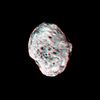
Hyperion-anagliph-PIA06244.jpgStereo-Hyperion! (from about 176.000 Km)59 visiteCaption NASA originale:"Saturn's moon Hyperion pops into view in this stereo anaglyph (or 3D view) created from Cassini images. Images taken from slightly different viewing angles allow construction of such stereo views, which are helpful in interpreting the moon's irregular shape.
Hyperion's unusual dimensions are 164 by 130 by 107 Km (such as 102 by 81 by 66 miles).
Craters are visible on the moon's surface down to the limit of resolution in this image, about 1 Km (0,6 mile) per pixel. The fresh appearance of most of these craters, combined with their high spatial density, makes Hyperion look something like a sponge. The moon's spongy-looking exterior is an interesting coincidence, as Hyperion's density seems to indicate that it is porous and much of its interior is filled with voids.
Dark material is concentrated in the bottoms of many craters visible here, perhaps resulting from the down slope movement of material, combined with sublimation of brighter ice".
(6 voti)
|
|

The Rings-PIA07512.jpgClose-up on the Rings!58 visiteCaption NASA originale:"This amazing close-up of Saturn's Rings reveals their incredible variety. In some regions there are wavelike structures, while in other places the Rings' structure appears to be more chaotic.
This image shows (from top to bottom) the A-Ring with the Encke gap, the Cassini Division, the B-Ring and the C-Ring.
The image was taken in visible light with the Cassini spacecraft narrow-angle camera on April 26, 2005, at a distance of approx. 2,3 MKM (such as 1,5 MMs) from Saturn. The image scale is 14 Km (approx. 8 miles) per pixel".
(6 voti)
|
|

Saturn&C.-PIA07510.jpgA "string" of Moons...61 visiteCaptionn NASA originale:"A string of three of Saturn's icy moons encircles the planet in this Cassini image.
Visible here are: Mimas, on near lower right; Janus just below the F-Ring and Enceladus on the lower left; the scene has been brightened to increase the moons' visibility.
The image was taken in visible light with the Cassini spacecraft wide-angle camera on April 25, 2005, at a distance of approx. 2,4 MKM (about 1,5 MMs) from Saturn. The image scale is 141 Km (approx. 87 miles) per pixel".
(6 voti)
|
|

Atlas-PIA06659.jpgAtlas: Ring-Master or Prisoner of the Rings?59 visiteCaption NASA originale:"Saturn's little moon Atlas orbits Saturn between the outer edge of the A-Ring and the fascinating, twisted, F-Ring. This image just barely resolves the disk of Atlas and also shows some of the knotted structure for which the F-Ring is known. Atlas is 32 Km (about 20 miles) across. The bright outer edge of the A-Ring is overexposed here, but farther down the image several bright ring features can be seen. The image was taken in visible light with the Cassini spacecraft narrow-angle camera on April 25, 2005, at a distance of approx. 2, 4 MKM (about 1,5 MMs) from Atlas and at a Sun-Atlas-Spacecraft, or phase, angle of 60°. Resolution in the original image was 14 Km (approx. 9 miles) per pixel".
(6 voti)
|
|

Radio-Saturn.jpgRadio waves and the size of the Rings' forming particles59 visiteQuali sono le dimensioni delle particelle che formano gli Anelli di Saturno? Per scoprirlo, Cassini ha trasmesso verso Terra una serie di onde radio (aventi lunghezze d'onda approssimative di 1, 3,5 e 13 cm) le quali, viaggiando verso di noi, hanno dovuto attraversare gli Anelli stessi. Ora, premesso che le particelle sensibilmente più grandi di un'onda 'riflettono' l'onda stessa, guardate la fotografia: essa è una ricostruzione digitale in falsi colori di Saturno e dei suoi Anelli "visti" dalle onde radio. Il color lilla indica regioni in cui le dimensioni medie delle particelle superano i 5 cm; il verde, invece, indica regioni in cui le loro dimensioni medie sono inferiori ad 1 cm. Il bianco - al centro dell'Anello B - ci dice che la densità di particelle, in quella regione, è troppo alta per consentire una adeguata definizione delle loro dimensioni. Infine, secondo stime fatte impiegando delle onde radio a banda molto larga, si è ipotizzato che in alcune regioni queste 'particelle' abbiano dimensioni di svariati metri.
(6 voti)
|
|

Enceladus-PIA06653.jpgPink Rings and Enceladus, in "natural colors"60 visiteCaption NASA originale:"Saturn's icy moon Enceladus hovers above Saturn's exquisite Rings in this color view from Cassini.
The Rings, made of nearly pure water ice, have also become somewhat contaminated by meteoritic dust during their history, which may span several hundred million years. Enceladus shares the Rings' nearly pure water ice composition, but appears to have eluded dust contamination through resurfacing processes that scientists are still trying to fully understand. Dust affects the Rings' color, while differences in brightness are attributable to varying particle sizes and concentrations. The images for this natural color view were taken with the Cassini spacecraft narrow-angle camera on April 5, 2005, at a distance of approximately 2,2 MKM (approx. 1,4 MMs) from Saturn through red, green and blue spectral filters. The image scale is 13 Km (about 8 miles) per pixel".
(6 voti)
|
|

Rhea-PIA06648.jpgWhite young crater on Rhea57 visiteCaption NASA originale:"Looking closely at Saturn's moon Rhea during a distant flyby, Cassini provides this view of what appears to be a bright, rayed and therefore relatively young crater. This crater was also observed by Cassini at much lower resolution in the fall of 2004 and in spring of 2005. For comparison, viewing the same crater near the terminator (the line between day and night) would highlight the crater's topography (vertical relief), compared to its brightness, which is highlighted in this view where the Sun is at a higher angle.
North on Rhea is up and rotated about 15° to the left. This view shows principally the leading hemisphere on Rhea".
Nota: guardate molto bene il bordo di Rhea e poi chiedeteVi se esso sembri di più il bordo di una 'sfera' o di uno 'sferoide'. Poi, se avete tempo e voglia, provate a rileggere i commenti del Prof. Hoagland sulla forma di Giapeto e sulle sue possibili cause ed implicazioni.
(6 voti)
|
|
| 2244 immagini su 187 pagina(e) |
 |
|
|
|
|
42 | |
|
|
|
|





