| Piú votate - Saturn: the "Ringed Beauty" and His Moons |

Dione-PIA07581.jpgThe "Old Face" of Dione58 visiteOriginal NASA caption"Dione's Southern Polar Region (as shown here) contains fractures whose softened appearance suggests that they have different ages than the bright braided fractures seen in the image to the North. This Region is also notably brighter than the near equatorial terrain at the top of the image. At center, several of the bright, radial streaks mark a feature named Cassandra, which may be a rayed crater or a tectonic feature.
This view of Dione (1118 Km across) captures high southern latitudes on the Moon's trailing hemisphere.
The image was taken in visible light with the Cassini spacecraft narrow-angle camera on Aug. 1, 2005, at a distance of approx. 269.000 Km(about 167.000 miles) from Dione and at a Sun-Dione-spacecraft, or phase, angle of 41°. Image scale is 2 Km (about 1,2 miles) per pixel".
(6 voti)
|
|
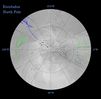
Enceladus-S-NP-PIA07721_modest.jpgEnceladus: Global Patterns of Fracture (Northern Polar Projection)57 visiteTerrain near the North Pole is among the most heavily cratered and oldest on the surface of Enceladus. The conspicuously fractured Southern Polar Region is nearly devoid of impact craters, making this terrain among the youngest on the Moon's surface.
A unique feature of the South Polar terrains is that broad networks of folded or kinked fractures can be found throughout the Region. A prominent "chain" of these fractures (marked in red in the South Polar Map) abruptly separates the youthful South Polar terrains from the older terrains that lie closer to the Equator and appears to encircle the South Pole near about 55° South Latitude.
The wavy boundary of the South Polar terrain is interrupted in numerous places by Y-shaped, or funnel-shaped, discontinuities that curve and taper northward. Well-developed examples of the funnel-shaped discontinuities appear to transition to systems of North-South trending surface cracks (marked in blue).
These north-south trending cracks are best explained as if they formed in response to tension stresses that are parallel to lines of latitude. Such extensional "hoop stresses" would be expected to develop if the equator became wider, perhaps in response to a change in the moon¿s spin rate.
Globally systematic patterns of fracture on Enceladus occur in ancient, cratered terrain as well as youthful terrain. Shown in green on the maps -- and particularly apparent in the northern hemisphere projection -- are roughly orthogonal (or perpendicular) systems of north-south and east-west trending fractures that formed quite close to the tidal axis of Enceladus. The moon¿s tidal axis is a line extending from 0-degrees longitude to 180-degrees longitude. Such orthogonal fractures might have formed in response to tidal stresses exerted on Enceladus by Saturn.
(6 voti)
|
|

Enceladus-Model0-PIA03553.jpgWater Vapor & Particles Over Enceladus54 visiteThis plot shows results from Cassini's Ion Neutral Mass Spectrometer (INMS) and Cosmic Dust Analyzer (CDA), obtained during the spacecraft's close approach to Enceladus on July 14, 2005. Within a minute of that closest approach, the 2 instruments detected material coming from the surface of the Moon. The INMS measured a large peak in the abundance of water vapor at approx. 35" before closest approach to Enceladus, as it flew over the South Polar Region at an altitude of 270 Km. The high rate detector of the CDA observed a peak in the number of fine, powder-sized icy particles coming from the surface approx. 1' before reaching closest approach, at an altitude of 460 Km. The character of these detections is very similar to the venting of vapor and fine, icy particles from the surfaces of comets when they are warmed as they near the Sun. On Enceladus, it is believed that internal heat, possibly from tidal forces, is responsible for the activity. The close but different occurrences of the two detections are yielding important clues to the location of the vents and even the venting process.
(6 voti)
|
|
Saturn-PIA07569.jpgThe Kingdom of Beauty60 visiteAbbiamo da tempo notato che le immagini di Saturno (e/o di Giove) e dei loro Sistemi non sembrano interessare i Lettori. Non è solo il counter che esprime "quante volte" un frame è stato aperto che parla e ci racconta, bensì anche gli altri indici statistici che ci informano su quanti Visitatori sono entrati in ciascuna Sezione o sub-Sezione del Sito. Ebbene, quando verifichiamo questi dati per le sub-Sezioni dedicate a Giove e Saturno, la delusione è grande. Forse la colpa è nostra, ci siamo detti, perchè non riusciamo a rendere 'accattivante' il Regno dei Giganti Gassosi...O forse la colpa, se di colpa si può parlare, è dei media i quali, spesso e volentieri, parlano - anche a vanvera - di Marte e/o della Luna, ma molto raramente (2/3 volte l'anno) accennano a Saturno (e Titano). Giove, ormai, è solo un ricordo.
La verità, secondo noi, è che su Marte i media si sono sbizzarriti così tanto che viene quasi naturale interessarsi solo al Pianeta Rosso...Ma attenti: il Futuro, è ben oltre le sabbie di Cydonia!
(6 voti)
|
|

Mimas Map-PIA06255.jpgMimas' Map55 visiteOriginal caption:"This map of the surface of Saturn's moon Mimas illustrates the Regions that were imaged by Cassini during the spacecraft's flyby of the moon on Aug. 2, 2005. At closest approach, the spacecraft passed within approx. 62.900 Km above the Moon's surface. The colored lines delineate the Regions that were imaged at differing resolutions. The closest images were obtained near closest approach. Mimas has never been imaged this closely before. The flyby provided the best views yet of the South Pole of Mimas and some of its northern latitudes, as well as distant views of the giant crater Herschel, near the terminator.
The highest resolution images show the trailing hemisphere of Mimas, opposite Herschel. Several fracture systems have been seen in the region in NASA Voyager images, like Pelion Chasma and Tintagil Chasma. Images obtained from this Cassini encounter may help test whether these canyons and others on Mimas' surface, are related to the formation of Herschel (...)".
(6 voti)
|
|

Epimetheus-PIA07567.jpgEpimetheus, from approx. 87.000 Km54 visiteCaption originale:"From 34° above Saturn's equatorial plane, Cassini gazed down at Saturn's moon Epimetheus. The region seen here includes territory farther North and East than that imaged in March 2005 (PIA06226).
The two largest craters visible here are the only officially named features on Epimetheus. The crater at the left (at about the 9 o'clock position) is named Pollux; the crater at lower left (containing a string of several smaller craters) is called Hilairea. Epimetheus is 116 Km (about 72 miles) across. The image was taken in visible light with the Cassini spacecraft narrow-angle camera on July 14, 2005, at a distance of approx. 87.000 Km (about 54.000 miles) from Epimetheus and at a phase angle of 95°. The image scale is 520 mt (approx. 1710 feet) per pixel".
(6 voti)
|
|

Saturn-PIA07568.jpgThe "dusty" D-Ring of Saturn58 visiteOriginal caption:"This close-up view is Cassini's best look yet at Saturn's tenuous innermost D-Ring. The narrow ringlet visible here is named D68 and is the innermost discrete feature in the D-Ring.
This image also clearly shows how the diffuse component of the D-Ring tapers off as it approaches the Planet.
The view is looking down on the dark side of the Rings, with the Planet's lower half being illuminated by reflected light from the Rings. The upper half of the Planet is also dark. The image was taken at a high phase angle - such as the Sun-Saturn-spacecraft angle - such as 177°. Viewing the Rings at high phase angle makes the finest dusty particles visible.
The inner edge of the C-Ring enters the scene at the lower left and Saturn's shadow cuts off the view of the Rings. Several background stars can also be seen here.
The image was taken in visible light with the Cassini spacecraft wide-angle camera on July 15, 2005, at a distance of approx. 293.000 Km from Saturn".
(6 voti)
|
|

Hyperion-N00038106.jpgHyperion, from about 868.000 Km58 visiteUn'immagine molto bella e che ci spinge a considerare molto seriamente l'ipotesi che la Luna conosciuta come "Hyperion" non sia altro che una cometa mancata, ovvero un astro composto prevalentemente da ghiaccio d'acqua, il cui cammino verso il Sole venne interrotto (repentinamente e per sempre) dall'abbraccio gravitazionale di Saturno. A proposito: se osservate Hyperion con una certa attenzione, dovreste notare una certa (e forte) somiglianza con un altro corpo celeste "vagante", recentemente salito agli onori delle Cronache Spaziali.
Quale?
(6 voti)
|
|

Mimas-PIA06412.jpgMimas and the Rings54 visiteCaption NASA originale:"During its close flyby of Saturn's moon Mimas on Aug. 2, 2005, Cassini caught a glimpse of Mimas against the broad expanse of Saturn's Rings. The Keeler Gap in the outer A-Ring, in which Cassini spied a never-before-seen small moon, is at the upper right.
The ancient, almost asteroid-like surface of Mimas is evident in its crater-upon-crater appearance. Even the material which has slumped down into the bottom of some of its craters bears the marks of later impacts.
This image was taken through the clear filter of the Cassini spacecraft narrow-angle camera at a distance of 68.000 Km (about 42.500 miles) from Mimas and very near closest approach. The smallest features seen on the moon are about 400 mt wide (approx. 440 yards); the Sun-Mimas-Cassini angle is 44°".
(6 voti)
|
|

Mimas-PIA06259.jpgMimas: surface geology through "false colors" (Herschel Crater)54 visiteHerschel Crater, a 140-Km-wide (about 88 miles) impact feature with a prominent central peak, is visible in the upper right of each image. The unusual bluer materials are seen to broadly surround Herschel Crater. However, the bluer material is not uniformly distributed in and around the Crater. Instead, it appears to be concentrated on the outside of the Crater and more to the West than to the North or South.
The origin of the color differences is not yet understood. It may represent ejecta material that was excavated from inside Mimas when the Herschel impact occurred.
The bluer color of these materials may be caused by subtle differences in the surface composition or the sizes of grains making up the icy soil.
The images were obtained when the Cassini spacecraft was above 25°South, 134° West latitude and longitude.
The Sun-Mimas-spacecraft angle was 45° and North is at the top.
(6 voti)
|
|

Tethys-N00037660.jpgCrescent Tethys57 visiteUn'immagine di Tethys, ripresa da una distanza di circa 840.000 Km, che ci mostra, alla luce di un Sole lontano, solo una sottilissima falce della sua rocciosa superficie.
Ben visibile, comunque - poichè illuminata dalla luce di Saturno - la parte di Tethys immersa nella notte.
A ridosso della Linea del Terminatore, due grandi crateri che, simili a degli occhi, sembrano scrutare le profondità del cielo.
(6 voti)
|
|

Mimas-N00037785.jpgMimas, from approx. 62.000 Km57 visitenessun commento
(6 voti)
|
|
| 2244 immagini su 187 pagina(e) |
 |
|
|
|
|
41 | |
|
|
|
|





