| Piú votate - Saturn: the "Ringed Beauty" and His Moons |
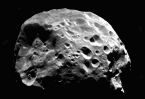
Phoebe.jpgPhoebe (Original NASA/JPL/ASU b/w Image-Mosaic)58 visiteWas Saturn's moon Phoebe once a comet? Images from the Cassini spacecraft taken two years ago (early 2004) when entering the neighborhood of Saturn, indicate that Phoebe may have originated in the outer Solar System.
Phoebe's irregular surface, retrograde orbit, unusually dark surface, assortment of large and small craters, and low average density appear consistent with the hypothesis that Phoebe was once part of the Kuiper Belt of icy comets beyond Neptune before being captured by Saturn. Visible in the above image of Phoebe are craters, streaks, and layered deposits of light and dark material. The image was taken from around 30.000 Km out from this 200-Km diameter moon.
Two weeks after taking the above image, Cassini fired its engines to decelerate into orbit around Saturn. 
(6 voti)
|
|

Janus&Epimetheus-PIA07699.jpgHigh-Phase in the Darkness: Janus and Epimetheus59 visiteThis close pairing of Janus and Epimetheus shows the 2 moons at "high phase," meaning that only a thin sliver of sunlit terrain is visible on each moon. Portions of each are also lit feebly by reflected light from Saturn.
Janus (181 Km, or about 113 miles across) is at top and Epimetheus (116 Km, or about 72 miles across) is below.
The image was taken in visible light with the Cassini spacecraft narrow-angle camera on Dec. 25, 2005, at a distance of approx. 479.000 Km(roughly 298.000 miles) from Janus and about 455,000 Km (roughly 283.000 miles) from Epimetheus. The image scale is about 3 Km (approx 2 miles) per pixel on both moons.
(6 voti)
|
|

Enceladus-PIA07694.jpgThe "Young Face" of Enceladus57 visiteOriginal caption:"For Enceladus, wrinkles mean the opposite of old age. This view of a crescent Enceladus shows a transition zone between a wrinkled and presumably younger Region of terrain and an older, more heavily cratered Region. The moon's geologically active Southern Polar Region is seen on the left.
The lit terrain shown here is on the side of Enceladus that faces away from Saturn.
The image was taken in visible light with the Cassini spacecraft narrow-angle camera on Dec. 24, 2005 at a distance of approx. 108.000 Km (such as about 67.000 miles) from Enceladus, at a Sun-Enceladus-spacecraft angle of 102°.
Image scale is roughly 646 mt (about 2.118 feet) per pixel".
(6 voti)
|
|

Enceladus&Tethys-PIA07664.jpgBrothers in the Night57 visiteThe Cassini spacecraft captures this dual portrait of an apparently dead moon and one that is very much alive. Tethys, in the foreground, shows no signs of recent geologic activity. Enceladus, instead, is covered in fractures and faults - near its South Pole in particular - and spews icy particles into space from active vents. Tethys' giant crater Odysseus lurks in the dark just west of the terminator. North on the moons is up.
The image was taken in visible light with the Cassini spacecraft narrow-angle camera on Nov. 29, 2005 at a distance of app.x 970.000 Km (roughly 600.000 miles) from Tethys and at a Sun-Tethys-spacecraft angle of 122°. Cassini was then 1,1 MKM (700.000 miles) from Enceladus. Image scale is about 6 Km per pixel on Tethys (at left) and 7 Km per pixel on Enceladus (at right).
(6 voti)
|
|

Tethys-N00047239.jpgTethys' "Eye"!55 visiteOriginal caption:"N00047239.jpg was taken on December 24, 2005 and received on Earth December 25, 2005. The camera was pointing toward TETHYS that, at the time, was approximately 196.167 kilometers away, and the image was taken using the CL1 and GRN filters".
(6 voti)
|
|

Janus-N00047285.jpgThe "Runners": Janus and Epimetheus (3)56 visiteOriginal caption:"N00047285.jpg was taken on December 25, 2005 and received on Earth December 26, 2005. The camera was pointing toward Epimetheus (and Janus) that, at the time, was approximately 459.714 Km away. The image was taken using the CL1 and CL2 filters".
(6 voti)
|
|

Janus-N00047282.jpgThe "Runners": Janus and Epimetheus (2)57 visiteOriginal caption:"N00047282.jpg was taken on December 25, 2005 and received on Earth December 26, 2005.
The camera was pointing toward Epimetheus (and Janus) that, at the time, was approx. 456.101 Km away. The image was taken using the CL1 and CL2 filters".
(6 voti)
|
|

Hyperion-N00047056.jpgHyperion? (2)60 visiteOriginal caption:"N00047056.jpg was taken on December 23, 2005 and received on Earth December 23, 2005. The camera was pointing toward HYPERION that, at the time, was approximately 235.195 Km away.
The image was taken using the CL1 and CL2 filters".
(6 voti)
|
|

Janus-N00047102.jpgJanus and...?59 visiteOriginal caption:"N00047102.jpg was taken on December 23, 2005 and received on Earth December 23, 2005. The camera was pointing toward JANUS that, at the time, was approximately 1.111.348 Km away.
The image was taken using the CL1 and CL2 filters".
(6 voti)
|
|

Prometheus-PIA07653.jpgThe Runners in the Ring: Prometheus and Pandora64 visiteThis spectacular image shows Prometheus (at left) and Pandora (at right), with their flock of icy ring particles (the F-Ring) between them. Pandora is exterior to the Ring, and closer to the spacecraft here. Each of the shepherd satellites has an unusual shape, with a few craters clearly visible.
The effect of Prometheus (about 102 Km across) on the F-Ring is visible as it pulls material out of the Ring when it is farthest from Saturn in its orbit. Pandora is about 84 Km across.
The image was taken in polarized green light with the Cassini spacecraft narrow-angle camera on Oct. 29, 2005, at a distance of approx. 459.000 Km (about 285.000 miles) from Pandora and 483.500 Km (roughly 300.500 miles) from Prometheus. The image scale is 3 Km (about 2 miles) per pixel on Pandora and 3 Km (idem) per pixel on Prometheus. The view was acquired from about 1/3 of 1° below the Ring-Plane.
(6 voti)
|
|

Rhea and Dione-PIA07649.jpgSpheres...57 visiteOriginal caption:"Saturn's sibling moons, Rhea and Dione, pose for the Cassini spacecraft in this view.
Even at this distance, it is easy to see that Dione (below) appears to have been geologically active in the more recent past, compared to Rhea.
Dione's smoother surface and linear depressions mark a contrast with Rhea's cratered terrain.
Sunlit terrain seen on Rhea (1.528 Km, or 949 miles across) is on the moon's Saturn-Facing Hemisphere. Lit terrain on Dione (1.126 Km, or 700 miles across) is on that moon's Leading Hemisphere. North is up.
The image was taken in visible light with the Cassini spacecraft narrow-angle camera on Nov. 1, 2005, at a distance of approx. 1,8 MKM (about 1,1 MMs) from Rhea and 1,2 MKM (approx. 800.000 miles) from Dione. The image scale is 11 Km (about 7 miles) per pixel on Rhea and 7 Km (about 4 miles) per pixel on Dione".
(6 voti)
|
|

Hyperion-PIA07768.jpg"Meri Crater"58 visiteSaturn's moon Hyperion's crater, Meri, blooms in this extreme color-enhanced view. Meri is overprinted by a couple of smaller craters and displays dark material on its floor that is characteristic of many impact sites on this moon. The walls of craters seen here are noticeably smoother on their sloping sides than around their craggy rims.
To create this false-color view, ultraviolet, green and infrared images were combined into a single black and white picture that isolates and maps regional color differences. This "color map" was then superimposed over a clear-filter image. The combination of color map and brightness image shows how the colors vary across the moon's surface in relation to geologic features.
The origin of the color differences is not yet understood, but may be caused by subtle differences in the surface composition or the sizes of grains making up the icy soil. The images used to create this false-color view were acquired on 09-26-2005, at a mean distance of 17.900 Km from Hyperion. Image scale is about 110 meters (360 feet) per pixel.
(6 voti)
|
|
| 2244 immagini su 187 pagina(e) |
 |
|
|
|
|
38 | |
|
|
|
|





