| |

| Piú votate - Saturn: the "Ringed Beauty" and His Moons |
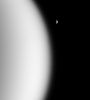
Rhea and Titan-PIA08204-br500.jpgOff the "smog"...66 visiteDuring a recent flyby of Titan, the Cassini spacecraft looked beyond the utterly overcast moon and spied clear, distant Rhea in the blackness.
Titan (5,150 kilometers, or 3,200 miles across) is two-and-a-half times smaller than Earth and much less massive. This circumstance causes its atmosphere to extend to much higher altitudes above the surface than does Earth's. The Cassini spacecraft is unable to fly much closer than about 1000 kilometers (600 miles) above Titan's surface -- much closer, and the spacecraft would experience excessive torques from the atmosphere that could interfere with its ability to track the target. By contrast, the International Space Station orbits Earth at an altitude of about 350 kilometers (220 miles).
The bright, fresh crater on Rhea (1,528 kilometers, or 949 miles across) appears near the center of the moon's crescent.
The image was taken in visible-light with the Cassini spacecraft wide-angle camera on May 20, 2006, at a distance of approximately 53,000 kilometers (33,000 miles) from Titan and 873,000 kilometers (543,000 miles) from Rhea. Image scale is 320 meters (1,050 feet) per pixel on Titan and 5 kilometers (3 miles) per pixel on Rhea.

(6 voti)
|
|

Enceladus-PIA08500.jpgWhat's inside Enceladus?62 visiteCaption originale:"This graphic illustrates the interior of Saturn's moon Enceladus. It shows warm, low-density material rising to the surface from within, in its icy shell (yellow) and/or its rocky core (red). A NASA-funded study says Enceladus might have rolled or rotated itself to place this area of low density at the south pole. This finding is in the June 1, 2006, issue of the journal Nature.
This graphic uses parts of visible-light images taken by the Cassini spacecraft camera that have been modified for the purpose of showing the interior structure. Cassini's cameras captured a giant plume blasting icy particles into space".
(6 voti)
|
|

Propellers-002-PIA07790.jpgThe "Propellers" of the Rings (3) - HR55 visiteThe Propellers are about 5 Km (approx. 3 miles) long from tip to tip, and the radial offset (the "leading" dash is slightly closer to Saturn) is about 300 mt (about 1000 feet).
The Propellers structures are unchanged as they orbit around Saturn.
In that way, they are much like the wave pattern that trails after a speedboat as it skims across a smooth lake. Such a pattern is hard to discern in a choppy sea (---> mare increspato). In much the same way, scientists think other effects may be preventing Cassini from seeing the Propellers except in very bland parts of the Rings.
(6 voti)
|
|

Propellers-001-PIA07792.jpgThe "Propellers" of the Rings (2) - HR55 visiteThis image is a closer view of the A-Ring, showing the radial locations where "Propeller Features" were spotted. The view is approx. 1.800 Km across (such as about 1.100 miles), from top to bottom, and includes a large density wave at the bottom (caused by the moons Janus and Epimetheus), as well as two smaller density waves.
The footprints of the Propellers are between density waves, in bland, quiescent regions of the Ring.
The Propellers appear as double dashes in the two close-up discovery images and they have been circled. The unseen moonlets, each roughly the size of a football field, lie in the center of each structure. These two images were taken during Saturn orbit insertion on July 1, 2004, and are presented here at one-half scale. Resolution in the original images was 52 mt (about 171 feet) per pixel.
The horizontal lines in the image represent electronic noise and do not correspond to any actual Ring features.
(6 voti)
|
|
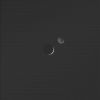
Rhea&Dione-N00056088.jpgIn-transit: Dione and Rhea (2)55 visiteSembra strano, ma dopo aver recuperato tutti i frames disponibili del transito Rhea-Dione, la nostra sensazione - dopo aver ricostruito il filmato dell'eclissi - è che ci sia, ad un certo punto (tra i frames 56091 e 56093) un leggero, ma netto, movimento di Cassini il quale sembra suggerire un repentino cambio di rotta della Sonda ed una conseguente modifica - anch'essa leggera, ma ben visibile - della prospettiva. Può anche darsi, tuttavia, che l'effetto "cambio di rotta" possa anche essere derivato dalla combinazione nel movimento dei tre vettori coinvolti (Rhea, Dione e Cassini).
Provate a verificare Voi stessi: i frames disponibili li abbiamo pubblicati tutti.
(6 voti)
|
|

Enceladus-N00055966.jpgThe "Fountain" of Enceladus (from 1,8 MKM!)58 visiteDel super-geyser di Encelado, se verificate andando a ritroso, sino a pochissimo tempo fa (giusto qualche mese) nessuno si era mai accorto – anche se di immagini ne erano già arrivate tante...Ora, come testimonia questo bel frame, la “Fontana” che sprizza cristalli d’acqua, polveri e fango si vede anche da considerevoli distanze. Come mai?
Si tratta di una fotografia ottenuta in condizioni di particolare favore, oppure questo fenomeno – che si supponeva debole e transitorio – si sta invece rinforzando nel tempo, acquisendo dimensioni sempre più spettacolari?
E se così fosse, a che cosa dovremmo far risalire questa “eruzione”?
Encelado è un mondo geologicamente attivo?
La Luna di Neve e Ghiaccio – così Encelado è stato battezzato dalla NASA – si sta sciogliendo in maniera eclatante?
O forse, anche in questo caso, l’eruzione – la quale era sfuggita al Voyager, negli Anni ’80, solo perché, forse...non c’era! – è una conseguenza (almeno parziale) della rinvigorita attività solare degli ultimi anni?
(6 voti)
|
|

Janus&Titan-N00055802.jpgPassing-by... (3)56 visiteData:"N00055802.jpg was taken on March 21, 2006 and received on Earth March 22, 2006. The camera was pointing toward janus that, at the time, was approximately 723.396 Km away.
The image was taken using the CL1 and CL2 filters".
(6 voti)
|
|
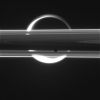
Janus&Titan-N00055798.jpgPassing-by... (2)57 visiteData:"N00055798.jpg was taken on March 21, 2006 and received on Earth March 22, 2006. The camera was pointing toward Janus that, at the time, was approximately 724.179 Km away.
The image was taken using the CL1 and CL2 filters".
Nota: la distanza fra Cassini e Titano, in questo frame - così come nel precedente e nel successivo - dovrebbe essere compresa fra i 2,2 ed i 2,4 MKM.
(6 voti)
|
|

Rhea-W00014318.jpgSliding in the Darkness... (3)57 visitenessun commento
(6 voti)
|
|

Enceladus-PIA07800f-2.jpgEnceladus (3) - detail mgnf and HR98 visiteEncelado è dunque "vivo e vegeto" e, dalla sua gelida superficie, in area Sud Polare, ciclopici geysers spruzzano (ma lo fanno continuativamente o di quando in quando?) fango, vapore e cristalli di ghiaccio d'acqua verso lo spazio che circonda questa piccola Luna.
Alla NASA, come potete vedere nel Modello "Cold Geyser", sono convinti che queste "fontane" trovino la loro origine in un sottosuolo NON attivo - in senso geologico - ma "caldo" (per motivi ancora da chiarire), il quale agirebbe come una sorta di "miccia" (o iniettore) su grandi sacche d'acqua (le cosiddette water pockets, contenenti acqua allo stato liquido, a circa 0°C, ed in pressione) le quali, una volta giunte ad ebollizione, spingono fanghi, cristalli d’acqua e vapore acqueo attraverso degli stretti condotti (vents) che, dalle profondità del pianeta, arrivano sino alla superficie (posta sul fondo delle Tiger Stripes) e quindi si aprono verso lo spazio circum-enceladiano, consentendo lo sfogo di quanto emerso e mantenendo l’intero sistema in un sostanziale equilibrio.
Ora, anche ammettendo che questo modello esplicativo delle "Fontane di Encelado" abbia una qualche attendibilità e sostanza, ci domandiamo: dato che Encelado è una luna molto piccola e che le sue "riserve d'acqua" (water-pockets) devono essere – logicamente – molto piccole, non è irragionevole supporre che tali geysers abbiano una vita – tutto sommato – molto breve e che, una volta finita l'acqua, finirà anche il fenomeno delle fontane di fango, ghiaccio e vapore. La logica direbbe questo.
Tuttavia, a quanto si deduce osservando la superficie di Encelado (la quale sembra proprio "fresca e giovane") dobbiamo invece supporre che un siffatto fenomeno stia andando avanti da ere.
Deduzioni (e domande): allora l'acqua delle water-pockets di Encelado si riforma, nel tempo?
E, se si (come la logica ci farebbe supporre), quest'acqua da dove viene?
Forse l’intero Encelado si sta “sciogliendo”, precipitando i ghiacci di superficie nel sottosuolo dove vengono scaldati, quindi liquefatti ed infine “sparati” nello spazio?
Oppure i geysers di Encelado si sono attivati "recentemente", ed è solo per questo che essi stanno vivendo questa stagione di splendore?
E se la risposta a questo ultimo quesito fosse "si", che cosa avrebbe innescato il riscaldamento delle viscere del pianeta?
Forse un'attività solare anomala e particolarmente intensa (la stessa che, secondo alcuni, sta aiutando Marte a scaldarsi)?
O magari la causa del fenomeno è nelle ondate di radiazioni che arrivano costantemente da Saturno?
I Giganti Gassosi, in fondo, in qualità di “stelline mancate”, non potrebbero operare come “riscaldatori” dei minuscoli corpi che li circondano?
Non è in fondo questa la costruzione che ha fatto pensarea molti Scienziati e Ricercatori – sin dagli Anni ’80 – che alcune Lune Gioviane potrebbero essere “mantenute in vita” proprio dall’energia termica (e non solo) che gli perviene dal loro Pianeta-Genitore e non certo dal Sole (troppo lontano)?
Conclusione: creare “modelli” interpretativi dei fenomeni anomali è, come avete notato, relativamente semplice. Analizzare le implicazioni proprie di ciascun modello, invece, non lo è affatto.
Noi, in fondo, possiamo anche permetterci, di tanto in tanto, di “inventarci un modello” e di proporlo (anche se non siamo scienziati, abbiamo comunque una testa e qualche capacità di ragionamento logico); ma quando ci accorgiamo che i nostri modelli, in fondo, hanno le stesse (purtroppo deboli e fortemente speculative) basi dei modelli NASA...Allora un pizzico di perplessità ci coglie.
Non credete?!?
(6 voti)
|
|

Enceladus-PIA07800-br500.jpgEnceladus (1)58 visiteA masterpiece of deep time and wrenching gravity, the tortured surface of Saturn's moon Enceladus and its fascinating ongoing geologic activity tell the story of the ancient and present struggles of one tiny world. This is a story that is recounted by imaging scientists in a paper published in the journal Science on March 10, 2006.
The enhanced color view of Enceladus seen here is largely of the Southern Hemisphere and includes the South Polar terrain at the bottom of the image.
Ancient craters remain somewhat pristine in some locales, but have clearly relaxed in others. Northward-trending fractures, likely caused by a change in the moon's rate of rotation and the consequent flattening of the moon's shape, rip across the southern hemisphere. The South Polar terrain is marked by a striking set of 'blue' fractures and encircled by a conspicuous and continuous chain of folds and ridges, testament to the forces within Enceladus that have yet to be silenced.
(6 voti)
|
|

Saturn-PIA08130.jpgIs that a "Vertical Relief"?!?76 visiteOccasional views like this one, showing "vertical relief" in Saturn's cloud tops, help the streamers and swirls of gas seem more like a three dimensional structure than a smooth surface. As on Saturn's solid moons, vertical relief is easiest to view near the Terminator, and makes visible the shading of deeper cloud tops by high altitude bands.
The image was taken in visible light with the Cassini spacecraft narrow-angle camera on Jan. 23, 2006, at a distance of approx. 2.7 MKM (about 1,7 MMs) from Saturn. Resolution in the original image was 16 Km (about 10 miles) per pixel. The image has been magnified by a factor of two and contrast-enhanced to aid visibility.
(6 voti)
|
|
| 2244 immagini su 187 pagina(e) |
|
|
|
|
|
37 | |
|
|
|
|
|
|





