| Piú votate - Saturn: the "Ringed Beauty" and His Moons |
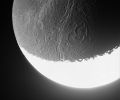
Dione-PIA08266.jpgThe Night-Side of Dione, in the Saturnshine58 visiteCaption NASA originale:"Cassini whizzed past Dione on Aug. 16, 2006, capturing this slightly motion-blurred view of the moon's fractured and broken landscape in reflected light from Saturn. The motion blur is a result of the long exposure time used to capture dim light from the moon's night side.
The many canyons on Dione rip through more ancient craters. Some medium-sized craters, like the one right of center, have several others overprinted onto them. This view shows southern terrain on the moon's Trailing Hemisphere. The gleaming, sunlit crescent is overexposed at bottom. North is up.
The image was taken in visible light with the Cassini spacecraft narrow-angle camera at a distance of approx. 157.000 Km (about 98.000 miles) from Dione and at a Sun-Dione-spacecraft angle of 129°.
Image scale is about 935 mt (roughly 3.067 feet) per pixel".
(6 voti)
|
|

Streak-N00065622-3.jpgWhat is that? (detail mgnf n. 2)75 visiteAl "cambio di direzione" n. 2 - il più netto - si intravede una leggera "nebbia", come se l'oggetto stesse perdendo materiale. Questo comportamento è coerente con l'ipotesi del "bolide", ma l'ipotesi di un bolide che si "incendi" nel vuoto è, in sè, insostenibile.
Purtroppo.
(6 voti)
|
|

Rhea-N00064852-B.jpgMoments of Rhea (7) - Squared Crater and anomalous "slope" (detail mgnf)57 visitenessun commento
(6 voti)
|
|

Rhea-N00064832-B.jpgMoments of Rhea (6) - Rhea's "Peak" (detail mgnf)58 visiteRicordate il "picco" (o la "Grande Montagna") di Oberon (Sez. "Uranus and His Moons")? Rilievi simili, per corpi celesti simili...
(6 voti)
|
|

Rhea-N00064832-A.jpgMoments of Rhea (6) - Rhea's "Peak" (context image)58 visiteRiuscite a vederlo?!?...
(6 voti)
|
|

Rhea-N00064809.jpgMoments of Rhea (3)58 visitenessun commento
(6 voti)
|
|

Rhea-N00064799-B.jpgMoments of Rhea (1) - detail mgnf: Squared Crater57 visiteUn dettaglio molto bello di uno dei rilievi superficiali più inriganti di questa Luna Saturniana: si tratta di un cratere dalla forma curiosa il quale pare presentare, sul suo versante Est (Dx dell'Osservatore), un'evidente Anomalìa di Superficie costituita da una sorta di "quadrangolo grigio" il quale ricopre nettamente un'ampia porzione della sua parete interna (la quale, come si vede bene, è di colore chiaro e ben illuminata, tranne che nella zona che abbiamo cerchiato in nero).
Che cosa può essere successo? Che cosa ha "oscurato" una porzione del versante Est del cratere? L'ipotesi della "valanga di polveri", e ce ne rendiamo conto, è "leggera" e discutibile; più plausibilmente si potrebbe trattare di un visio dell'immagine o di una manipolazione digitale. In ogni caso, ecco un nuovo "mistero" da valutare ed approfondire...
(6 voti)
|
|

Rings-PIA08241.jpgDifferent Light, Different Brightness, Different Motion...68 visiteCaption NASA:"This close-up view of the inner A-Ring shows intriguing variations in brightness along the direction of the Ring motion - from top to bottom. Close examination reveals dark regions that appear to widen and then narrow, and thin bright regions that disappear altogether.
Variations in brightness are to be expected in the direction of increasing orbital distance from Saturn, but variations along the azimuthal (or circumferential) direction are unusual, as they should be smoothed out quickly by ring particle motion.
Note: the faint "doughnut" left of center and the dark area in the lower right corner are imaging artifacts.
The image was taken in visible light with the Cassini spacecraft narrow-angle camera on July 23, 2006 at a distance of approx. 285.000 Km (about 177.000 miles) from Saturn. Image scale is about 1 Km (0,6 mile) per pixel".
(6 voti)
|
|
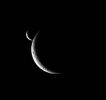
Rhea & Enceladus-PIA08237.jpgAfter the occultation...57 visiteCaption NASA originale:"Two slim crescents smile toward the Cassini spacecraft following an occultation event.
Taken only 5 minutes after Enceladus first approached the limb of Rhea, this view shows the bright little moon emerging from behind the larger moon's crescent.
The image was taken in visible light with the Cassini spacecraft narrow-angle camera on July 4, 2006 at a distance of approx. 1,4 MKM (about 800.000 miles) from Rhea and approx. 1,9 MKM (about 1,2 MMs) from Enceladus. The view was obtained at a Sun-moon-spacecraft, or phase, angle of about 142° relative to both moons.
Image scale is about 8 Km (5 miles) per pixel on Rhea and approx. 11 Km (about 7 miles) on Enceladus".
(6 voti)
|
|

Sky-N00064410.jpgThe "Big Streak" is just a "bad picture"?56 visiteCaption NASA originale:"N00064410.jpg was taken on July 26, 2006 and received on Earth July 26, 2006. The camera was pointing toward Saturn's E-Ring that, at the time, was approximately 1,4 MKM away.
The image was taken using the CL1 and CL2 filters.
This image has not been validated or calibrated".
Nota: non ci sembra che la fotocamera di Cassini stesse inquadrando il debole Anello "E" di Saturno. Questo frame, a nostro avviso, è il prodotto di uno scatto casuale ed effettuato impiegando parametri errati i quali si sono risolti in una immagine mossa (come le "strisce ondulate" - che riteniamo essere stelle - dimostrano ampiamente) e, di fatto, impossibile da spiegare.
L'inclinazione del notevole streak di luce bianca (Big Streak) visibile ad ore 9 del frame - un'inclinazione incongrua rispetto a quella degli streaks lasciati dalle altre stelle riprse - ci dimostra che questo "Big Streak" non dovrebbe essere dipeso dal fatto di Cassini (che scatta mentre si muove in maniera repentina), bensì dal SUO (autonomo) movimento RISPETTO a Cassini.
Gli altri puntini che costellano l'immagine sono dei photoartifacts (noise).
(6 voti)
|
|

Rhea-N00063470.jpgVoyagers... (2)58 visiteCaption originale:"N00063470.jpg was taken on July 04, 2006 and received on Earth July 04, 2006. The camera was pointing toward Rhea that, at the time, was approximately 1.360.001 Km away. The image was taken using the CL1 and CL2 filters".
(6 voti)
|
|

Janus and Enceladus-PIA08207.jpgJanus and Enceladus58 visiteCaption originale:"Wrinkled and cracked Enceladus hangs in the distance as the pitted ring moon Janus, at right, rounds the outer edge of the F-Ring. Enceladus is remarkable for its actively venting South Polar Region, while Janus is known for its orbital swap with the moon Epimetheus. The bright core of the F-Ring is perhaps 50 Km wide and contains numerous clumps and kinks.
Dimmer, flanking ringlets on either side of the core wind into a tight spiral structure, discovered in Cassini images.
The image was taken in visible light with the Cassini spacecraft narrow-angle camera on May 21, 2006, at a distance of approx. 565.000 Km (such as about 351.000 miles) from Janus; 702.000 Km (about 436.000 miles) from Enceladus and 530.000 Km (approx. 329.000 miles) from Saturn.
Image scale is roughly 3 Km (about 2 miles) per pixel on Janus and approx. 4 Km (a little more than 2 miles) per pixel on Enceladus".
(6 voti)
|
|
| 2244 immagini su 187 pagina(e) |
 |
|
|
|
|
36 | |
|
|
|
|





