| Piú votate - Saturn: the "Ringed Beauty" and His Moons |

Saturn-PIA08361.jpgThe Ring-World in natural colors57 visiteCaption NASA:"Our robotic emissary, flying high above Saturn, captured this view of an alien copper-colored Ring-World. The overexposed planet has deliberately been removed to show the unlit Rings alone, seen from an elevation of 60°, the highest Cassini has yet attained.
The view is a mosaic of 27 images -- nine separate sets of red, green and blue images -- taken over the course of about 45', as Cassini scanned across the entire main Ring System. The Planet's shadow carves a dark swath across the Ring-Plane at the right.
Moons visible in this image: Epimetheus, at the 1 o'clock position; Pandora, at the 5 o'clock position and Janus, at the 10 o'clock position.
Bright clumps of material in the narrow F-Ring moved in their orbits between each of the color exposures, creating a chromatic misalignment that provides some sense of the continuous motion in the Ring System.
Radially extending lens flare artifacts, which result from light being scattered within the camera optics, are present in the view.
The images in this natural-color view were obtained with the Cassini spacecraft wide-angle camera on Jan. 21, 2007, at a distance of approx. 1,6 MKM (1 MMs) from Saturn. Image scale is 90 roughly Km (about 56 miles) per pixel".
MareKromium
(6 voti)
|
|
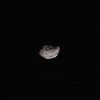
Hyperion-N00078277.jpgTumbling Hyperion (1 - natural colors, elab. Lunexit)57 visiteCaption NASA:"N00078277.jpg was taken on February 16, 2007 and received on Earth February 17, 2007. The camera was pointing toward Hyperion that, at the time, was approximately 214.446 Km away.
The image was taken using the P60 and GRN filters". MareKromium
(6 voti)
|
|

Wispy_Star-PIA08875.jpgTwinkle, twinkle, Little Star...64 visiteCaption NASA:"The Cassini spacecraft gazes toward a distant star as Saturn's Rings slip past in the foreground. At upper left is the outer A-Ring, with its dark Keeler Gap. At lower right, a train of bright clumps shuttles past in the wispy F-Ring.
A temporal sequence of images like this allows Cassini scientists to correlate features in the rings with stellar occultation data acquired by other instruments. As the star passes behind the Rings, the changes in its brightness indicate how much empty space is between particles at different locations on the Rings.
This view looks toward the lit side of the Rings from about 56° below the Ring-Plane.
The image was taken in visible light with the Cassini spacecraft narrow-angle camera on Dec. 30, 2006 at a distance of approx. 633.440 Km (such as about 393.686 miles) from Saturn. Image scale is roughly 4 Km (2 miles) per pixel".
(6 voti)
|
|

Rhea-N00075318.jpgRhea (natural colors)58 visitenessun commentoMareKromium
(6 voti)
|
|

Pandora-PIA08315.jpgPandora, from about 2 MKM57 visiteCaption NASA:"Less intrusive than her sibling shepherd moon (Prometheus), Pandora nonetheless provides a gravitational influence that helps confine and perturb the F-Ring's shape.
Also notable here is the brightness of the region of the outer A-Ring which lies outside the very narrow Keeler Gap. This view looks toward the unlit side of the Rings from about 38° above the Ring-Plane.
The image was taken in visible light with the Cassini spacecraft narrow-angle camera on Oct. 16, 2006 at a distance of approx. 2 MKM (about 1,2 MMs) from Pandora and at a Sun-Pandora-spacecraft, or phase, angle of 157°. Image scale is roughly 12 Km (about 7 miles) per pixel".
Nota: nell'inset, Pandora da poco meno di 52.000 Km di distanzaMareKromium
(6 voti)
|
|

Saturn-N00069102.jpgSaturnian hurricane...57 visitenessun commento
(6 voti)
|
|

The Rings-PIA08290.jpgThe F-Ring (detail mgnf)54 visiteCaption NASA:"For some time, scientists have suspected the presence of tiny moonlets that orbit Saturn in association with the clumpy and braided-looking Ring. As the small satellites move close to the F-Ring core they leave a gravitational signature. In some cases they can draw out material in the form of a "streamer" - a miniature version of the interaction Cassini has witnessed between Prometheus and the F-Ring material. The dynamics of this interaction are the same, but the scale is different.
Scientists speculate that there could be several small moons with a variety of sizes involved in the creation of structures like the one seen here.
The image was taken in visible light with the Cassini spacecraft narrow-angle camera on Sept. 25, 2006 at a distance of approx. 255.000 Km (about 159.000 miles) from Saturn and at phase angle of 29°. Scale in the original image was 1 Km (about 3.873 feet) per pixel. The image has been magnified by a factor of two and contrast enhanced".
(6 voti)
|
|

Enceladus-PIA08286.jpgCrescent Enceladus55 visiteCaption NASA originale:"A world whose mysteries are just coming to light, Enceladus has enchanted scientists and non-scientists alike. With its potential for near-surface liquid water, the icy moon may be the latest addition to the list of possible abodes for life (!).
The view was acquired about two-and-a-half hours after PIA08280, during one of the many encounters with Enceladus.
The image was taken using a combination of spectral filters sensitive to wavelengths of polarized ultraviolet light. The Cassini spacecraft narrow-angle camera acquired the view on Sept. 9, 2006 at a distance of approx. 141.000 Km (about 87.000 miles) from Enceladus and at a Sun-Enceladus-spacecraft, or phase, angle of 96°.
Image scale is roughly 850 mt (about 0,5 mile) per pixel".
(6 voti)
|
|
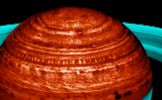
Saturn-PIA01941.jpgInfrared Saturn66 visiteIn this image, Saturn's fascinating meteorology manifests itself in a "string of pearls" formation, spanning over 60.000 Km (about 37.000 miles). Seen in new images acquired by Cassini's VIMS (Visual and Infrared Mapping Spectrometer) and lit from below by Saturn's internal thermal glow, the bright "pearls" are actually clearings in Saturn's deep cloud system. More than two dozen occur at 40° North Latitude. Each clearing follows another at a regular spacing of some 3,5° in Longitude.
This is the first time such a regular and extensive train of cloud-clearings has been observed. The regularity indicates that they may be a manifestation of a large planetary wave. Scientists plan to take more observations of this phenomenon over the next few years to try to understand Saturn's deep circulation systems and meteorology. This image was taken on April 27, 2006.
(6 voti)
|
|
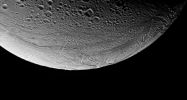
Enceladus-PIA08280.jpgThe active South Pole of Enceladus68 visiteCaption NASA originale:"The wrinkled border of Enceladus' South Polar Region snakes across this view, separating fresher, younger terrain from more ancient, cratered provinces.
This is the Region of Enceladus that is known to be presently geologically active. At right are clearly visible ridges and troughs thought to be caused (probably) by compressional stresses across the icy surface.
The image was taken in polarized green light with the Cassini spacecraft narrow-angle camera on Sept. 9, 2006 at a distance of approx. 66.000 Km (such as about 41.000 miles) from Enceladus and at a Sun-Enceladus-spacecraft, or phase, angle of 104°. Image scale is roughly 396 mt (about 1.300 feet) per pixel".
(6 voti)
|
|

Saturn-W00018153.jpgSunshine on Saturn...57 visitenessun commento
(6 voti)
|
|

Helene-PIA08269.jpgMoments of "Helene"59 visiteCaption NASA originale:"This set of images exposes details on small and crumpled-looking Helene. Large portions of this Trojan moon of Dione appear to have been blasted away by impacts.
Cassini passed within 50.000 Km (about 31,000 miles) of Helene (which is about 32 Km - or 20 miles across) on Aug. 17, 2006, when these images were acquired.
The views were obtained over the course of an hour and are presented here in reverse order (i.e.: the leftmost image was taken latest).
The images were taken in visible light with the Cassini spacecraft narrow-angle camera. As presented here, the views were acquired at distances ranging from about 62.000 to 51.000 Km (such as about 39.000 to 32.000 miles) from Helene and at a Sun-Helene-spacecraft, or phase, angle of 111 to 120°. Image scale is roughly 375 to 300 meters (approx. 1.230 to 984 feet) per pixel, from left to right".
(6 voti)
|
|
| 2244 immagini su 187 pagina(e) |
 |
|
|
|
|
35 | |
|
|
|
|





