| Piú votate - Saturn: the "Ringed Beauty" and His Moons |
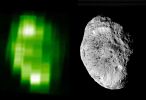
Hyperion-PIA09216.jpgCold Hyperion...57 visiteCaption NASA:"In this ultraviolet image of Hyperion, produced using data taken with Cassini's Ultraviolet Imaging Spectrograph during the September 2005 close flyby, brightness contrasts are due to both topographic and compositional variations across the surface. The brightest regions are exposed water ice in the rim of the crater that dominates the hemisphere in view.
This new ultraviolet map (left) is shown next to a previously released image (right) taken by the Imaging Science Subsystem".MareKromium
(6 voti)
|
|

Tethys-N00085054.jpgConjunction (1)56 visitenessun commentoMareKromium
(6 voti)
|
|

Tethys-N00085058.jpgConjunction (3)56 visitenessun commentoMareKromium
(6 voti)
|
|

Mimas-N00084762.jpgMimas: the "Egg-like Moon"56 visiteMimas ID:"Mimas is made primarily of water-ice. Its surface is heavily cratered, indicating that its impact features may date back to the time of the moon's creation.
One of the craters, named Herschel, is surprisingly large - nearly one-third the moon's entire diameter. Herschel is 10 Km (about 6 miles) deep, with a central mountain that rises 6 Km (about 3,7 miles) above the crater floor.
Traces of fracture marks can be seen on the opposite side of Mimas.
Mimas was discovered in 1789 by William Herschel; its mean distance from Saturn is approximately equal to 185.520 Km (such as about 115.277 miles); its mass is: 3.81 x 10¹⁹ Kg (such as 8.3 x 10¹⁹ lbs) and its dimensions are: 418 x 392 x 383 Km (260 x 244 x 238 miles)".
Period of Orbit around Saturn: 22.6 hoursMareKromium
(6 voti)
|
|

Enceladus-PIA08954.jpgIcy Emanations...57 visiteCaption NASA:"Peeking over the crescent of Enceladus, the Cassini spacecraft views the towering plume of ice particles erupting from the moon's South Polar Region.
Multiple components of the overall plume are visible in this view of Enceladus.
The image was taken in visible light with the Cassini spacecraft narrow-angle camera on April 24, 2007 at a distance of approx. 188.000 Km (such as about 117.000 miles) from Enceladus and at a Sun-Enceladus-spacecraft, or phase, angle of 153°.
Image scale is roughly 1 Km (about 0,6 miles) per pixel".MareKromium
(6 voti)
|
|
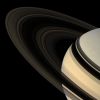
Saturn-PIA08370.jpgSaturn (natural colors - elab. NASA)54 visiteCaption NASA:"Colorful Saturn tilts its darkened Ring-Plane toward Cassini. Against the dark sky, the Rings are made visible by the light that scatters through them toward the camera.
The F-Ring shepherd moon Pandora is faintly visible at the top, left of center. Pandora's brightness was increased by a factor of three to aid its visibility.
This view looks toward the unilluminated side of the Rings from about 18° above the Ring-Plane. The Planet is visible through the innermost and outermost portions of the Rings.
Images taken using red, green and blue spectral filters were combined to create this natural color view. The images were obtained by the Cassini spacecraft wide-angle camera on April 13, 2007, at a distance of approx. 1,8 MKM (about 1,1 MMs) from Saturn.
Image scale is roughly 108 Km (about 67 miles) per pixel".MareKromium
(6 voti)
|
|

Saturn-PIA08934.jpgThe Upper Atmosphere of Saturn56 visiteCaption NASA:"Whorls, streamers and eddies play in the banded atmosphere of a Gas Giant. Strong image enhancement renders unto Saturn's clouds a grainy texture not unlike sandstone. However, the loss in delicate smoothness is compensated for by an increase in discernible detail.
The image was taken with the Cassini Spacecraft wide-angle camera using a combination of spectral filters sensitive to wavelengths of infrared light centered at 728 (green channel), 752 (red channel) and 890 (blue channel) nanometers. The semi-transparent red features across the image are clouds detected by the 752 nanometer filter. The view was acquired on Aug. 19, 2005 at a distance of approx. 492.000 Km (such as about 306.000 miles) from Saturn. Image scale is roughly 26 Km (about 16 miles) per pixel".MareKromium
(6 voti)
|
|
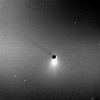
Enceladus-PIA08921.jpgCosmic Shadow56 visiteCaption NASA:"Blazing like an icy torch, the plume of Enceladus shines in scattered sunlight as the moon casts a shadow onto Saturn's E-Ring. Some of the tiny ice particles erupted from the moon's South Polar Region go into Saturn orbit, forming the doughnut-shaped ring, onto which the moon's shadow is cast in this view.
The shadow of Enceladus stretches away to the upper left at around the 10 o'clock position. The Sun-Enceladus-spacecraft, or phase, angle is 164° here, with the Sun being located toward the lower right. This means that Enceladus' shadow extends toward the Cassini spacecraft -- through part of the E-Ring.
Some of the bright dots in this heavily processed view are background stars. Others are due to cosmic ray hits on the camera detector.
The image was taken in visible light with the Cassini spacecraft narrow-angle camera on Aug. 11, 2006 at a distance of approx. 2.2 MKM (about 1,3 MMs) from Enceladus. Image scale is roughly 13 Km (about 8 miles) per pixel".MareKromium
(6 voti)
|
|

Hyperion-N00040272~0.jpgThe "True Colors" of Hyperion, according to Lunexit57 visitenessun commento
(6 voti)
|
|

Saturn-PIA08367.jpgSouthern Saturn56 visiteCaption NASA:"Cassini takes in a sweeping view of Saturn's South Polar Region as the planet's shadow masks the Rings and bright, icy Mimas looks on from left.
This view looks toward the lit side of the Rings from about 28° below the Ring-Plane.
Images taken using red, green and blue spectral filters were combined to create this color view. The view was acquired with the wide-angle camera on Feb. 20, 2007, at a distance of approximately 1 MKM (about 600.000 miles) from Saturn.
Image scale is roughly 58 Km (about 36 miles) per pixel".
(6 voti)
|
|

Hyperion-PIA08904.jpgPumice-Hyperion (natural colors - elab. Lunexit)57 visiteCaption NASA:"Chaotically tumbling and seriously eroded by impacts, Hyperion is one of Saturn's more unusual satellites. Scientists believe the moon to be quite porous, with a great deal of its volume being empty space.
(...) Only part of the moon is visible in this image, the rest being hidden in shadow.
The image was taken with the Cassini spacecraft narrow-angle camera using a spectral filter sensitive to wavelengths of infrared light centered at 930 nanometers. The view was acquired on Feb. 15, 2007 from a distance of approx. 224.000 Km (such as about 139.000 miles) from Hyperion.
Image scale is roughly 1 Km (4.404 feet) per pixel".
(6 voti)
|
|
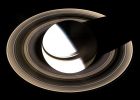
Saturn-PIA08362.jpgThe Ringed World, from above57 visiteCaption NASA:"Surely one of the most gorgeous sights the Solar System has to offer, Saturn sits enveloped by the full splendor of its stately Rings. Taking in the Rings in their entirety was the focus of this particular imaging sequence. Therefore, the camera exposure times were just right to capture the dark-side of its Rings, but longer than that required to properly expose the globe of sunlit Saturn. Consequently, the sunlit half of the Planet is overexposed.
Between the blinding light of day and the dark of night, there is a strip of twilight on the globe where colorful details in the atmosphere can be seen. Bright clouds dot the bluish-grey Northern Polar Region here. In the South, the Planet's night side glows golden in reflected light from the Rings' sunlit face.
Saturn's shadow stretches completely across the Rings in this view, taken on Jan. 19, 2007, in contrast to what Cassini saw when it arrived in 2004.
The view is a mosaic of 36 images -- that is, 12 separate sets of red, green and blue images -- taken over the course of about 2,5 hours, as Cassini scanned across the entire Main Ring System. This view looks toward the unlit side of the Rings from about 40° above the Ring-Plane.
The images in this natural-color view were obtained with the Cassini spacecraft wide-angle camera at a distance of approx. 1,23 MKM (about 764.000 miles) from Saturn. Image scale is roughly 70 Km (about 44 miles) per pixel".MareKromium
(6 voti)
|
|
| 2244 immagini su 187 pagina(e) |
 |
|
|
|
|
34 | |
|
|
|
|





