| Piú votate - Saturn: the "Ringed Beauty" and His Moons |

Mimas-PIA10589.jpgSunshine v/s Saturnshine on Mimas (Natural Colors; credits: Lunar Explorer Italia)57 visiteCaption NASA:"The transition from light to dark takes place on two fronts in this image of Mimas. The two Terminators that stretch across the moon are created by Sunshine across the North and Saturn-shine in the East.
This view looks toward the Trailing Hemisphere of Mimas. North on Mimas is up and rotated 33° to the right.
The image was taken in Visible Light with the Cassini Spacecraft narrow-angle camera on Jan. 23, 2009. The view was acquired at a distance of approx. 508.000 Km (about 316.000 miles) from Mimas and at a Sun-Mimas-Spacecraft, or Phase, Angle of 152°.
Image scale is roughly 3 Km (a little less than 2 miles) per pixel".MareKromium
(6 voti)
|
|
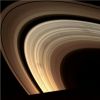
The_Rings-PIA11144.jpgSpokes (natural - but enhanced - colors; credits: Lunar Explorer Italia)102 visiteCaption NASA:"Dark Spokes dance around Saturn's B-Ring in this image taken with Cassini's wide-angle camera.
As Saturn nears Equinox (which will occur in August 2009) and the Sun angle on the Ring-Plane decreases, Spokes become common sights in Cassini images, just as they were in Voyager images. The Planet's orbital period is 29,5 years, so Saturn has nearly made one complete trip around the Sun since the flybys of the two Voyager Spacecraft (1980 and 1981), allowing Cassini to closely match Voyager's viewing geometry.
The Spokes appear dark against Saturn's B-Ring at low phase angles because the particles within them scatter light more efficiently in the forward direction (meaning away from Cassini) than the surrounding larger ring particles. In the opposite viewing geometry, at high phase angles, spokes appear bright relative to surrounding ring particles (See PIA07807).
MareKromium
(6 voti)
|
|

The_Rings-PIA10525.jpgSpokes in the "B-Ring" (possible True Colors; credits: Lunar Explorer Italia)67 visiteCaption NASA:"Broad, dark spokes in the B-Ring are clearly seen in this image of Saturn's Rings. The spokes are finally becoming quite common, as they were during the Voyager flybys. These observations and others like it seem to support the idea that the spokes become most prominent near the Saturnian Equinox. Also visible in this image is the moon Janus off beyond the Rings.
The image was taken in visible light with the Cassini Spacecraft wide-angle camera on Oct. 19, 2008 at a distance of approx. 1,1 MKM (such as about 628.000 miles) from Saturn and at a Phase Angle of 29°.
Image scale is roughly 57 Km (about 35 miles) per pixel".MareKromium
(6 voti)
|
|

Mimas-N00124650.jpgMimas and the Giant behind... (possible True Colors; credits: Lunar Explorer Italia)58 visiteCaption NASA:"N00124650.jpg was taken on November 26, 2008 and received on Earth November 27, 2008. The camera was pointing toward MIMAS that, at the time, was approx. 914.921 Km away
The image was taken using the CL1 and CL2 filters".MareKromium
(6 voti)
|
|

The_Rings-N00124200-N00124206.gifAnother UFO in the Space of Saturn? (GIF-Movie; credits: Dr G. Barca)71 visiteQuesto GIF-Movie costituisce una (bella!) risposta del Dr Barca al quesito posto in sede di commento ai frames che potrebbero raffigurare un OVNI che sfreccia nello Spazio di Saturno, a ridosso del suo Anello "F": osservate la traiettoria dell'oggetto.
Essa è palesemente iperbolica (nota: "...in Astrodinamica ed in Meccanica Celeste una Traiettoria Iperbolica è un'orbita con eccentricità maggiore di 1. Sotto le ipotesi standard, un corpo che viaggia lungo una Traiettoria Iperbolica arriverà all'infinito con una Velocità Orbitale (detta anche Velocità d'Eccesso Iperbolica, Eccesso Iperbolico o Terza Velocità Cosmica), rispetto al Corpo Centrale, non nulla (ricorda: la Velocità Orbitale di un Corpo Celeste, generalmente un pianeta, un satellite naturale, un satellite artificiale o una stella parte di un sistema multiplo, è la velocità con cui esso orbita attorno al Baricentro del Sistema - ed in genere attorno ad un corpo con massa maggiore. Il termine può riferirsi sia alla Velocità Orbitale Media (misurata su un'intera orbita), sia alla Velocità Istantanea in un certo punto dell'orbita).
Analogamente alle Traiettorie Paraboliche, quelle Iperboliche sono Orbite di Fuga e l'energia specifica di una Traiettoria Iperbolica è positiva...") e quindi - come ben spiegato dalla definizione estrapolata da Wikipedia - del tutto incoerente rispetto alle orbite e traiettorie (dette "Stazionarie") proprie dei satelliti (naturali e non) di un Corpo Celeste.
E questo è un PRIMO elemento che ci porta ad escludere l'eventualità che il Corpo Anomalo in transito sia una Luna Saturniana...Altre idee?MareKromium
(6 voti)
|
|

The_Rings-N00123890-N00123900.gifPossible UFO (and Cosmic Ray) in the Space of Saturn (GIF-Movie: credits: Dr G. Barca)66 visitenessun commentoMareKromium
(6 voti)
|
|

The_Rings-N00124198.jpgMore UFO's in the Space of Saturn?62 visiteCaption NASA:"N00124198.jpg was taken on November 16, 2008 and received on Earth November 17, 2008. The camera was pointing toward SATURN-RINGS that, at the time, were approx. 387.642 Km away, and the image was taken using the CL1 and CL2 filters. This image has not been validated or calibrated". MareKromium
(6 voti)
|
|

The_Rings-N00123873.jpgAnother UFO in the Space of Saturn: the UFO has diappeared (natural colors; credits: Lunexit)68 visitenessun commentoMareKromium
(6 voti)
|
|

The_Rings-N00123871.jpgAnother UFO in the Space of Saturn (natural colors; credits: Lunexit)112 visiteImage Artifact? No, decisamente no.
L'Oggetto Anomalo (curiosamente a forma di "sigaro" - una sagoma ricorrente per gli UFO osservati nei Cieli della Terra, come i Cultori di Ufologia sapranno bene) appare in due frames consecutivi, si presenta con un'albedo davvero elevata - ai limiti della sovraesposizione - ed è assolutamente reale.
Diciamo questo (e cioè che si tratta di un "Corpo Reale) con un ragionevole margine di sicurezza dopo aver osservato entrambi i frames in full-size: l'oggetto anomalo, infatti, oltre ad apparire in entrambi (senza mutare forma, nè albedo, ma CAMBIANDO posizione) riesce anche - probabilmente a causa della sua grande luminosità - a produrre un fenomeno di doppia riflessione all'interno dell'obbiettivo della fotocamera dell'Orbiter Cassini che ha effettuato la ripresa (un fenomeno, quello della "Doppia Riflessione", che non è coerente con la stessa idea e natura dell'image artifact tradizionale, quale che sia la sua origine).
Non si tratta neppure di una Luna Pastore (o almeno: non si tratta di una Luna Pastore conosciuta...) nè di un "propeller".
Ed ovviamente non è uno "streamer".
Conclusione: è un Oggetto Volante Non Identificato.MareKromium
(6 voti)
|
|

Waves-N00123354-0.gifGravity Waves (GIF-Movie by Dr M. Faccin)90 visiteEd ecco, in una chiarissima e assai suggestiva versione GIF prodotta dal Dr Faccin, che cosa significa e come si presenta una "normale" Onda Gravitazionale (o Gravity Wave).
Guardatela bene e poi confrontatela con la "Super" Onda Gravitazionale che invece è sembrata caratterizzare il transito dell'Oggetto Anomalo nei pressi dell'Orbiter Cassini (nel GIF-Movie prodotto dal Dr Barca): non Vi sarà difficile notare che l'Onda Gravitazionale ordinaria corre, leggera e locale, fianco a fianco alla Luna Pastore (Epimeteo, Atlas, Giano o Prometeo, tanto per indicare le Maggiori - e più note - Lune Pastore di Saturno).
L'Onda "Anomala" che segue il transito del Corpo Errante prossimo a Cassini, invece, sembra provocare una variazione altissima del moto delle particelle che formano l'Anello "F" di Saturno. Una variazione che corrisponderebbe - se ragionassimo in termini musicali - ad un acuto, seguito da una serie di eco gravi e degradanti.
Ebbene, lo ripetiamo una volta per tutte, se una simile "onda" si fosse davvero abbattuta sull'Anello "F" (come su qualsiasi altro Anello) di Saturno, essa avrebbe provocato il disrupting dell'Anello stesso e la sua frammentazione (perchè le particelle dell'Anello che si trovano in Equlibrio Lagrangiano con Saturno possono tollerare - come, di fatto, tollerano - dei disturbi che comportano delle perturbazioni nel loro moto, a condizione che dette perturbazioni sìano TOLLERABILI e cioè: 1) Limitate (a bassa Intensità) e 2) Locali (ossìa circoscritte ad una specifica - e modesta - regione/sezione dell'Anello).
Qualora la Limitatezza e/o la Località del disturbo venisse/venissero meno, l'Equilibrio (stabile, ma delicato) dell'Anello verrebbe radicalmente e definitivamente compromesso (il che vuol dire che una parte dell'Anello precipiterebbe verso Saturno ed un'altra si andrebbe a perdere nello Spazio Esterno).
Ma questo NON E' AVVENUTO! Ergo, il disturbo che vediamo nel filmato GIF prodotto dal Dr Barca e che pare seguire il transito del Corpo Errante, NON HA - come invece SEMBRA - interessato l'Anello "F", bensì' la VISIONE dell'Anello "F" da parte delle camere di Cassini.
Morale: si tratta di un effetto ottico (distorsione gravitazionale e/o magnetica).
Causa: il transito del Corpo Errante nei pressi di Cassini.
Natura del Corpo Errante: sconosciuta.MareKromium
(6 voti)
|
|

MimasandPrometheus-N00121942.jpgSpace Encounter: Mimas and Prometheus (3)54 visiteCaption NASA:"N00121933.jpg was taken on October 20, 2008 and received on Earth October 21, 2008.
The camera was pointing toward MIMAS that, at the time, was approx. 1.056.495 Km away.
This image was taken using the CL1 and CL2 filters and it has not been validated or calibrated." MareKromium
(6 voti)
|
|

Saturn-PIA10478.jpgSaturn and Mimas (natural colors; credits: NASA/JPL/Space Science Institute )56 visiteCaption NASA:"The Cassini Spacecraft looks beyond Saturn's limb toward the icy face of Mimas, the innermost of the Planet's major moons.
This view looks toward the sunlit side of the rings from about 3° below the Ring-Plane. Mimas is about 396 Km (approx. 246 miles) across.
Images taken using red, green and blue spectral filters were combined to create this natural color view. The images were acquired with the Cassini Spacecraft narrow-angle camera on Sept. 4, 2007 at a distance of approx. 2,7 MKM (such as about 1,7 MMs) from Saturn and 2,8 MKM (such as about 1,8 MMs) from Mimas.
Image scale is roughly 16 Km (about 10 miles) per pixel on Saturn and approx. 17 Km (such as about 11 miles) per pixel on Mimas". MareKromium
(6 voti)
|
|
| 2244 immagini su 187 pagina(e) |
 |
|
|
|
|
29 | |
|
|
|
|





