| Piú votate - Saturn: the "Ringed Beauty" and His Moons |
Dione-EB-LXTT3.jpgThe Surface of Dione (an Image-Mosaic by Elisabetta Bonora - Lunexit Team)57 visitenessun commentoMareKromium
(6 voti)
|
|
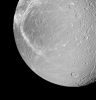
Dione-PIA12608.jpgDione59 visiteCaption NASA:"Wispy Terrain winds across the Trailing Hemisphere of Saturn's moon Dione in this Cassini view taken during the Spacecraft's Jan. 27, 2010 non-targeted Fly-By.
Cassini came within about 45.000 Km (approx. 28.000 miles) of the moon during this Fly-By, but this image was acquired at a distance of approx. 137.000 Km (about 85.000 miles) from Dione.
This view looks toward the anti-Saturn Side and Trailing Hemisphere of Dione. North on Dione is up.
The image was taken in Visible Light with the Cassini Spacecraft narrow-angle camera on Jan. 27, 2010. The view was obtained at a Sun-Dione-Spacecraft, or Phase, Angle of 38°.
Image scale is about 819 meters (2687 feet) per pixel".MareKromium
(6 voti)
|
|

Mimas-PIA12568.jpgThe "Eye" of Mimas58 visiteCaption NASA:"This mosaic, created from images taken by NASA's Cassini Spacecraft during its closest flyby of Saturn's moon Mimas, looks straight at the moon's huge Herschel Crater and reveals new insights about the moon's Surface. Bright-walled Craters, with Floors and surroundings - about 20% darker than the steep Crater Walls - are notable in this view. Mimas' original Surface, like the surfaces of most of the other major Saturnian moons without Atmospheres, is not pure ice but contains some dark impurities.
Herschel Crater (about 130 Km - approx. 80 miles - wide) and some of the smaller craters seen in this mosaic show relatively dark markings along the lower portion of their walls. Cassini scientists interpret this darkening as evidence for the gradual concentration of impurities from evaporating icy materials in areas where the dark impurities slide slowly down the Crater Wall. There, bright ice is baked away by the Sun and the vacuum of space.
At Herschel, the edge where the Darker Regions contact the Crater Floor, is interrupted by an extensive hummocky area. Scientists believe the hummocky texture came from the flow of melted ice that occurred during the impact that created the Crater itself. That melt filled the bottom of the Crater around the Central Peak.
Dark Streaks are seen making their way down the sides of some craters (marked red in the annotated version), often originating from pockets of dark contaminants embedded just below the rim of the crater wall. The pockets themselves likely represent small, pre-existing, dark-floored craters that were buried by the blanket of material that was thrown out from the newer impact that created the crater rim. The material from a newly exposed dark layer eventually moves downslope and forms a streak. Streaks are sometimes seen starting from the floors of smaller, dark-floored craters perched along Rims of larger Craters.
The interior of Herschel Crater is significantly less cratered than the continuous blanket of ejected material that extends radially outward from its rim. The violent meteor impact that excavated Herschel blasted pulverized debris, including massive chunks of ice, upward. The fallback of this ejected material over the Crater Rim created a thick Debris Blanket and dotted it with Secondary Craters. The presence of a fluid pool of melted material on the Crater Floor, which solidified after the debris fell, probably explains the relative absence of Craters on Herschel's Floor. These are common processes that should occur on bodies without Atmospheres throughout the Solar System. They may be accentuated on Mimas because of the large size of Herschel in comparison to Mimas' size.
Cassini came within about 9500 Km (approx. 5900 miles) of Mimas during its flyby on Feb. 13, 2010. This mosaic was created from 7 images taken that day in Visible Light with Cassini's narrow-angle camera. An eighth image, taken with the wide-angle camera on the same flyby, is used to fill in the lower right of the mosaic. The images were re-projected into an orthographic map projection. This view looks toward the Leading Hemisphere of Mimas.
This view is centered on terrain at about 10° South Latitude and 125° West Longitude. North is up.
The view was obtained at a distance of approx. 30.000 Km (about 19.000 miles) from Mimas and at a Sun-Mimas-Spacecraft, or Phase, Angle of 27°.
Image scale is roughly 180 meters (600 feet) per pixel".MareKromium
(6 voti)
|
|
Enceladus-EB5.jpgFountains of Light (High-Def-3D; credits: Elisabetta Bonora - Lunexit Team)58 visiteUn frame tridimensionale di fattura assai complessa, ma riuscitissimo e notevole - nonchè, ci sia consentito dirlo - estremamente suggestivo.
Ora indossate gli occhialini e verificate Voi stessi: le Fontane di Encelado splenderanno, in tre dimensioni, anche per Voi!
Grandi complimenti alla nostra eccezionale Amica e Partner, Elisabetta Bonora (alias "2di7").MareKromium
(6 voti)
|
|

Prometheus_and_Friends-EB.gifSingle Tone (GIF-Movie; credits: Elisabetta Bonora - Lunexit Team)58 visitenessun commentoMareKromium
(6 voti)
|
|

Dione-EB-4311210639_db673f3300_b.jpgA Beautiful "Slice" of Dione (by Elisabetta Bonora - Lunexit Team)58 visitenessun commentoMareKromium
(6 voti)
|
|

Rhea-N00146883_to_938-MF.jpgRhea (Image-Mosaic and Natural Colors; credits: Dr M. Faccin)58 visiteE questo image-mosaic, infine, oltre che ai Ragazzi di Pasadena ed allo Space Science Institute, lo dedichiamo anche ai Curatori della prestigiosa Rubrica "NASA - Picture of the Day" (caso mai avessero voglia di pubblicare qualcosa di VERAMENTE spettacolare, eseguito a Regola d'Arte e, soprattutto, di grandissimo valore tecnico e didattico).
Grandissimi Complimenti a Marco Faccin e Gianluigi Barca per i loro grandissimi sforzi (questo mosaico è costato poco più di due ore di lavoro), i quali vengono SEMPRE coronati da - a dire poco - grandissimi risultati (ancorchè detti risultati sono conosciuti e riconosciuti, purtroppo, solo da pochissimi...).MareKromium
(6 voti)
|
|
Enceladus-N00145360-N00145369.gifChange of Trajectory? (GIF-Movie; credits: Dr G. Barca)65 visiteUno spettacolo al quale siamo (si fa per dire) "abituati": le Fontane di Encelado. Ed ancora una volta, mentre le Fontane disegnano lampi ed archi di luce nello Spazio circum-Saturniano, un oggetto non identificato sfreccia davanti alle fotocamere di CASSINI.
La peculiarità? E' nel fatto che l'oggetto luminoso SEMBRA effettuare un leggero - ma visibile! - cambio di traiettoria proprio mentre passa davanti agli occhi elettronici dell'Orbiter.
Che dire? Il "traffico", dalle parti di Saturno, è veramente intenso... Grandissimi Complimenti e Ringraziamenti al Dr Barca per l'ennesimo - splendido - Lavoro.MareKromium
(6 voti)
|
|
Dione_Tethys-N00144184-N00144203-N00144746-N00144765.gifNight Passengers (GIF-Movie; credits: Dr G. Barca)59 visitenessun commentoMareKromium
(6 voti)
|
|

Unusual_Phenomenon-N00143386_to_425_detail.gifUnusual Phenomenon in the Space of Saturn (GIF-Movie; credits: Dr M. Faccin)100 visiteNel ringraziare il nostro Grande Amico e Partner, Marco Faccin, per i Lavori che produce OGNI GIORNO, Vi invitiamo a visionare l'intero filmato (Space Migration) che potete trovare al nostro nuovo indirizzo su Flickr.com (http : / / www . flickr . com / photos / lunexit / 4092732540/).
Buona Visione e, se volete, scriveteci quella che credete che possa essere la causa (o una delle cause) dell'Unusual Phenomenon "emerso", letteralmente, dal buio dello Spazio circum-Saturniano...
MareKromium
(6 voti)
|
|

Hyperion-PIA11617.jpgTumbling Hyperion (Natural Colors; credits: Lunexit)58 visiteCaption NASA:"The Cassini Spacecraft peers at the pitted Surface of the small and irregularly-shaped moon Hyperion.
See PIA09728 to learn how these pits are created on low-density Hyperion (about 270 Km, or approx. 168 miles across). To watch a movie of this "tumbling moon", see PIA07683.
Scale in the original image was 9 Km (approx. 5,5 miles) per pixel. The image has been magnified by a factor of three and contrast-enhanced to aid visibility.
The image was taken in Visible Light with the Cassini Spacecraft narrow-angle camera on Sept. 5, 2009. The view was obtained at a distance of approx. 1,4 MKM (such as about 870.000 miles) from Hyperion and at a Phase Angle of 91°".MareKromium
(6 voti)
|
|
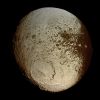
Japetus-big.jpgJapetus (Natural Colors; credits: Lunexit)57 visiteDa "NASA - Picture of the Day", del giorno 9 Agosto 2009:"What has happened to Saturn's moon Japetus? Vast sections of this strange world are dark as coal, while others are as bright as ice. The composition of the dark material is unknown, but InfraRed Spectra indicate that it possibly contains some dark form of carbon.
Japetus also has an unusual equatorial ridge that makes it appear like a walnut. To help better understand this seemingly painted moon, NASA directed the robotic Cassini Spacecraft orbiting Saturn to swoop within 2000 Km in 2007.
Pictured above, from about 75.000 Km out, Cassini's trajectory allowed unprecedented imaging of the hemisphere of Japetus that is always trailing.
A huge impact crater seen in the South spans a tremendous 450 Km and appears superposed on an older crater of similar size. The dark material is seen increasingly coating the easternmost part of Japetus, darkening craters and highlands alike.
Close inspection indicates that the dark coating typically faces the moon's Equator and is less than a meter thick. A leading hypothesis is that the dark material is mostly dirt leftover when relatively warm but dirty ice sublimates. An initial coating of dark material may have been effectively painted on by the accretion of meteor-liberated debris from other moons.
This and other images from Cassini's Japetus flyby are being studied for even greater clues".MareKromium
(6 voti)
|
|
| 2244 immagini su 187 pagina(e) |
 |
|
|
|
|
28 | |
|
|
|
|





