| Piú votate - Saturn: the "Ringed Beauty" and His Moons |

Hyperion-PIA07740-PCF-LXTT-IPF.jpgFeatures of Hyperion (CTX and EDM Frames in Absolute Natural Colors; credits for the additional process. and color.: Dr Paolo C. Fienga - Lunexit Team)112 visiteThese beautiful Absolute Natural Color views of the Saturnian moon Hyperion reveal crisp details across the strange, tumbling moon's Surface. Differences in color represent differences in the composition of the Surface Materials; both views (CTX Frame and EDM) were obtained during the Cassini's close Fly-By that occurred on September, 26, 2005.
The images were taken by the NASA - Cassini Spacecraft's narrow-angle camera at a distance of approx. 62.000 Km (about 38.500 miles) from Hyperion and at a Sun-Hyperion-Cassini Angle (a.k.a. "Phase Angle") of 52°. The image scale is 362 mt (about 1200 feet) per pixel.
These two frames have been colorized in Absolute Natural Colors (such as the colors that a human eye would actually perceive if someone were onboard the NASA - Cassini Spacecraft and then looked outside, towards the Saturnian moon Hyperion), by using an original technique created - and, in time, dramatically emproved - by the Lunar Explorer Italia Team.MareKromium
(6 voti)
|
|

Saturn_and_Friends-EB-MF-LXTT.jpgSaturn and some "Friends" (Natural Colors; credits for the additional process. and color.: Elisabetta Bonora and Marco Faccin - Lunexit Team)164 visitenessun commentoMareKromium
(6 voti)
|
|
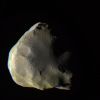
Helene-N00172877_78_79.jpgHelene (RAW Natural Colors; credits for the additional process. and color.: Dr Marco Faccin - Lunexit Team)220 visitenessun commentoMareKromium
(6 voti)
|
|

The_Rings-PIA12820.gifTilting Saturn's Rings (a Computer Animation by NASA/JPL/Cornell)159 visiteCaption NASA:"This animated graphic shows in a series of three images how Saturn's Rings, after they became tilted relative to Saturn's Equatorial Plane, would have transformed into a Corrugated Ring.
Images taken after Saturn's August 2009 equinox from NASA's Cassini Spacecraft revealed alternating light and dark bands extending from Saturn's D-Ring, completely across the C-Rg, and right up to the inner B-Rg Ege. These brightness variations are almost certainly caused by the changing slopes in the rippled Rng-Plane, much like the corrugations of a tin roof.
This series of images shows how such a vertical corrugation can be produced from an initially inclined ring by the natural tendency for inclined orbits to wobble systematically and slowly at different rates, depending on their distance from Saturn. The top image shows a simple inclined ring (the central planet is omitted for clarity), while the lower two images show the same ring at two later times, where the ring particles' wobbling orbits have sheared this inclined sheet into an increasingly tightly-wound spiral corrugation.
Cassini images show the corrugation extends for about 19.000 Km (11.799 miles). Based on detailed studies of this structure, scientists conclude that a broad swath of the Rings became suddenly tilted in the early 1980s, likely because Cometary Debris crashed into them.
The corrugation's radial extent implies that the impacting material was a dispersed cloud of debris instead of a single object. The corrugation's amplitude of about 2 to 20 meters (7 to 60 feet) indicates that the debris' total mass was around 1 Trillion Kg (or 1 Billion Metric Tons)".
MareKromium
(6 voti)
|
|

Helene-PIA12758-PCF-LXTT.jpgHelene (Absolute Natural Colors; credits for the additional process. and color.: Dr Paolo C. Fienga - Lunexit Team)233 visitenessun commentoMareKromium
(6 voti)
|
|

Enceladus-N00165592-165603-MF-LXTT.gifHuge "Spurt" from Enceladus (a GIF-Movie by Dr Marco Faccin - Lunexit Team)132 visiteSolo una nota: questo GIF-Movie è stato pubblicato IERI, 21 Dicembre 2010, sulle Pagine Flickr dei nostri Partner Marco FACCIN ed Elisabetta BONORA.
La NASA, con tutte le sue "menti" ed i suoi "immensi mezzi", ha evidenziato il fenomeno solamente oggi, dopo aver visitato le pagine Flickr di cui sopra.
Ogni ulteriore commento ci sembra superfluo...MareKromium
(6 voti)
|
|

Dione-PIA12743.jpgErulus Crater (Absolute Natural Colors; credits for the additional process. and color.: Dr Paolo C. Fienga - Lunexit Team)75 visiteCaption NASA:"The Cassini spacecraft snapped this shot of cratered Dione as it flew by the Saturnian moon on Oct. 17, 2010. The large crater at the center of the image is Erulus, which is about 120 Km, or approx. 75 miles, across. This view looks toward the Southern Latitudes of the Leading Hemisphere of Dione.
The image was taken in Visible Light with the Cassini Spacecraft narrow-angle camera. The view was acquired at a distance of approximately 41.000 Km (such as about 25.000 miles) from Dione and at a Sun-Dione-Spacecraft, or Phase, Angle of 53°.
Image scale is roughly 240 meters (787 feet) per pixel".MareKromium
(6 voti)
|
|
Enceladus-N00160966-N00160995-GB-LXTT3.gifClosing-up on the Enceladian "Fountains of Light" (a GIF-Movie by Dr Gianluigi Barca - Lunexit Team)68 visitenessun commentoMareKromium
(6 voti)
|
|

Saturn-W00064807-6-9-EB-LXTT.jpgFather and Son n. 1 (An Image-Mosaic in Natural Colors; credits for the additional process. and color.: Elisabetta Bonora - Lunexit Team)58 visitenessun commentoMareKromium
(6 voti)
|
|
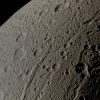
Dione-PIA12663.jpgDione (Absolute Natural Colors; credits for the additional process. and color.: Dr Paolo C. Fienga - Lunexit Team)60 visiteCaption NASA:"The Cassini Spacecraft swooped in for a close-up of the cratered, fractured surface of Saturn's moon Dione in this image taken during the Spacecraft's Jan. 27, 2010, non-targeted Fly-By.
Cassini came within about 45.000 Km (approx. 28.000 miles) of the moon during the Fly-By, and this image was acquired at a distance of approx. 46.000 Km (about 29.000 miles).
This view looks toward the Leading Hemisphere of Dione. North on Dione is up. The image was taken in Visible Light with the Cassini Spacecraft narrow-angle camera.
The view was acquired at a Sun-Dione-Spacecraft, or Phase, Angle of 108°. Image scale is roughly 270 meters (886 feet) per pixel".MareKromium
(6 voti)
|
|

Enceladus-EB-LXTT6.jpgBeyond the Visible Light: Enceladus in IR and UV (an Image-Mosaic by Elisabetta Bonora - Lunexit Team)56 visiteUn altro spettacolare "Educational" della nostra Amica e Partner Elisabetta Bonora, in attesa che anche la NASA o l'ESA - se non altro "ufficialmente" ed attraverso i loro "Canali Pubblici" - facciano qualcosa di ugualmente valido ed istruttivo.
Un'attesa che, molto probabilmente, sarà vana...MareKromium
(6 voti)
|
|

Dione-EB-LXTT2.jpgThe Surface of Dione (an Image-Mosaic by Elisabetta Bonora - Lunexit Team)57 visitenessun commentoMareKromium
(6 voti)
|
|
| 2244 immagini su 187 pagina(e) |
 |
|
|
|
|
27 | |
|
|
|
|





