| Piú votate - Saturn: the "Ringed Beauty" and His Moons |

Saturn-W00004112.jpgSaturn and the "RingMasters"61 visitenessun commento
(7 voti)
|
|

Enceladus-N00026632.jpgCrescent Enceladus (2)55 visiteUna falce sottilissima e l'immagine - in full frame - è costellata da artefatti fotografici. In realtà il frame è comunque bellissimo e gli artefatti che vediamo nella versione piena della fotografia ci sono comunque utili per imparare a riconoscerli.
(7 voti)
|
|

Enceladus-N00026569.jpgCrescent Enceladus (1)55 visiteDue bellissime istantanee di Enceladus, una delle "Lune Minori" di Saturno. Il volume di dettagli della superficie di Enceladus che si riescono a cogliere con questo frame è davvero notevole, specie allorchè si guarda verso la linea del terminatore.
Non ci sono anomalie in queste immagini (o, almeno, noi non ne abbiamo viste); in compenso si tratta di due vedute di questo mondo gelido assolutamente splendide, da conservare.
(7 voti)
|
|

Japetus-PIA07000_modest.jpgJapetus' surface composition (organic material?!?)55 visiteCaption NASA originale:"These two color composite images of Saturn's moon Japetus from Cassini's visual and infrared mapping spectrometer were obtained on Dec. 31, 2004, an hour and a half before the New Year, at a distance of 121.000 Km (75.186 miles), with a spatial resolution of about 60 Km (37 miles).
The three colors used in the left mosaic correspond to 1.01, 1.51, and 2 microns, while the right mosaic is comprised of images at 3.0, 3.21, and 4.60 microns. The two images show the vast difference in the composition of the bright and dark regions of Japetus. As one moves from the near infrared 1 to 2 micron spectral region (left image) to the 3 to 5 micron spectral region (right image) the bright, ice-rich region on Japetus turns dark and the dark region rich in organics turns bright".
(7 voti)
|
|
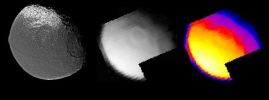
Japetus-temp.3-PIA07004_modest.jpgJapetus Thermal Radiation Image55 visiteCaption NASA originale:"This image of the infrared heat radiation from Saturn's moon Japetus was obtained by the Cassini composite infrared spectrometer instrument 16 hours before Cassini's closest approach to this mysterious moon, on December 31, 2004. The thermal radiation is shown as both a grayscale image, equivalent to what we would see if our eyes were sensitive to infrared wavelengths near 15 microns and as a color-coded temperature map. A previously-released mosaic obtained by Cassini's imaging camera shortly before the composite infrared spectrometer observation, with similar scale and orientation, is also shown for comparison. Temperatures in the large crater near the center of the disc are slightly different from those in surrounding areas, because sloping surfaces within the crater are warmer where they are tilted towards the Sun and cooler when tilted away from the Sun".
(7 voti)
|
|

Japetus-PIA06168_modest.jpgJapetus56 visiteCaption NASA originale:"This image reveals a heavily cratered surface and shows the boundary between Iapetus' bright trailing hemisphere and Cassini Regio - a large, dark region that covers the leading hemisphere of the moon's surface. Some of the dark material appears to have collected inside the rim of a large impact structure about 250 Km across that lies just beyond the edge of the dark region (seen here near the right of the image). NASA's Voyager images (see PIA02268) this feature appeared as a dark 'moat' and had been hypothesized to be an impact structure. The recent images from Cassini confirm an impact origin for this feature.
(7 voti)
|
|

Japetus-N00026251.jpgJapetus: the terminator, in HD (2)61 visitevedi i commenti al frame precedente
(7 voti)
|
|

Japetus-N00026250.jpgJapetus: the terminator, in HD (1)56 visiteLa linea del terminatore di Giapeto, ripresa da una distanza di circa 179.000 Km. Sembra, da questa immagine, che ci siano delle notevoli similitudini fra questa luna e la nostra Luna. Si tratta, come ovvio, di analogie apparenti le quali, ad un esame più approfondito, potrebbero essere smentite; comunque possiamo riconoscere le sagome familiari di crateri da impatto di varie età e dimensioni (più antichi al centro - uno, piuttosto grande, in particolare, a Dx - e, apparentemente, più recenti a Sn), rilievi montuosi molto accidentati (Sn) e canyons (uno, molto lungo e ben visibile, si trova all'incirca al centro del frame, a ridosso del terminatore, leggermente spostato sulla Sn). Sono visibili anche delle aree sostanzialmente pianeggianti (tipo i "mari" della Luna) sulle quali, tuttavia, rimangono evidenti segni di attività tettoniche occorse (ed esauritesi), con ogni probabilità, in epoche remote.
(7 voti)
|
|
Japetus-N25973.jpgJapetus from approx. 2,2 MKM60 visiteGiapeto: in questa immagine, ripresa da una considerevolissima distanza, possiamo vedere una parte del suo "volto": quella più scura ed enigmatica. La causa del buio che regna su un'ampia porzione della superficie di Giapeto viene attribuita, da qualche Scienziato, alla possibile presenza, su di essa, di enormi depositi di polveri (di carbone o, comunque, di qualcosa di molto simile alle polveri di carbone) i quali, letteralmente, "soffocano e spengono" tutta la luce che arriva. Un Mondo tenebroso, quindi: un Mondo fatto più di ombra che di luce.
Un Mondo, dunque, che sarebbe ancora più affascinante tentare di scoprire...
(7 voti)
|
|

Dione-PIA06164-detail mgnf.jpgThe anomalous "straight tectonic fracture" on Dione - detail mgnf103 visiteLa vedete la "frattura" anomala ora? Guardatela e studiatela con molta attenzione: si tratta di una configurazione della superficie di Dione davvero molto strana e, se si tratta davvero di una tectonic fracture, allora occorre dire che essa è molto differente, da tantissimi punti di vista, da tutte le altre che possiamo vedere nelle immagini HR di Dione.
(7 voti)
|
|

Dione-N00025769.jpgDione from approx. 82.000 Km55 visiteSpettacolare immagine di Dione in una sua area prossima al terminatore. Sono chiaramente visibili, oltre a numerosi crateri di notevole ampiezza, anche dei lunghissimi canyon i quali dovrebbero essere la conseguenza del "repentino" (in senso geologico, naturalmente) raffreddamento della sua superficie.
(7 voti)
|
|

Prometheus-PIA06143_modest.jpgPrometheus and the F-Ring56 visiteAs it completed its first orbit of Saturn, Cassini zoomed in on the rings to catch this wondrous view of the shepherd moon Prometheus (102 Km across) working its influence on the multi-stranded and kinked F-Ring. The F-Ring resolves into five separate strands in this closeup view. Potato-shaped Prometheus is seen here, connected to the ringlets by a faint strand of material. Imaging scientists are not sure exactly how Prometheus is interacting with the F-Ring here, but they have speculated that the moon might be gravitationally pulling material away from the ring. The ringlets are disturbed in several other places. In some, discontinuities or "kinks" in the ringlets are seen; in others, gaps in the diffuse inner strands are seen. All these features appear to be due to the influence of Prometheus. The image was taken in visible light with the narrow angle camera on Oct. 29, 2004, at a distance of about 782.000 Km from Prometheus and at a phase angle of 147°. Scale is 4.7 Km per pixel".
(7 voti)
|
|
| 2244 immagini su 187 pagina(e) |
 |
|
|
|
|
24 | |
|
|
|
|





