| Piú votate - Saturn: the "Ringed Beauty" and His Moons |

Mimas-PIA06591.jpg"Phase-locked" Mimas!55 visiteCaption NASA originale:"Cassini's ability to remain precisely and steadily pointed at targets, such as Saturn's moon Mimas (seen here) yields sharp images despite the relatively high speed at which the spacecraft moves.
Cassini was traveling at more than 13 Km per second when it acquired this view, which shows crisp detail on Mimas against the backdrop of Saturn's Northern Hemisphere. Shadows of the icy rings stretch across the atmosphere and appear to be blurred because of the spacecraft motion.
The part of Mimas visible here always faces away from Saturn as the moon orbits the Gas Giant. In scientific language (jargon...), Mimas is said to be "phase-locked".
The image has been rotated so that North on Mimas (and Saturn) is up. This view was obtained with the Cassini spacecraft narrow angle camera on Jan. 18, 2005, at a distance of approx. 1,25 MKM from Mimas and at a phase angle of 114°. The image was taken using filters sensitive to wavelengths of infrared and polarized light. Res. is 7 Km/pixel".
(7 voti)
|
|

Rhea-N00028939.jpgRhea (from approx. 2,5 MKM) and Tethys56 visiteUn'altra immagine del "Carosello Planetario" costituito dalle Lune di Saturno che si inseguono e si incrociano, davanti agli occhi di Cassini. Forse ci sbagliamo, perchè - in fondo - viviamo in un mondo cui le "cose che interessano" sono altre... Tuttavia noi crediamo che un simile spettacolo riuscirebbe ad interessare ed affascinare chiunque!
(7 voti)
|
|

Saturnian Aurora.jpgSaturnian Aurora - HST56 visiteDa "NASA - Picture of the Day" del 22 Febbraio 2005:
"Are Saturn's auroras like Earth's? To help answer this question, the Hubble Space Telescope and the Cassini spacecraft monitored Saturn's South Pole simultaneously as Cassini closed in on the gas giant in January 2004. Hubble snapped images in ultraviolet light, while Cassini recorded radio emissions and monitored the solar wind. Like on Earth, Saturn's auroras make total or partial rings around magnetic poles. Unlike on Earth, however, Saturn's auroras persist for days, as opposed to only minutes on Earth. Although surely created by charged particles entering the atmosphere, Saturn's auroras also appear to be more closely modulated by the solar wind than either Earth's or Jupiter's auroras. The above sequence shows 3 Hubble images of Saturn each taken two days apart".
(7 voti)
|
|

Saturn-W00005056.jpgSaturn, from approx. 1.130.000 Km58 visitenessun commento
(7 voti)
|
|

Janus-N00028725.jpgJanus and the "Lord of the Rings"58 visitenessun commento
(7 voti)
|
|

Enceladus-PIA06188.jpgEnceladus "tormented" surface57 visiteCaption NASA originale:"This HR image from Cassini shows a region of "smooth plains" terrain on the surface of Saturn's moon Enceladus, located slightly north of the equator on the moon's Saturn-facing hemisphere. The area is about 70 by 84 Km.
The image shows a variety of tectonic features that attest to Enceladus' dynamic geological history. At the top of the image is a relatively fresh-looking crevasse system with individual fractures more than a kilometer wide. The crevasse system cross-cuts a complex NE-to-SW-trending system of older faults. A 12-Km-wide band of crudely aligned, chevron-shaped features runs down the center of the image. Among the most intriguing features in this view are a series of dark, small spots, 125 to 750 meters in diameter.
The "dark spots" often seem to be aligned in chains parallel to narrow fractures. The contrast of the dark features with the surrounding bright terrain suggests that they may be compositionally distinct, but their origin is a new mystery".
(7 voti)
|
|

Tethys-PIA06583.jpgItacha Chasma on Tethys56 visiteCaption NASA originale:"Ithaca Chasma is one of the two most prominent features on Saturn's moon Tethys; the other is the gigantic crater Odysseus. Ithaca Chasma is visible near the moon's lower right limb in this image, which does not reveal the branching canyon's full extent. Discovered in NASA Voyager images, the chasm is about 100 Km across on average, and is 4 Km deep in places. It stretches more than 1.000 Km over Tethys' surface, from North to South. This view was obtained with the Cassini spacecraft narrow angle camera on Jan. 17, 2005, at a distance of approximately 1 MKM (approx. 621.000 miles) from Tethys and at a phase angle of 110°. Resolution in the original image was about 6 Km (3,7 miles) per pixel. Contrast was enhanced and the image was magnified by a factor of two to aid visibility".
(7 voti)
|
|

Enceladus-PIA06581_modest.jpgEnceladus: getting closer...61 visiteCaption NASA originale:"This Cassini image of Saturn's moon Enceladus shows a region containing bizarre, wrinkled terrain. Enceladus is covered with bright water ice. The part of its surface visible here appears to be largely free of craters - indicating that it is geologically young (NOTA LUN-EX-IT: la mancanza di crateri non è solo indice di "gioventù geologica"; essa può anche essere dipendente dal fatto - improbabile ma da NON escludersi a-priori - che taluni processi geologici sìano ancora in corso!
Il tutto senza escludere la possibilità - anch'essa remota ma non assurda - che Encelado sia stata una "luna fortunata" e bombardata in misura inferiore rispetto alle altre...).
The first close imaging of this moon will be done by Cassini in February 2005 and should reveal many surprises. Enceladus has a diameter of 499 Km (310 miles). This view shows primarily the leading hemisphere of Enceladus and it was taken from a distance of 367.000 Km. Resolution in the original image was about 2 Km per pixel".
(7 voti)
|
|

Enceladus-PIA06579.jpgCrescent Enceladus, the brightest gem of Saturn's System57 visiteCaption NASA originale:"In the dim light of the outer Solar System, Cassini gazed back at Saturn's brightest gem: the moon Enceladus. The icy little world presents only a slim crescent in this natural color view. Cassini has now matched the best spatial resolution on Enceladus achieved by NASA's Voyager spacecraft, and will soon have excellent coverage of the moon (at more than 10 times the resolution in this image), following a flyby planned for February 17.
When seen from its day side, Enceladus (499 Km across) has one of the brightest and whitest surfaces in the Solar System. Since it reflects most of the sunlight that strikes it, the temperature there remains at a chilly -200°C (-330° Fahrenheit).
In this view, Cassini was pointed at the leading hemisphere of Enceladus, which was in darkness at the time. The image has been rotated so that north on Enceladus is up".
(7 voti)
|
|
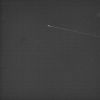
Unexplainable-N00027253.jpgSomething's moving in the Space of Saturn59 visiteImmagine ripresa dalla Sonda Cassini il 31 Gennaio 2005 e ricevuta a Terra il 1mo Febbraio.
Che cosa mostra? Si tratta, evidentemente, di un fenomeno - per noi - "unexplainable", come molti altri.
Le ipotesi sono le solite: 1) immagine "mossa" di una stella o di un piccolo satellite di Saturno (ipotesi più probabile); 2) oggetto in movimento "di passaggio" accanto alla Sonda - un UFO? - (ipotesi leggermente meno probabile); 3) artefatto fotografico (ipotesi decisamente improbabile). Noi saremmo propensi, per una molteplicità di fattori, a considerare l'ipotesi 1) come la più probabile (almeno in questo frangente).
(7 voti)
|
|

Japetus-cassini-big.jpgJapetus: the most misterious Saturnian moon57 visiteCaption NASA originale:"What has happened to Saturn's moon Japetus? A strange ridge crosses the moon near the equator, visible near the bottom of the above image, making Japetus appear similar to the pit of a peach. Half of Japetus is so dark that it can nearly disappear when viewed from Earth. Recent observations show that the degree of darkness of the terrain is strangely uniform, like a dark coating was somehow recently applied to an ancient and highly cratered surface. The other half of Japetus is relatively bright but oddly covered with long and thin streaks of dark. A 400-Km wide impact basin is visible near the image center, delineated by deep scarps that drop sharply to the crater floor. The above image was taken by the Saturn-orbiting Cassini spacecraft during a flyby of Japetus at the end of last year".
(7 voti)
|
|

Saturn-N00027083.jpgHiding behind the Rings!57 visiteRhea - o almeno così ci sembra, ma potremmo anche sbagliare - "gioca" a nascondersi dietro gli Anelli di Saturno.
Un'immagine incredibile che fissa il momento in cui questa luna si accinge a scomparire dalla visuale della Sonda Cassini, attratta e quindi "assorbita" - si fa per dire... dai maestosi Anelli del Gigante.
(7 voti)
|
|
| 2244 immagini su 187 pagina(e) |
 |
|
|
|
|
23 | |
|
|
|
|





