| Piú votate - Saturn: the "Ringed Beauty" and His Moons |

Tethys-IMG001589-br500.jpgItaca Chasma on Tethys57 visiteCaption NASA originale:"Saturn's icy moon Tethys displays a very old impact basin here, just South-East of its giant canyon system, Ithaca Chasma. The large crater has been degraded, or softened, by time and a more recent impact has formed a smaller crater near its southern edge. This large basin was first seen in images from the NASA Voyager mission. A sharper, presumably younger crater called Penelope lies near the eastern limb, at the 3 o'clock position. This view shows principally the trailing hemisphere on Tethys and North is directly up.
The image was taken in visible light with the Cassini spacecraft narrow-angle camera on May 20, 2005, at a distance of approx. 1 MKM (approx. 600.000 miles) from Tethys and at a Sun-Tethys-spacecraft, or phase, angle of 31°. Resolution in the original image was 6 Km (about 4 miles) per pixel. The image has been contrast-enhanced and magnified by a factor of two to aid visibility".
(7 voti)
|
|

Pandora-PIA07530.jpgPandora: the closest view so far!56 visiteCaption NASA originale:"This is one of Cassini's closest views to date of Saturn's F-Ring shepherd moon Pandora. At least one crater is visible on the surface of this moon, which is thought to be an icy rubble pile, loosely bound together by gravity. Pandora is 84 Km across.
Several of Saturn's Ring moons, including Pandora, show elongated, oval-like shapes with their long axes oriented along the moon-Saturn line. In this view, Cassini is looking at the side of Pandora facing away from Saturn. The image shows the moon's leading hemisphere (although, as mentioned, Pandora is not actually round). To the right, much of the moon's surface is in shadow. The image was taken in visible light with the Cassini spacecraft narrow-angle camera on May 20, 2005, at a distance of approx. 346.000 Km from Pandora and at a Sun-Pandora-spacecraft, or phase, angle of 21°".
(7 voti)
|
|

Pandora-PIA07523.jpgPandora and the F-Ring57 visiteCaption NASA originale:"The shepherd moon, Pandora, is seen here alongside the narrow F-Ring that it helps maintain in the right equlibrium.
Cassini obtained this view from about 4° above the ringplane. Captured here are several faint, dusty ringlets in the vicinity of the F-Ring core.
The ringlets do not appear to be perturbed to the degree seen in the core.
The appearance of Pandora here is exciting, as the moon's complete shape can be seen, thanks to reflected light from Saturn, which illuminates Pandora's dark side; also the hint of a crater is visible on the dark side of the moon.
The image was taken in visible light with the Cassini spacecraft narrow-angle camera on May 4, 2005, at a distance of approx. 967.000 Km (such as approx. 601.000 miles) from Pandora and at a Sun-Pandora-spacecraft angle of 117°. The image scale is 6 Km per pixel".
(7 voti)
|
|

Saturn-SouthPole-PIA06657.jpgThe South-Pole of Saturn57 visiteCaption NASA originale:"Cassini peeks at Saturn's relatively dark South Pole, providing an up-close look at the haze-free upper atmosphere there. The banded structure around the pole seems to be superimposed on the characteristic high-latitude, mottled, turbulent structure (the white puffs of cloud near the Pole), suggesting that the banding is a shallow, not deep, feature.
The image was taken in visible light with the Cassini spacecraft narrow-angle camera on April 23, 2005, through a filter sensitive to wavelengths of polarized infrared light at a distance of approx. 2,4 MKM (about 1,5 MMs) from Saturn. The image scale is 14 Km (approx. 9 miles) per pixel".
(7 voti)
|
|

Saturn-PIA06658.jpgSunlit South...57 visiteCaption NASA originale:"This poetic wide-angle camera view of Saturn reveals several small, dark storms in the southern latitudes, where storm activity has been prevalent since before Cassini arrived in orbit.
Also notable here is the semi-transparent C-Ring, which is visible against the backdrop of the planet.
The image was taken in visible light with the Cassini spacecraft wide-angle camera on April 23, 2005, through a filter sensitive to wavelengths of infrared light centered at 1028 nnmts and at a distance of approx. 2,4 MKM (about 1,5 MMs) from Saturn. The image scale is 142 Km (approx. 88 miles) per pixel".
(7 voti)
|
|

Saturn-W00006821.jpgSpark in the Dark! (possible Anomaly)57 visiteCassini sta viaggiando nel cono d'ombra generato da Saturno e quindi, se il 'volto di Saturno' sta guardando il Sole, noi possiamo pure dire che Cassini è 'alle spalle' del Gigante Anellato.
Ciò premesso, riusciamo comunque a vedere una porzione dell'Anello F (ancora illuminato da Sole e davvero caratteristico ed inconfondibile per i suoi 'clumps'!) sull'estrema Dx dell'immagine mentre, proprio al centro del frame, distinguiamo chiaramente un corpo luminoso sferico e svariati altri puntini luminosi e svariati graffi. Sui 'puntini luminosi' ed i 'graffi', la nostra esperienza in campo di fotografia astronomica e spaziale ci dice che si tratta di semplici photo-artifacts. Il punto luminoso centrale, invece, secondo noi NON lo è.
Ora, dato che stiamo guardando in una regione immersa nell'ombra di Saturno (e dunque nel buio), quel punto - se effettivamente NON è un photo-artifact - NON può neppure essere una delle Lune Saturniane!
E allora che cos'è?
(7 voti)
|
|

Japetus-PIA06646.jpgJapetus: a clear view in the darkness64 visiteNon è certo un frame di qualità eccezionale, ma - finalmente! - si torna a vedere Giapeto, la "Luna Bifronte" (ossìa per metà chiara e luminosa e per metà nera come la pece).
Questo il commento NASA originale:"This view shows one of the huge impact basins on the terminator of Saturn's moon Iapetus and a smaller, but still fairly large, crater near the southern bright-dark boundary. Just visible near the western limb, in the dark territory of Cassini Regio, is the moon's mysterious equatorial ridge. The ridge was discovered in Cassini images and reaches 20 Km (approx. 12 miles) high in places. This view shows principally the leading hemisphere on Iapetus. North is up and tilted 15 degrees to the right. The image was taken with the Cassini spacecraft narrow-angle camera on March 19, 2005, through spectral filters sensitive to wavelengths of infrared light centered at 752 nnmts. The view was acquired at a distance of approximately 1,4 MKM from Iapetus and at a phase angle of 70°. Resolution is 8 Km/pixel".
(7 voti)
|
|

Hyperion-PIA06645.jpgThe "tumbling" Hyperion is still on sight57 visitenessun commento
(7 voti)
|
|

Saturn_s Rings-PIA06239.jpgS/2005 S1: The "Wave-Maker" (2)57 visiteCaption NASA originale:"In the vicinity of the newly discovered little moon, the Keeler Gap's edges bear striking similarities to the scalloped edges of the 322 Km-wide (approx. 200-mile) Encke Gap, where the small moon Pan (25 Km, or approx. 16 miles across) resides.
From the size of the waves seen in the scalloped edges of the Encke Gap, imaging scientists were able to estimate the mass of Pan.
They expect to do the same, eventually, with S/2005 S1".
(7 voti)
|
|
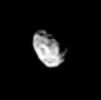
Hyperion-PIA06623.jpgHyperion from 1,7 MKM55 visiteCaption NASA originale:"The rugged surface of Saturn's irregular (and "tumbling") moon Hyperion is revealed in this Cassini image. Hyperion is 266 Km (approx. 165 miles) across.
The image was taken in visible light with the Cassini spacecraft narrow-angle camera on Feb. 23, 2005, at a distance of approx. 1,7 MKM (such as approx. 1 MMs) from Hyperion and at a Sun-Hyperion-spacecraft, or phase, angle of 42°. Resolution in the original image was 10 Km (approx. 6 miles) per pixel. The image has been contrast-enhanced and magnified by a factor of 3 to aid visibility".
(7 voti)
|
|

Saturn-PIA06604.jpgSaturn, Titan, Rhea and Enceladus60 visiteCaption NASA originale:"Saturn's biggest and brightest moons are visible in this portrait by Cassini.
Titan (5.150 Km, or 3,200 miles across) is Saturn's largest moon and appears at the lower left. Note that some details in the moon's smoggy atmosphere are visible here. Rhea (1.528 Km, or 949 miles across) is the planet's second largest moon and is seen above center. Enceladus (505 Km, or 314 miles across) has the brightest surface in the solar system, reflecting nearly all of the sunlight that falls upon it. Enceladus is just above the rings, left of center. Titan was on the far side of the planet at the time of this exposure, while the other moons were on the near side, much closer to Cassini.
Also seen here are details in the cloud bands of Saturn's mostly hydrogen atmosphere, variations in brightness across the dazzling rings and magnificent ring shadows cast upon the northern hemisphere. The image was taken with the Cassini spacecraft wide-angle camera on Feb. 5, 2005, at a distance of approximately 3.4 million kilometers (2.1 million miles) from Saturn through a filter sensitive to wavelengths of infrared light centered at 728 nanometers. The image scale is 200 kilometers (124 miles) per pixel".
(7 voti)
|
|

Japetus-A-The-Wall-Mosaic-l.jpgThe "Wall" of Japetus56 visiteEffettivamente la configurazione esteriore della superficie di Giapeto non ci è proprio possibile definirla "convenzionale": in questa immagine ripresa dalla Sonda Cassini possiamo vedere un interessante rilievo superficiale che il Prof. Hoagland ha, secondo noi correttamente, definito "Wall": un muro.
Ora andiamo a vedere - con il prossimo frame - un detail mgnf di questo "muro"...
(7 voti)
|
|
| 2244 immagini su 187 pagina(e) |
 |
|
|
|
|
22 | |
|
|
|
|





