| Piú votate - Saturn: the "Ringed Beauty" and His Moons |

Mimas-N00041399.jpgMimas and Prometheus55 visiteN00041399.jpg was taken on October 13, 2005 and received on Earth October 14, 2005. The camera was pointing toward PROMETHEUS - distant approximately 769.213 Km away - and the image was taken using the CL1 and CL2 filters. This image has not been validated or calibrated. 
(7 voti)
|
|

Pandora-PIA07602.jpgPandora55 visiteOriginal caption:"Saturn's moon Pandora is almost overwhelmed by the brightness of the F-Ring in this view. The F-Ring's bright core displays kinks and is flanked by fainter ringlets. Imaging scientists recently determined these fainter ringlets to be a single spiral ring that winds around the Planet. Pandora is faintly lit by "Saturnshine," or reflected light from the planet, and few features can be seen here. This image was acquired by Cassini exactly three hours after the spacecraft took the image seen in previous PIA07601, which showed Prometheus interior to the F-Ring.
The image was taken in visible light with the Cassini spacecraft narrow-angle camera on Aug. 21, 2005, at a distance of appx. 583.000 Km from Saturn and at a high Sun-Saturn-spacecraft angle of 136°. Resolution is about 3 Km per pixel".
Nota: osservate il frame PIA07530 e poi confrontate le due immagini di Pandora. A noi sembra che ci sia una "profonda" differenza e che il corpo celeste ripreso nei due frames NON sia lo stesso.
(7 voti)
|
|
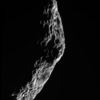
Hyperion-PIA07739.jpgGood-bye Hyperion...56 visiteOriginal caption:"As Cassini sped away from its close encounter with Saturn's moon Hyperion on Sept. 26, 2005, it took this parting shot of the battered moon's shadowy limb.
The image was taken in visible light with the Cassini spacecraft narrow-angle camera at a distance of approx. 32.300 Km (about 20.000 miles) from Hyperion and at a Sun-Hyperion-spacecraft angle of 127°.
Image scale is 192 meters (630 feet) per pixel".
(7 voti)
|
|

Hyperion-N00040374.jpgHyperion (22)55 visiteCassini è a soli 4800 Km - circa - da Hyperion: anche questo frame è davvero di grandissimo fascino e di imparagonabile attrattiva (sebbene, come avremo modo di vedere e parlarne - grazie all'aiuto del Dr Feltri - in Reserved Area, siamo a "rischio" di falso "planetario"...)
(7 voti)
|
|

Rhea-PIA07583.jpgRhea, from about 255.000 Km91 visiteSaturn's moon Rhea is an alien ice world, but in this frame-filling view it is vaguely familiar. Here, Rhea's cratered surface looks in some ways similar to our own Moon, or the planet Mercury. But make no mistake - Rhea's icy exterior would quickly melt if this moon were brought as close to the Sun as Mercury.
Instead, Rhea preserves a record of impacts at its post in the Outer Solar System.
For exemple, the large impact crater at center left (near the terminator), called Izanagi, is just one of the numerous large impact basins on Rhea.
This view shows principally Rhea's Southern Polar Region, centered on 58° South and 265° West.
The image was taken in visible light with the Cassini spacecraft narrow-angle camera on Aug. 1, 2005, at a distance of approx. 255.000 Km (such as about 158.000 miles) from Rhea and at a Sun-Rhea-spacecraft, or phase, angle of 62°.
The image scale is 2 Km (about 1,2 miles) per pixel.
(7 voti)
|
|

Rings-PIA07718.jpgArcs in the G-Ring54 visiteOriginal NASA caption:"This sequence of images shows a faint arc of material in Saturn's G-Ring, a tenuous ring outside the main Ring System. These images were each taken about 45' apart. During this time, the arc (slightly brighter than the Ring itself) moves around the outer edge of the Ring. The arc is visible on the lower part of the Ring in the first image, just beneath the ansa (or outer edge). In the second image the arc is easily seen on the outer edge and then faintly just above the outer edge in the third image.
What makes this part of the G-Ring brighter than other parts is not clear. However, the existence of this arc might hold clues about how this ring was formed and where the material which makes up this ring comes from. These 3 images were taken in polarized near-infrared light using the Cassini spacecraft narrow-angle camera on May 24, 2005, at a distance of approx. 1,7 MKM (about 1,1 MMs) from Saturn. Resolution in the original images was about 97 Km per pixel".
(7 voti)
|
|

Saturn-PIA07559.jpgRings in the Rings, both cut by the darkness...57 visiteCaption NASA originale:"This view shows the unlit face of Saturn's Rings, visible via scattered and transmitted light. In these views, dark regions represent gaps and areas of higher particle densities, while brighter regions are filled with less dense concentrations of ring particles.
The dim right side of the image contains nearly the entire C-Ring. The brighter region in the middle is the inner B-Ring, while the darkest part represents the dense outer B-Ring. The Cassini Division and the innermost part of the A-Ring are at the upper-left.
Saturn's shadow carves a dark triangle out of the lower right corner of this image.
The image was taken in visible light with the Cassini spacecraft wide-angle camera on June 8, 2005, at a distance of approximately 433.000 Km (about 269.000 miles) from Saturn. The image scale is 22 Km (about 14 miles) per pixel".
(7 voti)
|
|

Rings-PIA07556.jpgThe "Opposition Effect"58 visiteCaption NASA originale:"The "opposition effect" can be seen in this image of Saturn's B ring. The bright spot occurs where the angle between the spacecraft, the Sun and the Rings is near zero.
Studies of the Opposition Effect on Saturn's Rings may help scientists constrain some of the properties of the Ring particles, such as their sizes and spatial distribution.
The image was taken in visible light with the Cassini spacecraft wide-angle camera on June 26, 2005, at a distance of approximately 478.000 Km (about 297.000 miles) from Saturn. The image scale is 3 Km (about 2 miles) per pixel".
(7 voti)
|
|

Mimas-N00037768.jpgMimas, from approx. 63.000 Km57 visitenessun commento
(7 voti)
|
|

Prometheus-PIA07549~0.jpgPrometheus from approx. 438.000 Km55 visiteCaption NASA originale:"Saturn's shepherd moon Prometheus reveals its elongated, irregular form to Cassini in this image. The moon's long axis points toward Saturn, while this view shows the southern part of the moon's anti-Saturn side (such as the face that always points away from Saturn).
The image was taken in visible red light with the Cassini spacecraft narrow-angle camera on June 7, 2005, at a distance of approx. 438.000 Km (about 272.000 miles) from Prometheus. Resolution in the original image was 3 Km per pixel. The image has been contrast-enhanced and magnified by a factor of two to aid visibility".
(7 voti)
|
|

Enceladus-N005-N00037070.jpgEnceladus from approx. 545 Km (2)58 visitenessun commento
(7 voti)
|
|

Prometheus-PIA07540.jpgThe "double night" of Prometheus55 visiteCaption NASA originale:"Saturn's moon Prometheus is seen here emerging from the darkness of Saturn's shadow. This shepherd moon, like most of Saturn's moons, always keeps the same face pointing toward the Planet. An observer on the moon's Saturn-facing side would never see the Sun directly overhead at noon, for the Planet would always be in the way (creating an eclipse). Instead, the Sun would rise in the east, but as noon approached the eclipse would begin, bringing darkness a second time. Night comes twice on Prometheus.
This image was taken in visible light with the Cassini spacecraft narrow-angle camera on June 3, 2005, at a distance of approx. 2,1 MKM (such as 1,3 MMs) from Saturn. The image scale is 13 Km (such as 8 miles) per pixel".
(7 voti)
|
|
| 2244 immagini su 187 pagina(e) |
 |
|
|
|
|
21 | |
|
|
|
|





