| Piú votate - Saturn: the "Ringed Beauty" and His Moons |

Saturn-W00019554.jpgA "Slice" of Light...54 visiteCaption NASA:"W00019554.jpg was taken on November 06, 2006 and received on Earth November 06, 2006. The camera was pointing toward Saturn that, at the time, was approximately 1.284.897 Km away.
The image was taken using the CB2 and IRP90 filters and it has not been validated or calibrated".
(7 voti)
|
|

The_Rings-PIA08298.jpgFrom the Dark Side of Saturn58 visiteCaption NASA:"The Cassini spacecraft gazes down through the Dark Side of Saturn's Rings toward the softly glowing Planet. The night side Southern Hemisphere is lit by Sunlight reflecting off the opposite side of the Rings.
The Planet's shadow slices diagonally across the scene.
This view was acquired from about 23° above the Ring-Plane. The sliver of Saturn's sunlit crescent is partly overexposed as seen through the Cassini Division, a Region where there is less material to block or scatter incoming light.
Images taken using red, green and blue spectral filters were combined to create this natural color view. The images were taken with the Cassini spacecraft wide-angle camera on Sept. 11, 2006 at a distance of approx. 1,1 MKM (about 700.000 miles) from Saturn and at a phase angle of 151°.
Image scale is about 60 Km (such as approx. 37 miles) per pixel".
(7 voti)
|
|

Streak-N00065622-4.jpgWhat is that? (detail mgnf n. 3)60 visiteNotate ora la "coda" di questa striscia di luce: notate come essa suggerisca un'ipotesi di "dissolvenza", concettualmente simile a quello che accade ad una traccia lasciata nel cielo da un aviogetto (la quale, poco dopo essere stata creata, viene spazzata via dal vento)?
Ora, quanto è compatibile questa costruzione logica con l'ipotesi del "bolide" (per non parlare dell'ipotesi del "raggio cosmico")?
Poco. Davvero poco.
Purtroppo non conosciamo i tempi di scatto (un millesimo di secondo o, per esempio, 10 secondi? O forse di più?), ma la nostra esperienza in materia di fotografia ci spinge a ritenere che questo scatto è stato molto breve (forse non più di un paio di secondi). Perchè? Perchè non si vedono stelle - che, con una posa appena più lunga, apparirebbero a centinaia/migliaia - e perchè la Striscia di Luce NON è mossa (come invece dovrebbe inevitabilmente accadere se si fosse trattato di uno scatto a posa media o medio-lunga).
Conclusioni? Noi non ne abbiamo. Però abbiamo (ed avete anche Voi) parecchi elementi interessanti per valutare ed ipotizzare...
(7 voti)
|
|

Prometheus.jpgPrometheus: the "Ring-Shaper"...54 visiteCaption NASA originale:"Prometheus zooms across the Cassini spacecraft's field of view, attended by faint streamers and deep gores in Saturn's F-Ring. This frame (taken from a movie sequence of five images) shows the F-Ring shepherd moon shaping the Ring's inner edge.
Note (watching the movie) that the faint ringlet coincident with the orbit of Prometheus (only 102 Km or approx. 63 miles across) decreases sharply in brightness behind the moon in its path. The normally twisted-looking F-Ring core is overexposed in the images, causing its appearance to be more uniform than it usually is.
This image was taken in visible light with the Cassini spacecraft narrow-angle camera on Aug. 11, 2006, at a distance of approx. 2,2 MKM (about 1,4 MMs) from Saturn and at a Sun-Saturn-spacecraft, or phase, angle of 162°. Image scale is roughly 13 Km (about 8 miles) per pixel".
(7 voti)
|
|

Rhea-N00064799-A.jpgMoments of Rhea (1) - context image54 visitenessun commento
(7 voti)
|
|

Japetus-PIA08177.jpgThe darkest moon is there...57 visiteA distant glimpse of Japetus reveals details within the dark terrain of the Cassini Regio, including an impact basin at top that is roughly 400 Km (about 250 miles) wide.
Researchers remain unsure about the mechanism that has darkened the Leading Hemisphere.
This view looks toward the Southern Hemisphere on the leading side of Japetus (1.468 Km, or about 912 miles across). North is up.
The image was taken in visible light with the Cassini spacecraft narrow-angle camera on April 4, 2006, at a distance of approx. 1,4 MKM (such as about 900.000 miles) from Japetus.
The image scale is roughly 9 Km (about 6 miles) per pixel.
(7 voti)
|
|

Janus and Epimetheus-PIA08170.jpgJanus, Epimetheus and the "Orbital Switch"54 visiteCaption NASA originale:"In their orbital ballet, Janus and Epimetheus swap positions every four years - one moon moving closer to Saturn, the other moving farther away. The two recently changed positions (the swap occurring on January 21, 2006), and Janus will remain the innermost of the pair until 2010, when they will switch positions again.
Although the moons appear to be close in the image, they are not. Janus is about 40.000 Km (appx. 25.000 miles) farther away from Cassini than Epimetheus (at left) in this view. In fact, even when they are at their closest, tugging at each other and swapping orbital positions, they are never closer than about 15.000 Km (about 9.000 miles).
The image was taken in visible light with the Cassini spacecraft narrow-angle camera on March 20, 2006 at a distance of approx. 452.000 Km(about 281.000 miles) from Epimetheus and 492.000 Km (about 306,000 miles) from Janus. The image scale is about 3 Km (appx. 2 miles) per pixel on both moons".
(7 voti)
|
|

Rhea-N00055690.jpgRhea and a "streak of light"55 visiteCerchiatura Bianca: un (nuovo) "streak" di luce bianca e molto intensa il quale, laddove non fosse il solito photoartifact, potrebbe concretare una interessante Anomalìa.
In realtà, la "striscia" in questione non ci pare proprio un photoartifact ed inoltre essa non dovrebbe neppure essere la semplice evidenza di un corpo celeste (un'altra luna di Saturno, ad esempio) il quale è rimasto non solo sovraesposto, ma anche strisciato (o "mosso") a causa della (eccessiva) durata della ripresa fotografica in rapporto alla velocità della Sonda . Per altro, anche osservando altri frames della Serie "N" - ad esempio N00055772 - la nostra sensazione è che il moto di Cassini, dal punto di vista dell'Osservatore e rispetto a Rhea, è ORIZZONTALE (da Sx a Dx) mentre lo streak è invece VERTICALE!
Deduzione logica: lo streak rappresenta un oggetto reale, situato ad una distanza indefinita da Cassini, il quale si sta muovendo rapidamente mentre asseconda una traiettoria incongrua rispetto a quella di Cassini.
Un "UFO", insomma...
(7 voti)
|
|
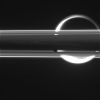
Janus&Titan-N00055796.jpgPassing-by... (1)55 visiteUna piccola serie di 3 frames (decisamente suggestivi) i quali ci mostrano alcuni istanti del transito della Sonda Cassini in una porzione dello spazio circum-saturniano capace di mostrarci lo spettacolo dell'incrocio (si tratta, come ovvio, di un semplice gioco prospettico) fra la piccola luna Giano (Janus), gli Anelli di Saturno e Titano.
Data:"N00055796.jpg was taken on March 21, 2006 and received on Earth March 22, 2006. The camera was pointing toward Janus that, at the time, was approximately 724.598 Km away.
The image was taken using the CL1 and CL2 filters".
(7 voti)
|
|
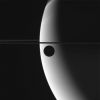
Rhea-W00014306.jpgSliding in the Darkness... (2)54 visitenessun commento
(7 voti)
|
|
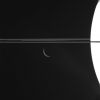
Rhea-W00014280.jpgSliding in the Darkness... (1)54 visiteUn trittico di immagini molto suggestive: Rhea, muovendosi nel silenzio dello spazio circum-saturniano, scivola verso l'ombra del Gigante Anellato e si immerge nella Notte di Saturno.
Commenti? Inutili...
(7 voti)
|
|

Mimas-PIA08135.jpgOverlapping Planets55 visiteCaption originale:"Mimas briefly slipped in front of Tethys while the Cassini spacecraft looked on and captured the event in this series of images.
The images were taken in visible light with the Cassini spacecraft narrow-angle camera on Feb. 11, 2006, at a distance of approx. 3,7 MKM (such as about 2,3 MMs) from Mimas and 4,1 MKM (such as about 2,5 MMs) from Tethys. Resolution in the original images was approx. 22 Km (about 14 miles) per pixel on Mimas and approx. 25 Km (about 16 miles) per pixel on Tethys.
The images have been magnified by a factor of two".
(7 voti)
|
|
| 2244 immagini su 187 pagina(e) |
 |
|
|
|
|
19 | |
|
|
|
|





