| Piú votate - Saturn: the "Ringed Beauty" and His Moons |

AC-Still the E-ring-W00001386.jpgA bright light in the Space of Saturn: Saturn overexposed (3)107 visiteQuesta volta l'immagine che dovrebbe riguardare l'Anello "E" di Saturno e che invece, di regola, si risolve in un fascio di luce, ci appare in una nuova forma. Si potrebbero dire tante cose, ma noi dobbiamo essere pragmatici ed attenerci ai fatti: questo enorme bagliore non sappiamo cosa è o cosa rappresenta.
La NASA, pur non rispondendo direttamente alle nostre richieste, ha detto - commentando un frame simile a questo - che si tratta SEMPRE di Saturno e/o della porzione più esterna dei suoi Anelli, ampiamente sovraesposto/i.
Sinceramente, non sappiamo cosa dire, però abbiamo trovato dei frames simili a questo ma ottenuti dalla Sonda Voyager 2 durante il suo transito accanto ad Urano.
In quel caso la NASA disse, con grande chiarezza ed immediatamente, che si trattava di effetti luminosi causati dalla sovraesposizione del corpo più luminoso inquadrato dalla camera della Sonda (e cioè di Urano stesso).
(9 voti)
|
|

INORBIT2-61690main_soi4-516.jpgOrbital Insertion Complete - In orbit around Saturn (2)56 visitenessun commento
(9 voti)
|
|

TheRings-G-Ring-PIA07643.jpgThe G-Ring's "Glow"55 visiteOriginal caption:"Saturn's G-Ring glows like a neon garland in this lovely narrow angle camera image from Cassini. The comparison between the diffuse outer boundary and the sharp inner edge of this Ring, which consists of fine, dust-sized icy particles, is particularly noteworthy. Close Cassini views such as this should provide Ring scientists with clues about how this Ring is produced and confined.
The G-Ring extends from 166.000 to 173.200 Km (about 103.100 to 107.600 miles) from Saturn's center. (remember: Saturn is 120.500 Km [about 74.900 miles] wide at its equator).
The image was taken in visible light with the Cassini narrow-angle camera on Oct. 24, 2005, at a distance of approx. 2,1 MKM (about 1,3 MMs) from Saturn. The image scale is 12 Km (about 8 miles) per pixel".
(8 voti)
|
|

Saturn-PIA07731-2.jpgSpokes (2)54 visiteAt the bottom left corner of the 1 st and 2nd image, the bright inner edge of the A-Ring is visible. Continuing radially inward (or toward Saturn) are several bands that lie within the Cassini Division, bounded by the bright outer edge of the B-Ring. The rounded shadow of Saturn cuts across the Rings in the image at right.
Cassini's first sighting of Spokes occurs on the unilluminated side of the Rings, in the same region in which they were seen during the Voyager flybys. Although the most familiar Voyager images of spokes showed them on the sunlit side of the Rings, spokes also were seen on the unilluminated side.
In Voyager images, when Spokes were seen at low phase angles, they appeared dark; when seen at high phase angles, they appeared bright. The Spokes seen here are viewed by Cassini at a very high phase angle, which is about 145° at the center of each image.
(8 voti)
|
|

AC-Anomaly-Saturn_s Sky.jpgA bright light in the Space of Saturn: Saturn overexposed (2)105 visiteQuesta immagine, ricevuta il giorno 13 Agosto 2004, appare identica a quella ricevuta il giorno 4 Agosto 2004. In teoria, dovrebbe essere Saturno (o il suo anello "E") "altamente sovraesposto". In pratica noi possiamo dire, con onestà, che la sovraesposizione di un corpo luminoso come Saturno dovrebbe dare esiti visivi completamente diversi da quelli che Vi mostriamo in questo frame.
Di che si tratta? Forse del Sole. Forse un'altra sorgente luminosa, molto più vicina. Noi non lo sappiamo, ma abbiamo chiesto lumi alla NASA.
(8 voti)
|
|

The Rings from 6.280.000 Km.jpgThe Rings from app.x 6.280.000 Km54 visitenessun commento
(8 voti)
|
|

SATURN-61696main_soi7-516.jpgThe "F-Ring" of Saturn from Cassini-Huygens56 visitenessun commento
(8 voti)
|
|

Japetus-PIA12657.jpgLight and Darkness on Japetus (possible Natural Colors; credits for the additional process. and color.: Dr Paolo C. Fienga - Lunexit Team)56 visiteCaption NASA:"Light and Dark Terrain covers the Surface of Saturn's moon Japetus; Lit Terrain seen here is on the area between the Saturn-facing Side and Trailing Hemisphere of Japetus. North is up and rotated 4° to the right.
The image was taken in Visible Light with the Cassini Spacecraft narrow-angle camera on Dec. 1, 2009. The view was obtained at a distance of approx. 1,4 MKM (about 870.000 miles) from Japetus and at a Sun-Japetus-Spacecraft, or Phase, Angle of 100°.
Image scale is roughly 8 Km (approx. 5 miles) per pixel".MareKromium
(4 voti)
|
|
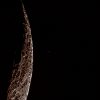
Japetus-W00035137.jpgJapetus (possible natural colors - elab. Lunexit)55 visiteCaption NASA:"W00035137.jpg was taken on September 10, 2007 and received on Earth September 10, 2007. The camera was pointing toward Japetus that, at the time, was approx. 5.983 Km away, and the image was taken using the CL1 and CL2 filters. This image has not been validated or calibrated".MareKromium
(4 voti)
|
|

Saturn-PIA07672.jpgSaturn's limb (enhanced - and yet natural - colors)54 visiteOriginal caption:"Twice as far from the Sun as Jupiter, Saturn's colder temperatures mean that clouds form lower in its atmosphere. As a result, the visible cloud patterns - so striking on Jupiter - occur deeper inside Saturn, reducing their visibility in natural color views.
This enhanced-color view uses exaggerated contrast and intensity in order to make Saturn's cloud bands easy to see.
The Latitude seen at the image center is approximately 60° South of the Equator.
Images taken in blue (BL2), green and red (CB1) polarized spectral filters were combined to create this enhanced-color view. The images were taken with the Cassini spacecraft narrow-angle camera on Dec. 7, 2005, at a distance of approximately 3,1 MKM (1,9 MMs) from Saturn. The image scale is about 36 Km (app.x 22 miles) per pixel".
(4 voti)
|
|

Saturn-N00044404~0.jpgPhotographic Defect, Photo-Artifact or UFO in-transit? (2)57 visiteQuesto frame (dal seriale N. 00044404) contiene un piccolo enigma che, presumibilmente, susciterà una nuova, modesta (e fuggevole) vampata di interesse per la Missione Cassini. Che cosa c'è di così "curioso"? Una striscia (un "bright streak") che taglia - letteralmente - l'immagine e che può ricordare le tracce lasciate da un oggetto in movimento rapido (tipo un satellite o un aereo) quando scattiamo una fotografia del cielo usando un'esposizione non brevissima (ma neppure - necessariamente - lunga). Ci sono elementi per ritenere che questa "linea bianca" sia solo un mero difetto dell'immagine (causato, p.e., da una perdita di dati durante la trasmissione da Saturno), e ci sono elementi - diremmo evidenti - per escludere l'ipotesi del "raggio cosmico" o del "riflesso".
Il frame precedente e quello successivo (anche se non conosciamo il tempo intercorso fra le diverse riprese) non evidenziano l'Anomalìa la quale rimane quindi confinata solo su questa immagine.
Conclusioni? Nessuna, naturalmente...
(4 voti)
|
|

AF-A new Streak in the Sky-N00015685.jpgA new "Big Streak" in the Sky of Saturn120 visiteImmagine ripresa dalla Sonda Cassini/Huygens il giorno 30 Agosto 2004 e ricevuta dal Mission Control il giorno successivo. C'è qualcosa che è passato (o sta passando...) accanto alla Sonda, mentre questa riprende un'immagine dello Spazio di Saturno.
E' un semplice riflesso?
Forse no.
Vi abbiamo proposto delle immagini che riprendono "riflessi" (o qualcosa di simile ad essi) e l'effetto che si vede è molto diverso.
(4 voti)
|
|
| 2244 immagini su 187 pagina(e) |
 |
|
|
|
|
179 | |
|
|
|
|





