| Piú votate - Saturn: the "Ringed Beauty" and His Moons |

Dione-PIA07638.jpgDione: Carthage Linea61 visiteDione's icy surface is scarred by craters and sliced up by multiple generations of geologically-young bright fractures. Numerous fine, roughly-parallel linear grooves run across the terrain in the upper left corner. Most of the craters seen here have bright walls and dark deposits of material on their floors. As on other Saturnian moons, rockslides on Dione may reveal cleaner ice, while the darker materials accumulate in areas of lower topography and lower slope (e.g. crater floors and the bases of scarps).
The terrain seen here is centered at 15,4° North Latitude, 330,3° West Longitude, in a Region called Carthage Linea. North on Dione is up and rotated 50° to the left.
The image was taken in visible green light with the Cassini narrow-angle camera on Oct. 11, 2005, at a distance of approx. 19.600 Km (roughly 12.200 miles) from Dione. The image scale is about 230 mt (760 feet) per pixel".
(1 voti)
|
|

Telesto-N00041291.jpgTelesto54 visiteOriginal caption:"N00041291.jpg was taken on October 11, 2005 and received on Earth October 12, 2005. The camera was pointing toward TELESTO at approximately 12,230 kilometers away, and the image was taken using the CL1 and CL2 filters. This image has not been validated or calibrated".
Nota: ricordate il discusso Fly-By di Hyperion durante il quale questa piccola luna rimaneva completamente immobile durante l'avvicinamento di Cassini (vedi "Hyperion", di A. Feltri e P. C. Fienga su NEXUS)? Notate ora come Telesto, invece, cambi VISIBILMENTE posizione tra un frame e l'altro. Sarà perchè Telesto ruota su sè stesso molto più rapidamente di Hyperion o forse perchè Cassini ha diminuito la sua velocità di crociera?
O magari perchè queste immagini sono genuine e quelle del Fly-By di Hyperion non lo erano?...
Voi che dite?
(1 voti)
|
|

Atlas from appx. 23.685.000.jpgAtlas from approx. 23.685.000 Km65 visitenessun commento
(1 voti)
|
|

A - Saturn-a.jpgSaturn, Tethys and Dione in almost true colors190 visiteSaturn Data and Statistics
Mass (kg) = 5.688e+26
Mass (Earth = 1) = 9,5181e+01
Equatorial radius = 60.268 Km
Equatorial radius (Earth = 1) = 9,4494e+00
Mean density (gm/cm^3) = 0,69
Mean distance from the Sun = 1.429.400.000 Km
Mean distance from the Sun (Earth = 1) = 9,5388
Rotational period (hours) = 10,233
Orbital period (years) = 29,458
Mean orbital velocity = 9,67 Km per second
Tilt of axis = 25,33°
Orbital inclination = 2,488°
Equatorial surface gravity (m/sec^2) = 9,05
Equatorial escape velocity = 35,49 Km per second
Magnitude (Vo) = 0,67
Mean cloud temperature = - 125°C
Atmospheric pressure (bars) = 1,4
Atmospheric composition: Hydrogen 97% and Helium 3%
(18 voti)
|
|

Rings-PIA06588.jpgThe "rings" and a "string" of Moons...55 visiteCaption NASA originale:"Moons visible in this image: Mimas (398 Km, or 247 miles across) at right, Pandora (84 Km, or 52 miles across) near center and Janus (181 Km, or 113 miles across) in the lower left corner. Mimas' orbit inclination of 1,6° relative to Saturn's equator is enough to make it appear as if it orbits just beyond the F-Ring when viewed from this vantage point of 5° below the Rings. In fact, it is 34.000 Km (such as approx. 21.000 miles) more distant than Janus".
(12 voti)
|
|

PIA05075-Color Rings.jpgThe "A" Ring of Saturn in the ultraviolet71 visiteColori "falsi" - decisamente... - ma grande "suggestione per questa vista di Saturno, colta attraverso la radiazione ultravioletta.
(11 voti)
|
|

Janus-N00021433.jpgRings and Janus55 visitenessun commento
(10 voti)
|
|

Saturn_s Clouds-V1-PIA00027_modest.jpgSaturn's Clouds from Voyager 155 visitecaption NASA originale:"This image was obtained on November 10, 1980 when Voyager 1 was at a distance of 3,500,000 kilometers (2,200,000 miles) from Saturn. The smallest resolved features in this photograph are 65 kilometers (40 miles) in diameter. Images with similar resolution indicate that Saturn's circulation is somewhat different from Jupiter's. The maximum westward velocities seen on Saturn are located in the middle of the darker regions, while on Jupiter they are located at the poleward interface between belts and zones".
(10 voti)
|
|

Prometheus & Pandora form Voyager 1.jpgPrometheus & Pandora from Voyager 156 visiteUn'immagine "datata", ma la prima - in assoluto! - che riuscì a mostrarci i primi due (e forse i più famosi) Ring-Master di Saturno: Pandora e Prometeo.
Simili, per i compiti da essi svolti, ai cani che i pastori impiegano per impedire alle pecore raccolte in gregge di disperdersi (ed anche per tale motivo chiamati "Shepherd Moons"), essi "vegliano" sui detriti che formano il più sottile ed irregolare degli Anelli di Saturno ( l'Anello "F") e lo mantengono "in situ"!
Da non dimenticare, tuttavia, che Prometeo - anche a seguito di alcune immagini ottenute da Cassini (una delle quali Vi proponiamo più avanti - PIA06143), sembra essere "collegato" all'Anello "F" da un "cordone di polveri e detriti" e qualche Scienziato ha anche ipotizzato che questo Ring-Master non solo concorre a mantenere l'Anello "F" stabile, ma anche - ed in qualche modo - lo "priva" di parte del materiale che lo forma.
(10 voti)
|
|

Saturn from 8.800.000 Km.jpgSaturn and Mimas from 8.800.000 Km55 visitenessun commento
(9 voti)
|
|
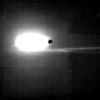
The Rings-N00042087.jpgThe "G-Ring" and a "Dark Object" in the light...54 visiteOriginal caption:"N00042087.jpg was taken on October 24, 2005 and received on Earth October 25, 2005. The camera was pointing toward SATURN-G-RING at approximately 2.120.861 kilometers away and the image was taken using the IR2 and CL2 filters. This image has not been validated or calibrated".
Una simile immagine - un probabile photo-artifact, ma non si può esserne sicuri al 100% - l'avevamo già incontrata quando, diversi mesi fa, la Sonda Cassini si era avvicinata a Giapeto ed aveva effettuato due scatti che produssero un risultato visivo molto simile a questo. E Voi cosa dite? Stiamo guardando una Nave Spaziale Aliena che si "nasconde" nei raggi e nella luce di un Sole lontano - ma comunque brillante - oppure è solo un artefatto fotografico (una "distorsione" da sovraesposizione)?
(8 voti)
|
|

Rhea-PIA07575.jpgTirawa Impact Basin on Rhea54 visiteThe giant Tirawa impact basin straddles the day and night boundary on Saturn's moon Rhea in this view from the Cassini spacecraft. The ancient basin is 5 Km deep in places, as measured in NASA Voyager images. The whole basin is about 360 Km across.
The prominent bright splotch to the southeast of Tirawa is ejecta from a fairly fresh crater. This view of Rhea (1.528 Km, such as about 949 miles across) reveals terrain slightly to the East of a similar Cassini view, released earlier (see Diversity of Impacts). The sunlit surface in this view is principally on the leading hemisphere of Rhea. North is up and rotated 13° to the left.
The image was taken in visible light with the Cassini spacecraft narrow-angle camera on Aug. 13, 2005, at a distance of approx. 2 MKM (about 1,2 MMs) from Rhea and at a Sun-Rhea-spacecraft, or phase, angle of 50°. Resolution in the original image was 12 kilometers (7 miles) per pixel. The image has been contrast-enhanced and magnified by a factor of two to aid visibility.
(8 voti)
|
|
| 2244 immagini su 187 pagina(e) |
 |
|
|
|
|
175 | |
|
|
|
|





