| Piú votate - Saturn: the "Ringed Beauty" and His Moons |

Earth-PIA08324-1.jpgEarth, from Saturn's Space (1)81 visiteCaption NASA originale:"Not since NASA's Voyager 1 spacecraft saw our home as a pale blue dot from beyond the orbit of Neptune has Earth been imaged in color from the Outer Solar System. Now, Cassini casts powerful eyes on our home Planet, and captures Earth, a pale blue orb - and a faint suggestion of our Moon - among the glories of the Saturn System.
Earth is captured here in a natural color portrait made possible by the passing of Saturn directly in front of the Sun from Cassini's point of view. At the distance of Saturn's orbit, Earth is too narrowly separated from the Sun for the spacecraft to safely point its cameras and other instruments toward its birthplace without protection from the Sun's glare.
The Earth-and-Moon System is visible as a bright blue point on the right side of the image above center. Here, Cassini is looking down on the Atlantic Ocean and the Western Coast of North Africa. The phase angle of Earth, seen from Cassini is about 30°".
(1 voti)
|
|
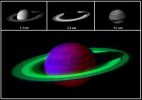
Saturn-PIA08735.jpgThree, for one and the same: Saturn, in infrared light56 visiteCaption NASA:"This false-color image of Saturn was constructed by combining 3 images at 3 different infrared wavelengths.
The image at the upper left was taken at 1,3 microns, where both Saturn and its Rings strongly reflect light. The center image in the top panel was taken at 2,4 microns, where the Rings strongly reflect light, but Saturn, because of the methane in its atmosphere, absorbs most of the light. The third image on the right in the panel was taken at a wavelength of 5 microns where, because they are composed of almost pure water ice, the Rings absorb almost all the light, and Saturn, because its interior is warm, glows. Assigning each of the three images to blue, green and red, respectively, results in the beautiful, false-color, composite image shown here.
These images were taken on June 21, 2004, with Cassini's VIMS (Visual and Infrared Mapping Spectrometer) from a distance of approx. 6,35 MKM (about 3,94 MMs) from Saturn".
(1 voti)
|
|

Mimas-PIA08264.jpgMimas54 visiteCaption NASA originale:"Mimas plows along in its orbit, its pockmarked surface in crisp relief. The bright, steep walls of the enormous crater, Herschel (130 Km, or 80 miles wide), gleam in the Sunlight.
The lit terrain seen here is on the Leading Hemisphere of Mimas (about 397 Km, or 247 miles across). North is up.
The image was taken in visible light with the Cassini spacecraft narrow-angle camera on Aug. 16, 2006 at a distance of approx. 221.000 Km (about 137.000 miles) from Mimas and at a Sun-Mimas-spacecraft, or phase, angle of 80°.
The image scale is roughly 1 Km (about 0,6 mile) per pixel".
(1 voti)
|
|
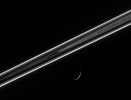
The Rings&Dione-PIA08201.jpgLike Neon-Lights...54 visiteCaption originale:"The dark side of the Ring-Plane glows with scattered light, including the luminous F-Ring, which shines like a rope of brilliant neon.
Below, Dione (1.126 Km, or 700 miles across) presents an exquisitely thin crescent.
The image was taken using a spectral filter sensitive to wavelengths of infrared light centered at 930 nanometers and it was acquired with the Cassini spacecraft narrow-angle camera on May 3, 2006 at a distance of approx. 1,8 MKM (about 1,1 MMs) from Dione and at a phase angle of 160°. Image scale is roughly 11 Km (about 7 miles) per pixel".
(1 voti)
|
|

Saturn-PIA08190.jpgThrough the Rings...54 visiteCaption NASA originale:"The dark shadows that drape Saturn's Northern Latitudes are split by 3 familiar bright gaps. From bottom to top, Sunlight passes through the broad Cassini Division (4.800 Km - or about 2.980 miles - wide), the Encke Gap (325 Km - or about 200 miles - wide) and (barely visible) the Keeler Gap (42 Km - or about 26 miles - wide).
It is unlikely that the shadows cast by Saturn's Rings have much of an effect on the large-scale movements of the atmosphere. The dynamic clouds of this Gas Giant are driven by processes going on much deeper inside the Planet, where Sunlight does not penetrate.
The image was taken using a spectral filter sensitive to wavelengths of infrared light centered at 752 nanometers. The image was acquired with the Cassini spacecraft wide-angle camera on April 28, 2006 at a distance of approximately 377.000 Km (about 234.000 miles) from Saturn. Image scale is roughly 19 Km (such as about 12 miles) per pixel".
(1 voti)
|
|
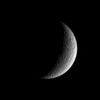
Rhea-PIA08186.jpgRhea: so "old" and yet so "beautiful...85 visiteCaption NASA:"Rhea displays a prominent scar in this view from Cassini. A large and ancient impact basin can be seen at upper right. The giant feature occurs within a terrain that appears rugged and which likely is saturated with other smaller craters.
Rhea is Saturn's second-largest moon at 1.528 Km (about 949 miles) across. This view shows terrain on the moon's Trailing Hemisphere.
North is up.
The image was taken in polarized ultraviolet light with the Cassini spacecraft narrow-angle camera on April 24, 2006 at a distance of approx. 2 MKM (such as about 1,2 MMs) from Rhea and at a Sun-Rhea-spacecraft, or phase, angle of 117°. Resolution in the original image was approx. 12 Km (about 7 miles) per pixel. The image has been magnified by a factor of two and contrast-enhanced to aid visibility".
(1 voti)
|
|
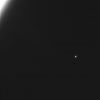
Earth-N00061732-c.jpgEarth and Moon...maybe? (1)57 visiteLa nostra impressione è che, in questo frame (apparentemente del tutto insignificante) ci sia una ripresa - molto suggestiva - della nostra Terra (e della Luna).
Ci sbagliamo? Forse no. La NASA, purtroppo, non ci è di aiuto e questa è la caption che riserva al frame:"N00061732.jpg was taken on May 22, 2006 and received on Earth on the same date. The camera was pointing toward Saturn that, at the time, was approximately 384.937 Km away.
The image was taken using the BL1 and CL2 filters".
(1 voti)
|
|

Dione-N00060593.jpgIn the darkness...54 visitenessun commento
(1 voti)
|
|

Rhea-PIA08148.jpgRhea (HR)82 visiteCaption NASA originale:"Rhea shows off her bright, fresh-looking impact crater in this Cassini view taken during a close approach. The view is toward the Leading Hemisphere on Rhea. North is up.
The image was taken in visible light with the Cassini spacecraft narrow-angle camera on Feb. 24, 2006 at a distance of approx. 343.000 Km (such as about 213.000 miles) from Rhea and at a phase angle of 27°. Image scale is 2 Km (about 1 mile) per pixel".
(1 voti)
|
|

Saturn-N00052964.jpgVertical relief, Cosmic Ray or UFO?71 visiteCerchiatura Bianca: si tratta del solito (e banalissimo) photoartifact; di una curiosa nuvola "a colonna" (detta anche "vertical relief"), oppure di un Raggio Cosmico catturato "al volo" (uno dei tanti...), o magari di un oggetto di altra natura (un luminosissimo UFO?), colto durante un suo passaggio sulle nuvole di Saturno e ad una distanza imprecisata da Cassini?
(1 voti)
|
|
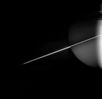
Saturn-PIA07678.jpgNeon-lights in the night of Saturn71 visiteOriginal caption:"Like a rope of brilliant neon, Saturn's Rings outshine everything else in this night side view, while the sunlit southern face of the Rings reflects a dim glow onto the atmosphere below. When viewed nearly edge-on, the Rings often appear very bright.
Epimetheus and Janus are mere specks to the left of the Ring edge (and Epimetheus being the outermost of the pair).
The image was taken in visible light with the Cassini spacecraft wide-angle camera on Dec. 17, 2005, at a distance of approximately 2,7 MKM (such as about 1,7 MMs) from Saturn and at a Sun-Saturn-spacecraft angle of 75°. The image scale is about 164 Km (roughly 102 miles) per pixel".
(1 voti)
|
|

Saturn-N00044403.jpgPhotographic Defect, Photo-Artifact or UFO in-transit? (1)56 visitevedi il commento al frame successivo
(1 voti)
|
|
| 2244 immagini su 187 pagina(e) |
 |
|
|
|
|
174 | |
|
|
|
|





