| Piú votate - Saturn: the "Ringed Beauty" and His Moons |
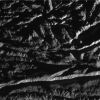
Enceladus-PIA11106.jpgCairo Sulcus58 visiteCaption NASA:"This image is the 3rd skeet-shoot image taken during Cassini's very close flyby of Enceladus on Aug. 11, 2008.
Cairo Sulcus is crossing the southern part of the image. The terrain is littered with blocks of ice.
The image was taken with the Cassini Spacecraft narrow-angle camera on Aug. 11, 2008, a distance of approx. 2446 Km (such as about 1396 miles) above the surface of Enceladus.
Image scale is approximately 18 meters (59 feet) per pixel". MareKromium
(1 voti)
|
|
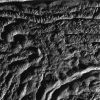
Enceladus-PIA11109.jpgCairo Sulcus55 visiteCaption NASA:"This image is the 4th skeet-shoot footprint taken during Cassini's very close flyby of Enceladus on Aug. 11, 2008. Cairo Sulcus is shown crossing the upper left portion of the image. An unnamed fracture curves around the lower right corner.
The image was taken with the Cassini Spacecraft narrow-angle camera on Aug. 11, 2008, a distance of approx. 3027 Km (such as about 1881 miles) above the surface of Enceladus.
Image scale is approximately 20 meters (66 feet) per pixel". MareKromium
(1 voti)
|
|

Janus-PIA10417-1.JPGRugged Janus (Saturated Natural Colors; credits for the additional process. and color.: Dr Paolo C. Fienga - Lunexit Team)55 visiteCaption NASA:"Craters large and small cover the rugged surface of Saturn's moon Janus.
This view looks toward the Southern Hemisphere of Janus (about 179 Km, or approx. 111 miles across at its widest point). The moon's South Pole is at center.
The image was taken with the Cassini Spacecraft narrow-angle camera on May 26, 2008 using a spectral filter sensitive to wavelengths of IR light centered at 930 nanometers. The view was acquired at a distance of approx. 186.000 Km (such as about 115.000 miles) from Janus and at a Sun-Janus-Spacecraft, or Phase, angle of 83°.
Image scale is roughly 1 Km (about 0,6 miles) per pixel".MareKromium
(1 voti)
|
|

Enceladus-PIA10361-1.jpgJet Spots in Tiger Stripes59 visiteCaption NASA:"Heat radiating from the entire length of 150 Km (about 95 mile)-long fractures is seen in this best-yet heat map of the active South Polar Region of Saturn's ice moon Enceladus. The warmest parts of the fractures tend to lie on locations of the plume jets identified in earlier images, shown in the annotated version with yellow stars. The measurements were obtained by the Cassini Spacecraft's Composite Infrared Spectrometer from the spacecraft's close flyby of the moon on March 12, 2008.
Remarkably high temperatures, at least 180 Kelvin (such as -135 degrees Fahrenheit) were registered along the brightest fracture, named Damascus Sulcus, in the lower left portion of the image. For comparison, surface temperatures elsewhere in the South Polar Region of Enceladus are below 72 Kelvin (such as -330 degrees Fahrenheit).
Heat is escaping from Enceladus' interior along these warm fractures, dubbed "Tiger Stripes", which are also the source of the geysers that erupt from the Polar Region.
The infrared radiation was mapped at wavelengths between 12 and 16 microns. The infrared data, shown in false color, are superimposed on a grayscale image mosaic of the South Pole obtained by Cassini's cameras on July 14, 2005, during the previous close Enceladus flyby. Numbers on the map indicate Latitude and Longitude.
This new view shows that at least 3 of the South Polar fractures are active along almost their full lengths - the 4th one, on the right, was only partially covered by this scan. The level of activity varies greatly along the fractures. The warmest parts of the fractures tend to lie on locations of the plume jets identified in earlier images. The main "Tiger Stripe" fractures are not the only sources of heat, however; additional warm spots are seen in the upper right part of the scan.
The warm regions are probably concentrated within less than a few hundred meters (a few hundred yards) of the fractures, and their apparent width in this image results from the relatively low resolution of the infrared data.
This map was made by scanning the South Pole during the period from 16' to 37' (minutes) after closest approach to Enceladus, at a distance between 14.000 and 32.000 Km (about 8.700 and 20.000 miles) as Cassini rapidly receded from its close (50-Km or about 32-miles) flyby".MareKromium
(1 voti)
|
|
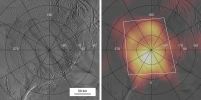
Enceladus-PIA10360.jpgStripes and Heat Map Side-by-Side69 visiteCaption NASA:"Cassini's March 12, 2008, flyby of Enceladus provided the best view yet of the heat radiation from the active South Pole of the satellite. These images summarize what was learned about the South Polar landscapes and heat radiation during the previous close flyby on July 15, 2005.
The left panel shows a map of the South Pole constructed from images taken by the Spacecraft's Imaging System. Four prominent fractures, informally called "Tiger Stripes", cut diagonally across the South Polar Region. In the right-hand panel, a July 2005 map of the south polar heat radiation, obtained by Cassini's Composite Infrared Spectrometer, is superimposed in false color on the visible images.
The observations revealed a prominent warm region centered on the South Pole, appearing yellow and orange in this view, which coincides with the locations of the tiger stripes. However, these data were taken from too far away from Enceladus (about 80.000 Km) to distinguish the fine details of the heat radiation.
The July 2005 flyby also included some scattered close-up snapshots by the Composite Infrared Spectrometer; these showed that the heat radiation was concentrated along the Tiger Stripe fractures, but those snapshots covered only a small fraction of the South Polar Region.
The white lines enclose the area covered by the much more detailed view of the South Pole obtained by the spectrometer during the March 12, 2008, flyby.
Numbers on the map show Latitude and Longitude".MareKromium
(1 voti)
|
|

Tethys-PIA09788.jpgTrue Colors?54 visiteCaption NASA:"As seen from the side not illuminated by the Sun, Saturn's thinner Rings are highlighted in shades of brown and gold, contrasting with the more neutral appearance of the icy moon Tethys. The A-Ring and Cassini Division are separated by the optically thick B-Ring, which does not permit sunlight to penetrate and appears as the broad, dark lane between them in this view.
This view looks toward the anti-Saturn side of Tethys.
North is up and rotated 35° to the right.
The view looks toward the unilluminated side of the rings from about 2° above the Ring-Plane.
Images taken using red, green and blue spectral filters were combined to create this natural color view. The view was acquired with the Cassini spacecraft narrow-angle camera on Oct. 29, 2007, at a distance of approx. 2,1 MKM (about 1,3 MMs) from Tethys and at a Sun-Tethys-spacecraft, or phase, angle of 21°.
Image scale is roughly 12 kilometers (8 miles) per pixel".MareKromium
(1 voti)
|
|

Saturn-PIA08992.jpgSurging Across the Rings54 visiteCaption NASA:"A surge in brightness appears on the Rings directly opposite the Sun from the Cassini Spacecraft. This "opposition surge" travels across the Rings as the Spacecraft watches. This view looks toward the sunlit side of the Rings from about 9° below the Ring-Plane.
The image was taken in visible light with the Cassini spacecraft wide-angle camera on June 12, 2007 using a spectral filter sensitive to wavelengths of infrared light centered at 853 nanometers.
The view was acquired at a distance of approx. 524.374 Km (such as about 325.830 miles) from Saturn.
Image scale is 31 Km (about 19 miles) per pixel".MareKromium
(1 voti)
|
|

The_Rings-PIA08988.jpgBright Region in the C-Ring56 visiteCaption NASA:"This bright, isolated plateau in the middle of the C-Ring displays interesting internal variations in brightness. The plateau is not high in terms of elevation, but rather in terms of its particle density (seen here as brightness), which is several times higher than the surrounding Ring Structure.
Ring scientists are working to understand what produces the sharp boundaries of the plateau features, as well as the nature of the internal variations in brightness.
This view looks toward the sunlit side of the Rings from about 18° below the Ring-Plane.
The image was taken in visible light with the Cassini spacecraft narrow-angle camera on June 12, 2007 at a distance of approx. 230.000 Km (about 143.000 miles) from Saturn. Image scale is roughly 1 Km (3353 feet) per pixel".MareKromium
(1 voti)
|
|

Saturn-PIA08987.jpgNorthern Latitudes54 visiteCaption NASA:"Incredible swirling details in Saturn's Northern Clouds can be seen in this dazzling view. Shadows cast by the Rings embrace the Northern Hemisphere.
The view looks toward the unilluminated side of the Rings from about 16° above the Ring-Plane.
The image was taken with the Cassini spacecraft wide-angle camera on June 10, 2007 using a spectral filter sensitive to wavelengths of infrared light centered at 939 nanometers. The view was acquired at a distance of approx. 1,3 MKM (such as about 800.000 miles) from Saturn. Image scale is roughly 72 Km (about 45 miles) per pixel".MareKromium
(1 voti)
|
|
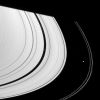
The_Rings-PIA08985.jpgMoons...56 visiteCaption NASA:"The effects of three of Saturn's Ring Moons can be spotted in this single narrow-angle camera view.
The image has been strongly enhanced to better show the wakes on both sides of the Encke Gap caused by Pan (left of center), as well as a hint of the edge waves in the narrow Keeler Gap caused by Daphnis (just below center).
Bright Prometheus (on the right) pulls away from its latest close encounter with the F-Ring. The aftereffects of its recent passes are visible in the Ring's inner edge.
This view looks toward the unilluminated side of the Rings from about 10° above the Ping-Plane.
Saturn's shadow cuts across the Rings at the top of the scene.
The image was taken in visible light with the Cassini spacecraft narrow-angle camera on June 5, 2007 at a distance of approx. 2,3 MKM (about 1,4 MMs) from Pan.
Image scale is about 13 Km (approx. 8 miles) per pixel".MareKromium
(1 voti)
|
|

The_Rings-PIA08887.jpgHeading to the Darkness55 visiteCaption NASA:"This strikingly crisp view shows Atlas heading into Saturn's shadow at upper left. The moon's basic, elongated shape is easy to detect here. Above Atlas, a bright clump in the F-Ring also heads toward the darkness. This view looks toward the unlit side of the Rings from about 30° above the Ring-Plane.
The image was taken in visible light with the Cassini spacecraft narrow-angle camera on Jan. 19, 2007 at a distance of approx. 1,2 MKM (about 700.000 miles) from Atlas. Image scale is roughly 7 Km (about 4 miles) per pixel".
(1 voti)
|
|

The_Rings-PIA08837.jpgThe Rings (in natural colors)55 visiteCaption NASA:"Saturn's sunlit Rings gleam in the blackness as two icy moons cruise past in the foreground.
Enceladus is a small crescent near upper left; Janus is a speck above the F-Ring, near center. Janus was brightened slightly for visibility.
This view looks toward the lit side of the Rings from about 5° below the Ring-Plane.
This image was taken in visible red light with the Cassini spacecraft wide-angle camera on Nov. 7, 2006, at a distance of approx. 1,1 MKM (about 700.000 miles) from Saturn and at a Sun-Saturn-Spacecraft, or phase, angle of 139°.
Image scale on the sky at the distance of Saturn is roughly 63 Km (about 39 miles) per pixel".
(1 voti)
|
|
| 2244 immagini su 187 pagina(e) |
 |
|
|
|
|
173 | |
|
|
|
|





