| Piú votate - Saturn: the "Ringed Beauty" and His Moons |
Mimas-Titan-Rhea-W00062956-58-EB-LXTT.jpgBrothers in the Night... (Natural Colors; credits: Elisabetta Bonora - Lunexit Team)61 visitenessun commentoMareKromium
(1 voti)
|
|

Prometheus-4312264140_cd64e12a23_o.jpgPrometheus adrift... (possible Natural Colors; credits: Dr M. Faccin - Lunexit Team)56 visitenessun commentoMareKromium
(1 voti)
|
|

Rhea-4229274308_c987cf73d9_o.jpgLarge Crater on Rhea (possible True Colors; credits: Dr M. Faccin - Lunexit Team)57 visitenessun commentoMareKromium
(1 voti)
|
|

Janus-PIA11694.gifObscuring Janus (GIF-Movie; credits: NASA/JPL/Space Science Institute)60 visiteCaption NASA:"Sunlight passing through the Cassini Division between Saturn's "A" and "B" Rings sweeps across and illuminates the surface of the moon Janus in this movie captured shortly after Saturn's August 2009 Equinox.
The novel illumination geometry that accompanied Equinox lowered the Sun's Angle to the Ring-Plane, significantly darkened the Rings, caused out-of-plane structures to look anomalously bright and threw shadows across the Rings. As this movie shows, the Equinox period also allowed the Rings to cast shadows on the moons. These scenes were possible only during the few months before and after Saturn's Equinox, which occurs only once in about 15 Earth years. Before and after Equinox, cameras on NASA's Cassini Spacecraft spotted not only the predictable shadows of some of Saturn's moons, but also the shadows of newly revealed Vertical Structures in the Rings themselves (see PIA11665).
This view looks toward the Trailing Hemisphere of Janus (approx. 179 Km, or about 111 miles across). North on Janus is up and rotated 8° to the right.
The movie is a concatenation of 12 still images. The images were obtained in Visible Light with Cassini's narrow-angle camera on Aug. 27, 2009. The view was acquired at a distance of approx. 268.000 Km (about 67.000 miles) from Janus and at a Sun-Janus-Spacecraft, or Phase, Angle of 25°.
Image scale is roughly 2 Km (5271 feet) per pixel".MareKromium
(1 voti)
|
|
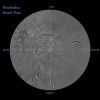
Enceladus-PIA11679.jpgEnceladus: South Polar Map62 visiteThe Northern and Southern Hemispheres of Enceladus are seen in these Polar Stereographic Maps, mosaicked from the best-available Cassini and Voyager clear-filter images. This image shows the South Polar Regions.
Each map is centered on one of the Poles and surface coverage extends to the Equator. Grid lines show Latitude and Longitude in 30-degree increments. The scale in the full-size versions of these maps is 110 meters (360 feet) per pixel.
These two maps show that the character of Terrains near the North Pole differs strongly from those near the South Pole. Terrain near the North Pole is among the most heavily cratered and oldest on the Surface of Enceladus.
The Northern Hemisphere map shows that a broad band of cratered terrain extends from the Equator on the Saturn-facing side (centered on 0-degrees Longitude), over the Pole and to the Equator on the anti-Saturn side (centered on 180-degrees Longitude). Terrains near the Equator and Mid-Latitudes on the Leading (90° West) and Trailing (270° West) sides of Enceladus are much less heavily cratered and are characterized by intense zones of fracturing and faulting.
As seen in the Southern Hemisphere map, the band of cratered terrain at 0 and 180° Longitude extends southward from the Equator. However, poleward of about 55° South Latitude, the cratered terrain is interrupted and replaced by a conspicuously fractured circumpolar terrain that is nearly devoid of impact craters.
In contrast to the very old North Polar Terrains, the South Circumpolar Terrains are among the youngest on the Surface of Enceladus.
Within the South Circumpolar Region is a group of prominent parallel "Stripes" made up of fractures that are delineated by relatively dark albedo markings flanking the sides of each fracture.
An interesting property of the parallel fracture system is that each appears to turn back at its westernmost segment as if it has been "bent" or "folded" into a hook-like curve. Similar patterns of folded or kinked fractures can be found throughout the region -- a unique feature of the South Polar Terrains.MareKromium
(1 voti)
|
|

Enceladus-PIA11562.jpgEnceladus, in the distance (Natural Colors; credits: Lunexit)57 visiteCaption NASA:"Cassini Spacecraft looks toward the varied Surface of the Trailing Hemisphere of Saturn's moon Enceladus. North on Enceladus (about 504 Km, or approx. 313 miles across) is up. For a more detailed view of this Hemisphere, see also PIA08353.
The image was taken in Visible Light with the Cassini spacecraft narrow-angle camera on June 25, 2009. The view was acquired at a distance of approx. 594.000 Km (about 369.000 miles) from Enceladus and at a Sun-Enceladus-Spacecraft, or Phase, Angle of 66°.
Image scale is roughly 4 Km (about 2,5 miles) per pixel".MareKromium
(1 voti)
|
|
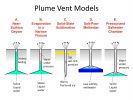
Enceladus-PIA12081.jpgEnceladus' Ice-Plume Models72 visiteCaption NASA:"These illustrations indicate possible ways in which the water vapor and ice particles in the plume of Enceladus may be formed. The Cassini spacecraft recently found a small fraction of salt-rich ice particles from the plumes, while Earth-based observations indicate gas from the plumes is very poor in sodium. These measurements are helping scientists to evaluate how the plumes form.
In model A, salty water boils explosively near the surface of Enceladus when it encounters the vacuum of space. This model can be ruled out, because such explosive activity would spread large amounts of sodium into space where it would have been seen by the Earth-based observers. If this model was correct, then nearly all the ice particles observed by Cassini would be salt-rich, instead of just a fraction of them.
In model B, salty water evaporates more slowly at some depth in a narrow fissure, creating vapor which escapes to the surface to form the plume. This model also seems unlikely because the fissure would rapidly become clogged by salt left behind as water evaporates. The water would also freeze, because not enough heat could reach the water surface up the narrow fissure to replace the heat lost by evaporation.
In model C, the warm ice evaporates directly into vapor to form the plume, in a process called sublimation. The salty particles found in the plume would have been created by liquid water in an earlier epoch and would have been stored in the near-surface layers of Enceladus until the present. These particles would now be incorporated into the plume by the escaping gases. This model cannot be ruled out, but seems unlikely because it may be difficult to dislodge old ice grains from the walls of the fracture.
In model D, the liquid water results from melting of near-surface ice rather than coming from an underlying salty ocean. The water is initially only slightly salty, but its salinity increases as evaporation removes some of the water and leaves the salt behind. Thus, in this model, the salt-rich ice particles seen by Cassini would be derived from initially salt-poor water. This model may be plausible and has not yet been evaluated in detail.
In model E, the water is originally salty, and perhaps comes from a subsurface ocean in contact with an underlying rocky core. The water evaporates slowly into a pressurized chamber, from which water vapor and ice particles, including salty particles from the salt water, escape to the surface along narrow fissures. The large area of the evaporating water surface prevents accumulated salt from clogging the vent and allows enough heat to reach the water surface from below to prevent the water from freezing. This model seems he simplest, and perhaps most likely of the models shown here, but is not the only possibility. Enceladus' plumes may involve a combination of several of these idealized models".MareKromium
(1 voti)
|
|
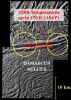
Enceladus-PIA12082.jpgHeat in Damascus Sulcus57 visiteCaption NASA:"This image shows the location of Cassini's most precise measurements so far of the surface temperatures at the active "Tiger Stripe" fractures that cut the South Polar Region of Enceladus. The background image, which shows the Tiger Stripe fracture named Damascus Sulcus, was obtained by Cassini's cameras during the close Enceladus flyby on August 11, 2008 (see PIA11113).
The yellow circles show the approximate location of two of the active plumes of ice particles identified by the Cassini cameras.
The red rectangles show the region of Damascus Sulcus from which heat radiation was measured by Cassini's Composite Infrared Spectrometer (CIRS) at about the same time as the images were taken. The CIRS measurements indicate temperatures up to at least 170 Kelvin (-103 Centigrade or -154 Fahrenheit) near Damascus Sulcus. This is more than 100 degrees Kelvin (180 degrees Fahrenheit) warmer than the surrounding surface, due to heat escaping from Enceladus' interior along the fractures. However, even warmer temperatures are probable over smaller regions close to the Tiger Stripes, and temperatures are expected to be warmer still below Enceladus' Surface.
Therefore, subsurface temperatures may be high enough to melt ice to create liquid water, as is suggested by recent Cassini measurements of the salty composition of ice grains ejected from the Tiger Stripes".MareKromium
(1 voti)
|
|
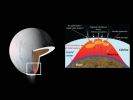
Enceladus-PIA12080.jpgMelted Ice56 visiteCaption NASA:"These drawings depict explanations for the source of intense heat that has been measured coming from Enceladus' South Polar Region. These models predict that water could exist in a deep layer as an ocean or sea and also near the Surface.
Cassini scientists infer that the temperature of the ice in the South Polar Region must be close to its melting point (shown in red). A layer of liquid water (dark blue) might exist between the ice and the silicate core (brown), allowing the ice to deform independent of the rock, providing even more mechanical energy and more flexing of the icy shell for extreme tidal heating.
Tidal heating could also cause friction in faults near the surface, leading to pockets of partially melted ice".MareKromium
(1 voti)
|
|

Saturn-PIA11464.jpgDaybreak from above55 visiteCaption NASA:"Day breaks on the Northern Hemisphere of Saturn in this image from Cassini. The D-Ring is hidden below the horizon, but, working outward from the Planet, this image shows the C, B, A and F-Rings. The moon Prometheus is a faint speck inside the thin F-Ring in the upper left of the image.
This view looks toward the unilluminated side of the Rings from about 39° above the Ring-Plane. The image was taken with the Cassini Spacecraft wide-angle camera on March 20, 2009 using a spectral filter sensitive to wavelengths of Near-InfraRed Light centered at 853 nanometers.
The view was obtained at a distance of approx. 888.000 Km (such as about 552.000 miles) from Saturn and at a Sun-Saturn-Spacecraft, or Phase, Angle of 121°.
Image scale is roughly 50 Km (about 31 miles) per pixel".MareKromium
(1 voti)
|
|

PIA07966-112203xx.mp3Audio Signals from the the Space of Saturn (by Dr M. Faccin)55 visitenessun commentoMareKromium
(1 voti)
|
|
Mimas-Cs.jpgMimas, from Cassini57 visitenessun commentoMareKromium
(1 voti)
|
|
| 2244 immagini su 187 pagina(e) |
 |
|
|
|
|
171 | |
|
|
|
|





