| Piú votate - Saturn: the "Ringed Beauty" and His Moons |

Unusual_Reflection-W00050623.jpgUnusual Reflection in the Space of Saturn58 visiteIn questo caso, probabilmente, si tratta solo di un frame "venuto male": e cioè mosso e sovraesposto.
Ma qual'è la "fonte" della sovraesposizione? Una Luna Saturniana (e, se SI, quale)? O forse si tratta di Saturno stesso?
Oppure è un'altra Anomalìa, tanto eclatante, quanto indecifrabile?...MareKromium
(7 voti)
|
|

Dione-N00119788.jpgCross-Worlds! (4)56 visitenessun commentoMareKromium
(7 voti)
|
|
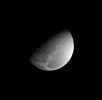
Dione-PIA10431.jpgDione54 visiteCaption NASA:"This Cassini Spacecraft view, taken from a vantage point 64° above Dione's Equator, looks down onto the bright fractures that cover the moon's Trailing Side. The fractures crisscross a region of terrain that is significantly darker than the rest of the moon's surface. Dione is approx. 1123 Km (about 698 miles) across.
The image was taken in visible light with the Cassini spacecraft narrow-angle camera on June 15, 2008. The view was obtained at a distance of approx. 601.000 Km (such as about 374.000 miles) from Dione and at a Sun-Dione-Spacecraft, or Phase, Angle of 76°. Image scale is roughly 4 Km (a little more than 2 miles) per pixel".MareKromium
(7 voti)
|
|

Saturn-PIA10413.jpgSwirling Clouds (MULTISPECTRUM; credits: Lunexit)54 visiteCaption NASA:"Sinuous clouds and hurricane-sized vortices mingle in Saturn's Northern Skies. This view looks toward a Region located at 70° North Latitude on Saturn.
Despite the level of detail visible here, the Region shown is wide enough to contain the planet Mars comfortably.
The image was taken with Cassini's CB1 spectral filter, which is sensitive to wavelengths of visible red light centered at 619 nanometers. The view was acquired with the spacecraft's narrow-angle camera on May 23, 2008 at a distance of approx. 1,2 MKM (about 775.000 miles) from Saturn.
Image scale is roughly 7 Km (about 4 miles) per pixel".MareKromium
(7 voti)
|
|

Star_Trails-N00099969.jpgStar-Trails...55 visitenessun commentoMareKromium
(7 voti)
|
|
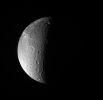
Dione-PIA09886~0.jpgJaniculum Dorsa54 visiteCaption NASA:"The Cassini spacecraft looks down, almost directly at the North Pole of Dione. The feature just left of the Terminator at bottom is Janiculum Dorsa, a long, roughly North-South trending ridge.
Lit terrain seen here is on the anti-Saturn and trailing sides of Dione (1126 Km, or approx. 700 miles across).
This image was taken with the Cassini spacecraft narrow-angle camera on March 22, 2008 using a spectral filter sensitive to wavelengths of ultraviolet light centered at 338 nanometers. The view was acquired at a distance of approx. 650.000 Km (about 404.000 miles) from Dione and at a Sun-Dione-Spacecraft, or phase, angle of 99°.
Image scale is roughly 4 Km (about 2 miles) per pixel".MareKromium
(7 voti)
|
|

UnknownObject-N00107570.jpgUnknown Object in the Space of Saturn55 visiteUna sorta di "Space Flare" si accende per pochi istanti nello Spazio di Saturno ed il "Caso" ha voluto che Cassini fosse lì, con gli "occhi aperti", pronto a fotografare.
Il risultato è questo: un curioso "flash" nel buio, dalla forma indefinibile e sulla cui Natura non ci è possibile investigare.
Forse non era nulla di importante, o forse si: ma comunque fosse, noi non lo sapremo mai.
Notate, infine, la curiosa (e sostanziale!) specularità dei corpi puntiformi ripresi.MareKromium
(7 voti)
|
|
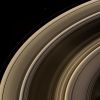
TheRings-PIA09865.jpgRings and Companions (natural colors; credits: NASA)54 visiteCaption NASA:"From on high, the Cassini spacecraft spies a group of 3 Ring Moons in their travels around Saturn. Janus (181 Km, or 113 miles across) is seen at top, while Pandora (84 Km, or 52 miles across) hugs the outer edge of the narrow F-Ring. More difficult to spot is Pan (26 Km, or 16 miles across), which is a mere speck in this view. Pan can be seen in the Encke Gap, near center left.
The speck seen between the A and F-Rings at left is a background star.
This view looks toward the unilluminated side of the Rings from about 40° above the Ring-Plane. Images taken using red, green and blue spectral filters were combined to create this natural color view.
Bright clumps of material in the narrow F-Ring moved in their orbits between each of the color exposures, creating a chromatic misalignment that provides some sense of the continuous motion in the Ring System.
The images were obtained with the Cassini spacecraft wide-angle camera on Feb. 7, 2008 at a distance of approx. 1,1 MKM (about 700.000 miles) from Saturn. Image scale at the center of the view is roughly 74 Km (about 46 miles) per pixel in the radial, or outward from Saturn, direction".MareKromium
(7 voti)
|
|

Dione-PIA09821.jpgDione (HR)54 visiteCaption NASA:"The Cassini spacecraft surveys the Southern Hemisphere on Dione's anti-Saturn side, spying a broad impact basin near bottom.
Most of the medium-sized craters visible here have pointed central peaks, owing to the rebound of material following the craters' initial formation.
(in this picture) North on Dione is up.
The image was taken in visible light with the Cassini spacecraft narrow-angle camera on Dec. 19, 2007. The view was obtained at a distance of approx. 240.000 Km (such as about 149.000 miles) from Dione and at a Sun-Dione-spacecraft, or phase, angle of 44°.
Image scale is roughly 1 Km (about 0,6 mile) per pixel".MareKromium
(7 voti)
|
|

Hyperion-PIA09790.jpgHyperion: the "Floating Column"54 visiteCaption NASA:"Saturn's irregularly shaped moon Hyperion is completely covered with large pits from which much of its material has been blasted by impacts, never to return. The moon's surface gravity is so low that crater-ejected material often escapes Hyperion entirely.
Hyperion is 280 Km (about 174 miles) across on average.
The image was taken in visible light with the Cassini spacecraft narrow-angle camera on Oct. 21, 2007. The view was obtained at a distance of approx. 151.000 Km (such as about 94.000 miles) from Hyperion and at a Sun-Hyperion-Spacecraft, or phase, angle of 111°.
Image scale is 906 meters (0,6 mile) per pixel".MareKromium
(7 voti)
|
|

Japetus-N00091972.jpgThe Mountains of Japetus (Transition Zone; possible natural colors - elab. Lunexit)54 visiteCaption NASA:"N00091972.jpg was taken on September 10, 2007 and received on Earth September 11, 2007. The camera was pointing toward Japetus that, at the time, was approx. 1776 Km away, and the image was taken using the CL1 and CL2 filters. This image has not been validated or calibrated".MareKromium
(7 voti)
|
|
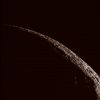
Japetus-N00091806.jpgApproaching Japetus' Terminator (possible natural colors; elab. Lunexit)54 visiteCaption NASA:"N00091806.jpg was taken on September 10, 2007 and received on Earth September 10, 2007. The camera was pointing toward Japetus that, at the time, was approx. 67.844 Km away, and the image was taken using the CL1 and CL2 filters. This image has not been validated or calibrated".MareKromium
(7 voti)
|
|
| 2244 immagini su 187 pagina(e) |
 |
|
|
|
|
17 | |
|
|
|
|





