| Piú votate - Saturn: the "Ringed Beauty" and His Moons |
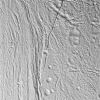
Enceladus-PIA06215.jpgCracks on Enceladus (and possible Anomaly)57 visiteCaption NASA originale:"This view of Enceladus shows an area that has undergone a very intriguing sequence of events. The craters here are subdued, as seen elsewhere on Enceladus and most, but not all, are older than the fractures. Fracturing has occurred at a wide variety of scales, from the wide rift running through the center of the image to much narrower sets of shorter fractures that crosscut the craters (and each other) to the left. This region is a transition from cratered to wrinkled terrain. Westward (left) of the central rift that divides the 2 regions are relatively parallel grooves and ridges that are reminiscent of terrain on Jupiter's large moon Ganymede. Very few craters are seen in this area of Enceladus. Right of the large rift the terrain becomes more cratered, although the craters are quite degraded. A prominent fracture runs North-South to the center of the image".
Nota: guardate bene che cosa c'è all'interno di questo crepaccio, in alto, proprio a ridosso del bordo superiore del frame!
(2 voti)
|
|

Epimetheus-PIA06605.jpgEpimetheus, from approx. 2,5 MKM57 visiteCaption NASA originale:"One of Saturn's strange co-orbital moons, Epimetheus, was captured by Cassini in this view. Irregularly shaped Epimetheus occasionally swaps orbits with nearby Janus and both moons play a role in maintaining the outer edge of Saturn's bright A-Ring. Epimetheus is 116 Km (approx. 72 miles) across.
The image was taken in visible light with the Cassini spacecraft narrow-angle camera on Jan. 22, 2005, at a distance of approximately 2,5 MKM (approx. 1,6 MMs) from Epimetheus and at a phase angle of 90°.
Resolution in the image is 15 Km (approx. 9 miles) per pixel.
The image has been contrast-enhanced to aid visibility".
(2 voti)
|
|

Janus-PIA06603.jpgJanus and Atlas95 visiteCaption NASA originale:"The irregularly-shaped moon Janus (181 Km across) and the small ring moon Atlas (32 Km across) had just emerged from the darkness of Saturn's shadow when Cassini caught this view of the two moons.
Saturn's bright A-Ring is largely overexposed in this view, but several other ring details are nicely visible. The image shows two bright regions within the B-Ring (at right), ringlets of material within the dark, narrow Encke Gap and kinks in the F-Ring.
North on Saturn is tilted toward upper left. This view is from Cassini's vantage point beneath the ring plane. It is notable that, as Saturn orbits the Sun, its shadow has been steadily creeping farther out along the ring plane and now extends beyond the F-Ring. The image was taken in visible light with the Cassini spacecraft narrow-angle camera on Jan. 26, 2005, at a distance of approximately 3,2 MKM from Janus and at a phase angle of 81°. The image scale is 19Km/pixel".
(2 voti)
|
|

Enceladus-N00030265.jpgEnceladus, from approx. 925.000 Km57 visitenessun commento
(2 voti)
|
|

Tethys-N00030191.jpgTethys from approx. 197.000 Km56 visiteDa una luna all'altra, viaggiando sulle "autostrade" che vengono disegnate dalle orbite della Sonda Cassini intorno a Saturno, così come si passa da una città all'altra, sulle autostrade del nostro Pianeta. Dopo Encelado, avvicinata, sfiorata e superata, adesso è la volta di Teti, le cui caratteristiche superficiali - come già potete vedere molto bene in questo frame - sono decisamente diverse: non vediamo canyons, gole e canali, infatti, ma solo un terreno butterato da migliaia e migliaia di crateri da impatto. Un mondo lontano ma, in fondo, piuttosto simile alla nostra Luna e, da questo punto di vista, forse, un mondo molto più familiare...
(2 voti)
|
|

Enceladus-N00030123.jpgEnceladus, from approx. 166.000 Km69 visiteIl Fly-By è finito e, purtroppo, le immagini di Encelado da distanza inferiore ai 1000 Km, la NASA non le ha (ancora?) rese disponibili. In attesa, quindi, di vedere i dettagli ravvicinati delle incredibili increspature che segnano la superficie di Encelado, contentiamoci di questa - comunque - bellissima immagine di "arrivederci": una falce bene illuminata (e stupendamente definita) della "Luna di Neve", ossìa il corpo celeste più brillante - sia pure solo di luce riflessa - di tutto quanto il Sistema Solare.
(2 voti)
|
|
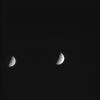
Dione-N00028856.jpgDione and Rhea (5)55 visitenessun commento
(2 voti)
|
|
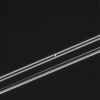
Epimetheus-N00028511.jpgEpimetheus56 visitenessun commento
(2 voti)
|
|

Dione-N00028517.jpgDione, Epimetheus and the Rings57 visitenessun commento
(2 voti)
|
|

Enceladus-N00028183.jpgEnceladus: from VERY close! (3)67 visiteNella terza immagine di Encelado (ripresa da circa 1100 Km di distanza dalla sua superficie) ci troviamo ancora davanti agli occhi un frammento di questo mondo di ghiaccio, suggestivo e contraddittorio: vediamo dei "fasci" - letteralmente - di solchi e canali e, di tanto in tanto, qualche area leggermente craterizzata di modeste dimensioni.
Se prestate una particolare attenzione ai dettagli dovreste anche riuscire a vedere - senza necessariamente ingrandire l'immagine - alcuni crateri che, sebbene sìano completamente sepolti, risultano ancora visibili ("buried craters", verso il centro del frame) ed altri (sulla Sx) tutt'ora ben definiti e "a nudo" (cioè non interessati da eventi modificativi del loro stato esteriore). Si tratta, forse, di crateri antichi rapportati ad altri recenti? Non ci sono (ancora) elementi sufficienti per operare una valutazione credibile al riguardo, ma la nostra impressione è che la fase di maggior craterizzazione di Encelado risalga ad un periodo unitario e che la causa di tali...
(2 voti)
|
|

Enceladus-N00028182.jpgEnceladus: from VERY close! (2)63 visiteIn questa seconda immagine del Fly-by della Sonda Cassini su Encelado possiamo vedere, sul lato Sx del frame, a ridosso di un grande crepaccio che descrive un ampio arco di circonferenza (ed in apertissima contrapposizione rispetto al panorama che invece caratterizza il lato Dx dell'immagine: cioè un'area della superficie Enceladiana TOTALMENTE ricoperta da solchi, canali e crepacci), un vero e proprio "crater cluster", ossìa un "ammasso di crateri".
Questo 'crater cluster' costituisce la prova indelebile (o quasi...) di un'intensa e ravvicinata attività di bombardamento meteorico la quale ebbe ad interessare Encelado in epoche (molto probabilmente) assai remote.
(2 voti)
|
|

Epimetheus-N00027756.jpgEpimetheus at the boundaries of the "Ringed Kingdom"57 visitenessun commento
(2 voti)
|
|
| 2244 immagini su 187 pagina(e) |
 |
|
|
|
|
167 | |
|
|
|
|





