| Piú votate - Saturn: the "Ringed Beauty" and His Moons |

Saturn-PIA08161.jpgCrescent Moons (2)56 visiteCaption NASA originale:"Three of Saturn's moons are captured with the Planet in this exquisite family portrait. At top, Saturn is bedecked with the shadows of its innermost rings.
Tethys appears at lower right, closest to Cassini. Janus (181 Km, or about 113 miles across) and Mimas (397 Km, or about 247 miles across) are on the far side of the immense Ringed Planet.
Mimas is just about to slip behind Saturn.
The image was taken in visible light with the Cassini spacecraft narrow-angle camera on March 13, 2006, at a distance of approx. 2,7 MKM (such as about 1,6 MMs) from Saturn. The image scale is about 17 Km (approx. 11 miles) per pixel on Janus and Mimas, and 14 about Km (such as about 9 miles) per pixel on Tethys".
(2 voti)
|
|

Saturn-N00055390.jpgWhat is rising? (1)56 visiteCaption NASA originale:"N00055390.jpg was taken on March 20, 2006 and received on Earth March 20, 2006. The camera was pointing toward Saturn that, at the time, was approximately 602.342 Km away.
This image was taken using the UV1 and CL2 filters and it has not been validated or calibrated".
(2 voti)
|
|

Saturn-N00054985.jpgThe "Sea of Clouds" near Saturn's Terminator56 visiteCaption originale:"N00054985.jpg was taken on March 13, 2006 and received on Earth March 15, 2006. The camera was pointing toward Saturn that, at the time, was approximately 2.562.202 Km away, and the image was taken using the RED and CL2 filters. This image has not been validated or calibrated".
(2 voti)
|
|

Saturn-PIA08131.jpgThe "Little Eye" of Saturn54 visiteCaption NASA originale:"This interesting vortex in Saturn's atmosphere is surrounded by a halo of bright clouds that extend away toward the East and West. Storms like this one seem to be bright at all wavelengths at which Cassini observes them.
The image was taken in visible light with the Cassini spacecraft narrow-angle camera on Jan. 24, 2006, at a distance of approx. 2,9 MKM (about 1,8 MMs) from Saturn. The image scale is roughly 17 Km (approx. 11 mi) per pixel".
Nota: le grandi tempeste di Saturno (come quelle di Giove), se abbiamo capito bene quello che dice la NASA, appaiono "brillanti" su tutte le lunghezze d'onda. Attenzione: noi sappiamo che le nuvole, in generale, riflettono molto bene la luce del Sole e che quindi (come ci insegna il caso di Venere) aumentano l'albedo visuale di qualsiasi corpo celeste il quale ne sia dotato. Tuttavia noi pensiamo che la luminosità a cui la NASA abbia fatto riferimento in questo caso NON sia quella che abbiamo appena cercato di esprimere (e cioè una maggiore/migliore riflessione della luce in arrivo dal Sole): a nostro parere quanto detto dalla NASA in sede di commento al frame in oggetto potrebbe e dovrebbe significare che le tempeste che occorrono sui Giganti Gassosi (forse anche Urano e Nettuno; certamente Giove e Saturno) esprimono un certo quantitativo di energia il quale viene colto anche sotto forma di luce (che poi si tratti di semplici lampi o di qualcosa di diverso e di più complesso, non lo sappiamo).
Per ora...
(2 voti)
|
|
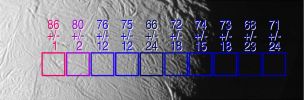
Enceladus-PIA07793.jpgEnceladus' surface temperatures (1)55 visiteThe exciting mystery of an active South Polar Region on Saturn's icy moon Enceladus continues to unfold as scientists make the correlation between geologically youthful surface fractures and unusually warm temperatures.
This view shows excess heat radiation from cracks near the moon's South Pole. These warm fissures are the source of plumes of dust and gas seen by multiple instruments on the Cassini spacecraft during its flyby of Enceladus on July 14, 2005, as described in a series of papers in the March 10, 2006, issue of the journal Science. This image shows two arrays of temperature readings across the surface of Enceladus, as measured by the Cassini Composite Infrared Spectrometer (CCIS), superimposed on images of the surface taken simultaneously by the Imaging Science Subsystem. Surface temperatures in Kelvin, derived from the intensity of infrared radiation detected by the composite infrared spectrometer, are shown along with their formal uncertainties, although true uncertainties for temperatures below about 75 Kelvin (minus 325 degrees Fahrenheit) are not easily described by a single number.
(2 voti)
|
|
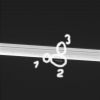
The Rings-N00051339.jpgHiding in the Rings?54 visitePortate l'immagine sino al full-size e poi verificate anche Voi:
Cerchiatura Bianca n. 1: si tratta di un clump, di un difetto dell'immagine (photoartifact) o di una shepherd moon non ancora catalogata?
Cerchiatura Bianca n. 2: evidentemente si tratta di una luna "mossa", ma quale luna di Saturno si esprime fotograficamente lasciando due strisce, per giunta disallineate?
Cerchiatura Bianca n. 3: secondo noi un'altra luna (o comunque un corpo celeste di qualche tipo) si intuisce appena, quasi del tutto eclissato dagli Anelli.
(2 voti)
|
|

Rhea-PIA08120.jpgRhea, from 245.000 Km and in "extreme" false colors...55 visiteBright, wispy markings stretch across a region of darker terrain on Rhea. In this extreme false-color view, the roughly North-South fractures occur within strips of material (which appear greenish here) that are a different color from the surrounding cratered landscape. To create the false-color view, ultraviolet, green and infrared images were combined into a single black and white picture that isolates and maps regional color differences. Most of the large-scale variations in brightness across the surface are removed by this process. This color map was then superimposed over a clear-filter image. The origin of the color differences is not yet understood, but it may be caused by subtle differences in the surface composition or grain sizes making up the icy soil. Wispy markings were seen on the trailing Hemispheres of both Rhea and Dione, in images taken by Voyager spacecrafts, and were hypothesized by some researchers to be the result of material extruded onto the surface by ice volcanism.
(2 voti)
|
|

Tehys-PIA07693.jpgOdysseus58 visiteOriginal caption:"Plunging cliffs and towering mountains characterize the gigantic impact structure called Odysseus on Saturn's moon Tethys. The great impact basin lies before the Cassini spacecraft in one of the best views yet obtained.
Quite a few small craters are visible inside Odysseus (450 Km - or 280 miles across), making it clear that this is not a very young structure. However, a comparison of cratering density between the interior of Odysseus and the surrounding terrain should show whether the large basin is at least relatively young.
Odysseus lies on the Leading Hemisphere of Tethys; North is up and rotated 18° to the right.
The image was taken in polarized ultraviolet light with the Cassini spacecraft narrow-angle camera on Dec. 24, 2005 at a distance of approx. 196.000 Km (about 122.000 miles) from Tethys and at a Sun-Tethys-spacecraft, or phase, angle of 85°. Resolution in the original image was about 1 Km (3,831 feet) per pixel. The image has been magnified by a factor of two and contrast-enhanced to aid visibility".
(2 voti)
|
|
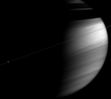
Saturn-PIA07673-br500.jpgLike a light in the darkness: Dione55 visiteThis moody portrait of Saturn captures a razor-thin Ring-Plane bisecting the clouds of the bright Equatorial Region. The Rings cast dark, shadowy bands onto the Planet's Northern Latitudes.
At left, Dione is a tiny sunlit orb against the Planet's Dark Side.
The image was taken in polarized infrared light with the Cassini spacecraft wide-angle camera on Dec. 7, 2005 at a distance of app.x 3,1 MKM (about 1,9 MMs) from Saturn and at a phase angle of 96°. Image scale is 179 Km (about 111 miles) per pixel.
(2 voti)
|
|

Saturn-N00047655.jpgWhite ice-clouds on Saturn's upper atmosphere (3)56 visiteOriginal caption:"N00047655.jpg was taken on January 02, 2006 and received on Earth January 03, 2006. The camera was pointing toward Saturn that, at the time, was approximately 2.732.667 Km away, and the image was taken using the CL1 and CL2 filters. This image has not been validated or calibrated".
(2 voti)
|
|
Saturn-N00047653.jpgWhite ice-clouds on Saturn's upper atmosphere (1)57 visiteOriginal caption:"N00047653.jpg was taken on January 02, 2006 and received on Earth January 03, 2006. The camera was pointing toward Saturn that, at the time, was approximately 2.732.201 Km away, and the image was taken using the CL1 and CL2 filters. This image has not been validated or calibrated".
(2 voti)
|
|

Pandora-PIA07647.jpgPandora and the F-Ring65 visiteThis dramatic image shows Saturn's craggy (---> rocciosa, colma di dirupi) moon Pandora skimming (to skim---> rasentare, sfiorare) along the F-Ring's outer edge.
Pandora orbits about 1.000 Km (approx. 620 miles) exterior to the Ring, but, in this view, is projected onto the Ring.
The moderately high-resolution of the image reveals the moonlet's odd shape.
The image was acquired from less than 1 degree below the Ring-Plane and taken in visible light with the Cassini spacecraft narrow-angle camera on Oct. 29, 2005, at a distance of approx. 455.000 Km (roughly 283.000 miles) from Pandora. The image scale is 3 Km (about 2 miles) per pixel.
(2 voti)
|
|
| 2244 immagini su 187 pagina(e) |
 |
|
|
|
|
165 | |
|
|
|
|





