| Piú votate - Saturn: the "Ringed Beauty" and His Moons |

The_Rings-PIA08901.jpgThe "Cassini Division"54 visiteCaption NASA:"The Cassini Division appears to emerge out of Saturn's shadow in this Cassini spacecraft image. This Division between the A and B Rings, visible through modest telescopes from Earth, actually contains five dim bands of ring material, here seen near the left side of the image between two small dark gaps.
This detailed view also displays a great deal of structure in the B-Ring, left of the Division. The Cassini Division is 4800 Km (2980 miles) wide. This view looks toward the unlit side of the Rings from about 59° above the Ring-Plane.
The image was taken in visible light with the Cassini spacecraft narrow-angle camera on Feb. 9, 2007 at a distance of approx. 1,7 MKM (about 1,1 MMs) from Saturn.
Image scale is roughly 10 Km (about 6 miles) per pixel".
(2 voti)
|
|

The_Rings-PIA08900.jpgThe "beginnings" of the Rings56 visiteCaption NASA:"High above the streamers of cloud in Saturn's atmosphere the Planet's immense Ring System begins with faint, thin rings populated with dust-sized ice particles. Here, features in the D-Ring are visible, beginning at about 67.000 Km (approx. 42.000 miles) from the Planet's center.
Stars trail across the background during this exposure, timed to capture the faint light from these D-Ring features.
This view looks toward the unlit side of the Rings, from about 59° above the Ring-Plane.
The image was taken in visible light with the Cassini spacecraft narrow-angle camera on Feb. 9, 2007 at a distance of approx. 1,7 MKM (1,1 MMs) from Saturn.
Image scale is roughly 10 Km (about 6 miles) per pixel".
(2 voti)
|
|

Helene_Mimas-PIA08897.jpgCelestial Wonders around Saturn: Helene and Mimas55 visiteCaption NASA:"Mimas (397 Km, or 247 miles across) is seen here just before gliding in front of Helene (32 Km, or 20 miles across), which lays about 192.000 Km (approx. 119.000 miles) in the distance beyond the larger moon.
The limb of Mimas is flattened in the West, where the rim if the large crater Herschel lies.
This view looks toward the lit side of the Rings from about 3° below the Ring-Plane.
The image was taken in visible light with the Cassini spacecraft narrow-angle camera on Feb. 3, 2007 at a distance of approx. 1,3 MKM (about 800.000 miles) from Mimas and 1,5 MKM (approx. 1 MMs) from Helene.
Image scale is roughly 8 Km (approx. 5 miles) per pixel on Mimas and 9 Km (about 6 miles) per pixel on Helene".
(2 voti)
|
|

Rhea-PIA08886.jpgDrawing Out Details on Rhea57 visiteRhea displays a marked color contrast from North to South that is particularly easy to see in the extreme color-enhanced Cassini spacecraft view presented here.
A clear filter image is also presented (left) alongside the color composite (right).
To create the false-color view, ultraviolet, green and infrared images were combined into a single picture that isolates and maps regional color differences.
This "color map" was then superimposed over a clear-filter image that preserves the relative brightness across the body.
The combination of color map and brightness image shows how colors vary across the surface of Rhea. The origin of the color differences is not yet understood, but may be caused by subtle differences in the surface composition or the sizes of grains making up the icy surface material.
This view looks toward the Trailing Hemisphere on Rhea. The view shows southerly latitudes on Rhea, down to the South Pole. North is up and rotated 17° to the right.
The image was taken in visible light with the Cassini spacecraft narrow-angle camera on Jan. 17, 2007 at a distance of approx. 457.000 Km (about 284.000 miles) from Rhea.
Image scale is roughly 3 Km (a little less than 2 miles) per pixel.
(2 voti)
|
|

Saturn-PIA08883.jpgSaturn's South Polar Regions (near Natural Colors - elab. NASA)54 visiteCaption NASA:"The Cassini spacecraft views Saturn's Southern Latitudes in color, spying a great, eye-shaped vortex just northward of the South Polar Region. Other dark vortices, common features of Saturn's general circulation, are visible in the Mid-Latitudes.
Contrast in the image was enhanced to make features in the atmosphere more visible.
Images taken using red, green and blue spectral filters were combined to create this near-natural color view. The images were taken in visible light with the Cassini spacecraft wide-angle camera on Jan. 14, 2007 at a distance of approx. 958.000 Km (such as about 595.000 miles) from Saturn.
Image scale is roughly 54 Km (about 33 miles) per pixel".MareKromium
(2 voti)
|
|

Mimas-N00077784.jpgOccultation? (3)63 visiteCaption NASA:"(...) The camera was pointing toward Mimas that, at the time, was at approximately 1.345.112 Km away, and the image was taken using the CL1 and CL2 filters (...)".
(2 voti)
|
|

Pan-PIA08857.jpgPan55 visiteCaption NASA:"Pan is seen in this color view as it sweeps through the Encke Gap with its attendant ringlets. As the lemon-shaped little moon orbits Saturn, it always keeps its long axis pointed along a line toward the Planet. From this vantage point, the dark side of the moon is visible.
This view looks toward Pan (26 Km or 16 miles across) within the Encke Gap (325 Km or 200 miles wide), on the unlit side of the Rings, and from an inclination of about 33° above the Ring-Plane.
Images taken using red, green and blue spectral filters were combined to create this natural color view. The image was taken with the Cassini spacecraft narrow-angle camera on Dec. 16, 2006 at a distance of approx. 779.000 Km (about 484.000 miles) from Pan and at a Sun-Pan-spacecraft, or phase angle of 83°.
Image scale is roughly 5 Km (a little more than 3 miles) per pixel".MareKromium
(2 voti)
|
|

The_Rings-PIA08845.jpgThe strange appearence of the F-Ring62 visiteCaption NASA:"The striated appearance of the F-Ring is immediately apparent in the region of the ring that trails behind the moon Prometheus. The F-Ring is characterized here by dark gores that stretch inward toward the planet and forward in the direction of motion.
This image has been expanded in the horizontal direction by a factor of 5 in order to make radial variations more prominent.
The curvature of the Rings is also exaggerated by the horizontal stretch.
The exterior flanking ringlets (to the right of the bright ring core) are not disturbed by Prometheus to the great degree seen in the inner ringlets. This view looks toward the unlit side of the Rings from about 31° above the Ring-Plane.
The image was taken in visible light with the Cassini spacecraft narrow-angle camera on Nov. 25, 2006 at a distance of approx. 1,7 MKM (about 1,1 MMs) from Saturn and at a phase angle of 162°. Scale in the original image is roughly 10 km per pixel".MareKromium
(2 voti)
|
|
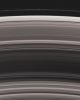
The_Rings-PIA08840.jpgThe Main Ring-System55 visiteCaption NASA originale:"This expansive view takes in most of Saturn's main Ring System, from the outer C-Ring to the narrow and knotted-looking F-Ring. The broad brightness plateaus in the C-Ring (at bottom) transform into the more densely populated (and thus darker in this viewing geometry) B-Ring. The Rings' appearance becomes brighter and smoother beyond the bands of the Cassini Division, in the A-Ring. This view looks toward the unlit side of the Rings from about 49° above the Ring-Plane.
The image was taken in visible blue light with the Cassini spacecraft wide-angle camera on Nov. 21, 2006 at a distance of approx. 539,000 Km (about 335.000 miles) from Saturn and at a Sun-Saturn-spacecraft, or phase, angle of 98°.
Image scale is 29 kilometers (18 miles) per pixel".MareKromium
(2 voti)
|
|

The_Rings-PIA08834.jpgThe Rings55 visiteCaption NASA:"The contrast is sharp between the outer portion of the A-Ring edge and the Ring's main body. One explanation for this is that the outer A-Ring region contains smaller particles (around 1 cm or 0,4" in radius) than the main rings, allowing more opportunities for light scattering before it scatters toward the camera.
Ringlets in the Encke Gap and flanking the bright F-Ring core are clearly visible here.
This view looks toward the lit side of the Rings from about 4° below the Ring-Plane.
The image was taken with the Cassini spacecraft narrow-angle camera using a spectral filter sensitive to wavelengths of infrared light centered at 752 nanometers on Nov. 7, 2006. Cassini was then at a distance of approx. 1,1 MKM (about 700.000 miles) from Saturn and at a Sun-Saturn-spacecraft, or phase, angle of 140°.
Image scale on the sky at the distance of Saturn is about 6 Km (a little less than 4 miles) per pixel".
(2 voti)
|
|

The_Rings-PIA08836.jpgThe Rings' texture55 visiteCaption NASA:"This close-up of the inner edge of the Cassini Division shows an enormous amount of structure, including a grainy texture in the bright outer B-Ring material near the gap edge.
An extreme enhancement of the original image, presented at right, reveals the grainy region with greater clarity.
This view looks toward the lit side of the rings from about 54° below the Ring-Plane.
The image was taken in visible light with the Cassini spacecraft narrow-angle camera on Nov. 8, 2006 at a distance of approx. 378.000 Km (about 235.000 miles) from Saturn and at a Sun-Saturn-spacecraft, or phase, angle of 68°.
Image scale is roughly 2 Km (a little more than 1 mile) per pixel".
(2 voti)
|
|
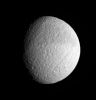
Tethys-PIA08291.jpgTethys56 visiteCaption NASA:"Tethys has a crater-saturated surface, where older, larger basins have been completely overprinted by newer, smaller impacts. This state is what scientists expect to see on a very old surface, where small impactors have struck more frequently than larger ones over several billion years. Larger impacts were more common events in the early history of the Solar System.
This view looks toward the Leading Hemisphere of Tethys (1.071 Km, or about 665 miles across). North is up. The great scar of Ithaca Chasma is seen at right.
The view was captured in visible light with the Cassini spacecraft narrow-angle camera on Sept. 25, 2006 at a distance of approx. 449.000 Km (such as about 279.000 miles) from Tethys and at a phase angle of 49°. Image scale is roughly 3 Km (about 2 miles) per pixel".
(2 voti)
|
|
| 2244 immagini su 187 pagina(e) |
 |
|
|
|
|
162 | |
|
|
|
|





