| Piú votate - Saturn: the "Ringed Beauty" and His Moons |

Tethys-PIA09737.jpgCrescent Tethys56 visiteCaption NASA:"The pockmarked crescent of Tethys displays slightly darker terrain in a band at its Equator. The rim of the great crater Odysseus lurks on the Terminator.
Lit terrain seen here is on the Leading Hemisphere of Tethys. North is up.
The image was taken in visible light with the Cassini spacecraft wide-angle camera on Aug. 29, 2007. The view was obtained at a distance of approx. 56.000 Km (such as about 35.000 miles) from Tethys and at a Sun-Tethys-spacecraft, or phase, angle of 105°.
Image scale is roughly 3 Km (about 2 miles) per pixel".MareKromium
(2 voti)
|
|
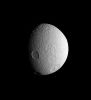
Tethys-PIA09723.jpgThe "Scars" of Tethys...56 visiteCaption NASA:"The Cassini spacecraft spies four large impact basins on the Southern Hemisphere of icy Tethys.
Tethys (approx. 1071 Km, or 665 miles across), like the other airless worlds of the Solar System, wears the record of countless impacts experienced over the eons.
Lit terrain seen here is on the leading hemisphere of Tethys. North is up and rotated 15° to the left.
The image was taken in visible light with the Cassini spacecraft narrow-angle camera on July 21, 2007. The view was obtained at a distance of approx. 452.000 Km (such as about 281.000 miles) from Tethys and at a Sun-Tethys-spacecraft, or phase, angle of 54°.
Image scale is roughly 3 Km (about 2 miles) per pixel".MareKromium
(2 voti)
|
|

Tethys-PIA09017.jpgOdysseus55 visiteCaption NASA:"The Cassini spacecraft provides a stunning view of the Odysseus impact basin on Tethys. The enormous basin is about 450 Km (approx. 280 miles) wide.
The medium-sized crater Melanthius is seen along the Terminator at lower left.
This view looks toward the Leading Hemisphere of Tethys. North is up.
The image was taken in visible light with the Cassini spacecraft narrow-angle camera on July 21, 2007. The view was obtained at a distance of approx. 211.000 Km (such as about 131000 miles) from Tethys and at a Sun-Tethys-spacecraft, or phase, angle of 46°.
Image scale is 1 kilometer (0.6 mile) per pixel".MareKromium
(2 voti)
|
|

Rhea_Dione-PIA09011.jpgThe "Crowded" Saturnian Sky58 visiteCaption NASA:"A string of icy moons stretches across the Saturn System in this view from nearly edge-on with the Ring-Plane.
Nearest to the Cassini spacecraft is Rhea (1528 Km, or about 949 miles across) below center; then little Atlas (32 Km, or about 20 miles across), huddled close to the narrow F-Ring. Dione (1126 Km, or about 700 miles across) floats in the distance beyond.
The image was taken in visible light with the Cassini spacecraft narrow-angle camera on July 8, 2007 at a distance of approx. 2,9 MKM (about 1,8 MMs) from Saturn. Image scale is roughly 14 Km (about 9 miles) per pixel on Rhea and 19 Km (about 12 miles) per pixel on Dione".MareKromium
(2 voti)
|
|

The_Rings-PIA08999.jpgSidelong View60 visiteCaption NASA:"Saturn's enchanting rings display crisply defined edges and strong contrast on their unilluminated side. Atlas (32 Km, or about 20 miles across) sits on the far side of the Rings above center, between the "A" and "F" Rings. This view was acquired from about 1° above the Ring-Plane.
The image was taken in visible light with the Cassini spacecraft narrow-angle camera on June 21, 2007 at a distance of approx. 2,4 MKM (about 1,5 MMs) from Atlas. Image scale is roughly 14 Km (about 9 miles) per pixel".MareKromium
(2 voti)
|
|
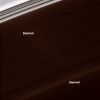
The_Rings-PIA08990.jpgStartrails through the D-Ring57 visiteCaption NASA:"Faint features in Saturn's innermost ring, the D-Ring, are brought into view in this strongly contrast-enhanced Cassini image. A few background stars are visible through the sheer ring as squiggly star trails.
The inner region of the C-Ring is seen at upper left. The faint diagonal wedge shape on the left side of the image was caused by stray light in the camera optics. The view looks toward the sunlit side of the Rings from about 18° below the Ring-Plane.
The image was taken in visible light with the Cassini spacecraft narrow-angle camera on June 12, 2007 at a distance of approx. 238.000 Km (about 148.000 miles) from Saturn.
Image scale is roughly 1 Km (0,6 miles) per pixel".MareKromium
(2 voti)
|
|

Saturn-PIA08983.jpgSpokes!59 visiteCaption NASA:"The Cassini Spacecraft spies multiple spokes in Saturn's outer B-Ring. The precise origin and evolution of these transient features continue to provide Ring Scientists with intriguing puzzles to solve.
Most of these spokes are about 4000 Km long; the 2 near the bottom of the scene are about 1000 Km (about 600 miles) wide.
This view looks toward the unilluminated side of the Rings from about 8° above the Ring-Plane.
The image was taken in visible green light with the Cassini spacecraft narrow-angle camera on June 2, 2007. The view was acquired at a distance of approx. 2,2 MKM (such as about 1,4 MMs) from Saturn.
Image scale is roughly 13 Km (about 8 miles) per pixel".MareKromium
(2 voti)
|
|
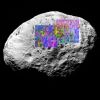
Hyperion-PIA09214.jpgWhat's all over Hyperion? (context image)65 visiteCaption NASA:"Hyperion, the eighth largest of Saturn's nearly 60 known moons, is covered in craters and landslides. Sprinkled over the icy surface is a thin layer of organic dust, which has somehow been concentrated in the bottoms of some of the craters, forming a reddish/black deposit.
This new color map shows the composition of a portion of Hyperion's surface determined with the Visual and Infrared Mapping Spectrometer aboard the Cassini spacecraft. The new composition map is overlaid onto a previously released Cassini image of Hyperion, taken with the Imaging Science Subsystem.
(...) Discovered in 1848, Hyperion held its secrets until the Cassini spacecraft flew close in September 2005, revealing its icy and organic composition.
Hyperion is irregular in shape, tumbles chaotically, and takes 21 days to orbit Saturn. It is 300 Km (about 180 miles) in its longest dimension".MareKromium
(2 voti)
|
|

Tethys-PIA08974-1.jpgTethys (natural colors - elab. Lunexit)59 visiteCaption NASA:"Ithaca Chasma rips across Tethys from North to South near the center of this view. The moon's western limb is flattened, indicating the rim of the giant impact basin Odysseus.
The dark, East-West trending band often observed in this region (see PIA07571) is just visible here, but its contrast is reversed at these short, ultraviolet wavelengths -- it is bright against the already bright terrain.
North on Tethys (1071 Km, or about 665 miles across) is up and rotated 24° to the left. This view looks toward the moon's Saturn-Facing Hemisphere.
The image was taken with the Cassini spacecraft narrow-angle camera on May 27, 2007 using a combination of spectral filters sensitive to wavelengths of light centered at 298 and 338 nanometers. The view was obtained at a distance of approx. 267.000 Km (about 166.000 miles) from Tethys and at a Sun-Tethys-spacecraft, or phase, angle of 13°.
Image scale is roughly 2 Km (5.236 feet) per pixel".MareKromium
(2 voti)
|
|

Mimas-N00083734.jpgMimas (natural colors - elab. Lunexit)58 visitenessun commentoMareKromium
(2 voti)
|
|

The_Rings-PIA08941.jpgDaphnis, Atlas and the Rings57 visiteCaption NASA:"Across the expanse of Saturn's Rings, the Cassini spacecraft spies 2 small moons in consort.
Atlas is seen exterior to the bright outer edge of the A-Ring. Daphnis, below Atlas in this view, orbits Saturn within the narrow Keeler Gap. The presence of Daphnis is revealed by the waves it raises in the ring material surrounding it on the edges of the gap. Daphnis and its waves moved between exposures taken to create this color view, resulting in their slight displacement in each color.
This view looks toward the unilluminated side of the Rings from about 18° above the Ring-Plane. Bright clumps are visible in the narrow F-Ring.
Images taken using red, green and blue spectral filters were combined to create this natural color view. The images were acquired with the Cassini spacecraft narrow-angle camera on April 13, 2007 at a distance of approx. 1,8 MKM (about 1,1 MMs) from Atlas.
Image scale is roughly 11 Km (about 7 miles) per pixel".MareKromium
(2 voti)
|
|

The_Rings-PIA08920.jpgSome in the Darkness, some in the Light...54 visiteCaption NASA:"Pan prepares to be engulfed by the darkness of Saturn's shadow, visible here as it stretches across the Rings.
When the Cassini spacecraft took a follow-up image of this same location about 50 seconds later, Pan (26 kilometers, or 16 miles across) had vanished into darkness.
This view looks toward the unilluminated side of the Rings from about 44° above the Ring-Plane.
The image was taken in visible light with the Cassini spacecraft narrow-angle camera on March 14, 2007 at a distance of approx. 1,9 MKM (about 1,2 MMs) from Pan. Image scale is roughly 11 Km (about 7 miles) per pixel".MareKromium
(2 voti)
|
|
| 2244 immagini su 187 pagina(e) |
 |
|
|
|
|
161 | |
|
|
|
|





