| |

| Piú votate - Saturn: the "Ringed Beauty" and His Moons |

EnceladusPlume-IMG002944-br500.jpgEnceladus' Plume Mechanics54 visiteCaption NASA:"This graphic shows how the ice particles and water vapor observed spewing from geysers on Saturn's moon Enceladus may be related to liquid water beneath the surface.
The large number of ice particles and the rate at which they are produced require high temperatures, close to the melting point of water. These warm temperatures indicate that there may be an internal lake of liquid water at or near the moon's South Pole, where the geysers are present.
This internal lake could be similar to Earth's Lake Vostok, where liquid water is locked in ice beneath Antarctica. The presence of liquid water inside Enceladus would have major implications for future studies of the possibility of life in the outer solar system". MareKromium
(2 voti)
|
|

Epimetheus-PIA09813.jpgEpimetheus, from about 37.000 Km (enhanced - but natural - colors; credits: NASA)55 visiteCaption NASA:"The Cassini spacecraft's close flyby of Epimetheus in December 2007 returned detailed images of the moon's South Polar Region.
The view shows what might be the remains of a large impact crater covering most of this face, and which could be responsible for the somewhat flattened shape of the Southern part of Epimetheus (116 Km, or about 72 miles across) seen previously at much lower resolution.
The image also shows two terrain types: darker, smoother areas, and brighter, slightly more yellowish, fractured terrain. One interpretation of this image is that the darker material evidently moves down slopes, and probably has a lower ice content than the brighter material, which appears more like "bedrock". Nonetheless, materials in both terrains are likely to be rich in water ice. (...)".
MareKromium
(2 voti)
|
|

Rhea-PIA09799.jpgRising Rhea (natural colors; credits: Lunexit)77 visiteCaption NASA:"The low illumination angle near the Terminator makes visible the steep topography of craters on Rhea's battered surface. This view is centered on 10° North Latitude, 128° West Longitude.
The image was taken in visible light with the Cassini spacecraft narrow-angle camera on Nov. 16, 2007. The view was obtained at a distance of approx. 313.000 Km (such as about 195.000 miles) from Rhea and at a Sun-Rhea-spacecraft, or phase, angle of 128°. Image scale is 2 Km (a little more than 1 mile) per pixel".MareKromium
(2 voti)
|
|
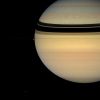
Saturn-PIA08394.jpgMoons... (natural colors; credits: NASA)56 visiteCaption NASA:"This colorful view, taken from edge-on with the Ring-Plane, contains 4 of Saturn's attendant moons. Tethys is seen against the black sky to the left of the Gas Giant's limb. Brilliant Enceladus sits against the Planet near right.
Irregular Hyperion is at the bottom of the image, near left. Much smaller Epimetheus is a speck below the Rings directly between Tethys and Enceladus. Epimetheus casts an equally tiny shadow onto the blue Northern Hemisphere, just above the thin shadow of the F-Ring.
Images taken using red, green and blue spectral filters were combined to create this natural color view. The images were acquired with the Cassini spacecraft wide-angle camera on July 24, 2007 at a distance of approx. 2 MKM (about 1,2 MMs) from Saturn. Image scale is 116 kilometers (72 miles) per pixel on Saturn".MareKromium
(2 voti)
|
|

Saturn-PIA09776.jpgJust like the Solar System!58 visiteCaption NASA:"Saturn's icy satellites wheel about the colorful Giant Planet, while the Rings shine dimly in scattered sunlight. The Ringed Planet is, in many ways, a laboratory for investigating the history of our Solar System and how planets form around other stars. There are 4 moons visible in this view. Tethys (1071 Km, or 665 miles across), largest in the scene, is on the far side of the Ring-Plane. Mimas (397 Km, or 247 miles across), is the one on the near side of the Rings, below Tethys. Janus (181 Km, or 113 miles across), is left of the Rings' edge. Pandora (84 Km, or 52 miles across) is a speck below the Rings' edge, between Janus and Mimas. Mimas casts a shadow onto Saturn's bluish Northern Hemisphere.
This view looks toward the unilluminated side of the Rings from about 2° above the Ring-Plane. Images taken using red, green and blue spectral filters were combined to create this natural color view. The view was acquired with the Cassini spacecraft wide-angle camera on Oct. 30, 2007.
The view was taken at a distance of approx. 2,6 MKM (such as about 1,6 MMs) from Saturn.
Image scale is roughly 153 Km (about 95 miles) per pixel on the Planet".MareKromium
(2 voti)
|
|

Tethys-PIA09766.jpgThe "Dark Belt" of Tethys124 visiteCaption NASA:"Around the Equator on its Leading Side, Tethys wears a band of slightly darker surface material. Cassini Imaging Scientists suspect that the darkened region may represent an area of less contaminated ice with differently sized grains than the material at higher latitudes on either side of the band.
Lit terrain seen here is on the Saturn-facing side of Tethys. North is up. Part of the great canyon system Ithaca Chasma can be seen near the eastern limb in this frame-filling view.
The image was taken with the Cassini spacecraft narrow-angle camera on Sept. 30, 2007 using a spectral filter sensitive to wavelengths of infrared light centered at 930 nanometers. The view was acquired at a distance of approx. 186.000 Km (such as about 116.000 miles) from Tethys and at a Sun-Tethys-spacecraft, or phase, angle of 62°.
Image scale is roughly 1 Km (about 0,6 mile) per pixel".MareKromium
(2 voti)
|
|
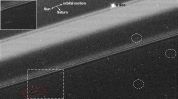
The_Rings-PIA10079.jpgSaturnian "Propellers" (context frame)59 visiteThe Cassini spacecraft captures 8 new propeller-like features within Saturn's A-Ring in what may be the propeller "hot zone" of Saturn's Rings.
Propeller features form around small moonlets that are not massive enough to clear out ring material, but are still able to pull smaller ring particles into a shape reminiscent of an airplane propeller. Scientists believe that propellers represent moonlet wakes, which are denser than the surrounding ring material and appear bright in the images.
Propellers were first discovered in Cassini images taken during Saturn orbit insertion in 2004. This new image is from a more extensive study of the full A-Ring and provides evidence that these features are not distributed evenly as previously thought, but are instead grouped in a 3000 Km-wide (about 1860 mile) Propeller Belt.
The largest propeller seen here is noted in the white dashed box, and it indicates the presence of a 150-meter (490-foot) moonlet. The size is inferred from the radial separation of the propeller wings. The propeller is seen in another image and is shown in the upper left box.
The reappearance of the propellers clearly demonstrates their orbital motion.MareKromium
(2 voti)
|
|
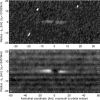
The_Rings-PIA10080.jpgSaturnian "Propellers" (extra-detail mgnf)59 visiteThis set of Cassini spacecraft images shows a close-up view of 2 propeller structures in Saturn's A-Ring. These images are part of a large view that captures eight new propeller-like features in what may be the propeller "hot zone" of Saturn's Rings. Propellers were first discovered in Cassini images taken during Saturn orbit insertion in 2004.
Propellers form around small moonlets that are not massive enough to clear out ring material, but are still able to push the ring particles into a shape reminiscent of an airplane propeller.
These pictures show 2 new propellers close up (one centered on each image). These images were put together from images in the Planetary Data System, a web site which archives and distributes scientific data from NASA planetary missions.
The image on the top shows a propeller induced by a 150-meter (490-foot) moonlet.
Smaller bright spots in the image are artifacts. The image on the bottom shows another propeller located just outside of the Encke Gap. Fine horizontal stripes seen in the image are wakes induced by the moon Pan.
In the top clear-filter image, taken during a stellar occultation on Aug. 20, 2005, the Cassini spacecraft narrow-angle camera observed the unlit side of the Rings, with a phase angle of 126°. The images were taken at 1 minute intervals with 0,05" exposure time. Image resolution is 1 Km (0,6 miles) per pixel.
The bottom clear-filter image was taken few hours later with 2" exposure time. Image resolution is roughly 1,5 Km (a little less than 1 mile) per pixel. MareKromium
(2 voti)
|
|

Rhea-PIA08402.jpgRayed Crater on Rhea (3D)89 visiteRhea's surface gains some depth in this stereo image, or anaglyph, which features the bright and geologically young-looking rayed crater on the moon's Leading Hemisphere. The view was created from images taken during Cassini's close encounter with Rhea on Aug. 30, 2007.
The crater is about 48 Km (approx. 30 miles) wide, and its rays extend several hundred kilometers outward. The rim of this crater is quite sharply defined, and there are few small craters overprinted onto it. These characteristics, along with the brightness of the crater and its rays are indicative of a feature formed relatively recently in geologic history.
The hummocky floor of the crater possesses a central peak and clusters of small craters. The little craters may be secondary impact sites, formed by ejecta from the primary impact that landed in the crater, or they could have been formed by material that had broken off of the body that struck Rhea.
This stereo image is a mosaic consisting of seven Cassini spacecraft narrow-angle camera images. The view is an orthographic projection centered on 12° South Latitude, 112° West Longitude and has a resolution of 45 meters (148 feet) per pixel. An orthographic view is most like the view seen by a distant observer looking through a telescope. North is up.
The clear filter images for this stereo image were taken from distances ranging from about 17.000 Km (approx. 10.600 miles, for the red-colored image) to 7.500 Km (such as about 4.700 miles, for the blue/green-colored image) from Rhea.MareKromium
(2 voti)
|
|

Tethys-PIA08400.jpgOdysseus is looking up!57 visiteThe vast expanse of the crater Odysseus spreads out below Cassini in this mosaic view of Saturn's moon Tethys.
The crater (about 450 Km or approx. 280 miles across) is a remarkably well-preserved example of an ancient multi-ringed impact basin: the outer ring is defined by steep, cliff-like walls that descend to generally broad internal terraces. The inner ring is formed by a prominent, crown-shaped, 140-Km (88-mile) diameter circular band of icy mountains. Multi-ring basins are seen on rocky bodies as well as icy ones.
The complex internal structure and multi-ringed nature of these very large basins are believed to arise from the rebound of intense shock waves that penetrated the body at the time of impact.
This mosaic was assembled from four clear filter, narrow-angle camera images. The view is an orthographic projection centered on 3° South Latitude, 119° West Longitude and has a resolution of 572 meters (0,35 mile) per pixel. An orthographic view is most like the view seen by a distant observer looking through a telescope. North is up.
The view was obtained by the Cassini spacecraft on Aug. 30, 2007, from a distance of approximately 97.000 Km (about 60.000 miles) and at a Sun-Tethys-Spacecraft, or phase, angle of 51°.MareKromium
(2 voti)
|
|

Saturn-PIA08392.jpgShadows on the Giant56 visiteLike a silvery pearl, an icy moon crosses the face of Saturn, while 2 of its siblings cast shadows onto the Planet.
Rhea hangs in the foreground. Near upper left on Saturn is the small shadow of Mimas. Near lower right is the penumbral shadow of Japetus - the part of the moon's shadow where Japetus does not completely block the Sun.
This view looks toward the unilluminated side of the Rings from less than 1° above the Ring-Plane. The Rings' shadows drape across the Northern Hemisphere. Images taken using red, green and blue spectral filters were combined to create this natural color view. The images were obtained with the Cassini spacecraft wide-angle camera on June 15, 2007, at a distance of approx. 1,2 MKM (such as about 744.000 miles) from Rhea and 1,7 MKM (1,1 MMs) from Saturn.
Image scale is roughly 71 Km (about 44 miles) per pixel on Rhea and 103 Km (about 64 miles) on Saturn.MareKromium
(2 voti)
|
|

Japetus-PIA08384-1.jpgThe Other Side of Japetus (false colors - elab. NASA)56 visiteCassini captures the first high-resolution glimpse of the bright trailing hemisphere of Saturn's moon Iapetus.
This false-color mosaic shows the entire hemisphere of Iapetus (1,468 kilometers, or 912 miles across) visible from Cassini on the outbound leg of its encounter with the two-toned moon in Sept. 2007. The central longitude of the trailing hemisphere is 24 degrees to the left of the mosaic's center.
Also shown here is the complicated transition region between the dark leading and bright trailing hemispheres. This region, visible along the right side of the image, was observed in many of the images acquired by Cassini near closest approach during the encounter.
Revealed here for the first time in detail are the geologic structures that mark the trailing hemisphere. The region appears heavily cratered, particularly in the north and south polar regions. Near the top of the mosaic, numerous impact features visible in NASA Voyager 2 spacecraft images (acquired in 1981) are visible, including the craters Ogier and Charlemagne.
The most prominent topographic feature in this view, in the bottom half of the mosaic, is a 450-kilometer (280-mile) wide impact basin, one of at least nine such large basins on Iapetus. In fact, the basin overlaps an older, similar-sized impact basin to its southeast.
In many places, the dark material -- thought to be composed of nitrogen-bearing organic compounds called cyanides, hydrated minerals and other carbonaceous minerals -- appears to coat equator-facing slopes and crater floors. The distribution of this material and variations in the color of the bright material across the trailing hemisphere will be crucial clues to understanding the origin of Iapetus' peculiar bright-dark dual personality.
The view was acquired with the Cassini spacecraft narrow-angle camera on Sept. 10, 2007, at a distance of about 73,000 kilometers (45,000 miles) from Iapetus.
The color seen in this view represents an expansion of the wavelengths of the electromagnetic spectrum visible to human eyes. The intense reddish-brown hue of the dark material is far less pronounced in true color images. The use of enhanced color makes the reddish character of the dark material more visible than it would be to the naked eye.
This mosaic consists of 60 images covering 15 footprints across the surface of Iapetus. The view is an orthographic projection centered on 10.8 degrees south latitude, 246.5 degrees west longitude and has a resolution of 426 meters (0.26 miles) per pixel. An orthographic view is most like the view seen by a distant observer looking through a telescope.
At each footprint, a full resolution clear filter image was combined with half-resolution images taken with infrared, green and ultraviolet spectral filters (centered at 752, 568 and 338 nanometers, respectively) to create this full-resolution false color mosaic.
MareKromium
(2 voti)
|
|
| 2244 immagini su 187 pagina(e) |
|
|
|
|
|
160 | |
|
|
|
|
|
|





