| Piú votate - Saturn: the "Ringed Beauty" and His Moons |

Anthe-PIA11101.jpgThe "Anthe Arc"54 visiteCaption NASA:"Cassini images reveal the existence of a faint "Arc of material" orbiting with Saturn's small moon Anthe.
The moon is moving downward and to the right in this perspective. In this image, most of the visible material in the Arc lies ahead of Anthe (2 Km, or a little more than 1 mile across) in its orbit. However, over time the moon drifts slowly back and forth with respect to the Arc.
The Arc extends over about 20° in Longitude (about 5,5% of Anthe's orbit) and appears to be associated with a gravitational resonance caused by the moon Mimas). Micrometeoroid impacts on Anthe are the likely source of the Arc material.
The orbit of Anthe lies between the larger moons Mimas and Enceladus. Anthe shares this region with two other small moons, Pallene (4 Km, or about 3 miles across) and Methone (3 Km, or approx. 2 miles across).
Methone also possesses an Arc (see PIA11102), while Pallene is known to orbit within a faint, complete ring of its own (see PIA08328).
Cassini imaging scientists believe the process that maintains the Anthe and Methone Arcs is similar to that which maintains the Arc in the G-Ring (see PIA08327). The general brightness of the image (along with the faint horizontal banding pattern) results from the long exposure time of 32" required to capture the extremely faint ring arc and the processing needed to enhance its visibility (which also enhances the digital background noise in the image). The image was digitally processed to remove most of the background noise. The long exposure also produced star trails in the background.
This view looks toward the un-illuminated side of the Rings from about 3° above the Ring-Plane.
The image was taken in visible light with the Cassini spacecraft narrow-angle camera on July 3, 2008. The view was obtained at a distance of approx. 1,2 MKM (such as about 739.000 miles) from Anthe and at a Sun-Anthe-Spacecraft, or Phase, Angle of 12°. Image scale is roughly 7 Km (about 4 miles) per pixel".MareKromium
(2 voti)
|
|

Enceladus-PIA11113.jpgDamascus Sulcus (possible True Colors; credits: Lunexit)56 visiteCaption NASA:"The yellow circles on this mosaic, showing the fracture known as Damascus Sulcus, indicate the Jets' Source Locations II and III, as identified in PIA08385.
This mosaic consists of two images obtained with the clear spectral filters on Cassini's narrow-angle camera. The view is an orthographic projection with an image scale of 24 meters (79 feet) per pixel. The area shown here is centered on 81,2° South Latitude and 309,9° West Longitude. The original images ranged in resolution from 27 to 30 meters (89 to 98 feet) per pixel and were taken at distances ranging from 4200 to 4742 Km (such as from about 2610 to approx. 2947 miles) from Enceladus".MareKromium
(2 voti)
|
|

Enceladus-PIA11107.jpgDamascus Sulcus58 visiteCaption NASA:"This image is the 7th skeet-shoot image taken during Cassini's very close flyby of Enceladus on Aug. 11, 2008. Damascus Sulcus is crossing the upper part of the image.
The image was taken with the Cassini Spacecraft narrow-angle camera on Aug. 11, 2008, a distance of approx. 4742 Km (such as about 2947 miles) above the surface of Enceladus.
Image scale is approximately 30 meters (98 feet) per pixel". MareKromium
(2 voti)
|
|
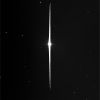
Enceladus-W00048456.jpgJust like a "Star"!55 visiteUno strabiliante "effetto goccia" (da over-saturation) per l'oggetto celeste la cui albedo è la più alta nell'intero Sistema Solare: Encelado, la "Luna di Neve".
Caption NASA:"W00048456.jpg was taken on August 11, 2008 and received on Earth August 11, 2008. The camera was pointing toward ENCELADUS that, at the time, was approx. 444.673 Km away.
The image was taken using the CL1 and CL2 filters and it has not been validated or calibrated".MareKromium
(2 voti)
|
|
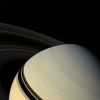
Saturn-PIA08414.jpgPerspectives... (natural colors; credits: NASA)57 visiteCaption NASA:"The Ringed Planet sits in repose, the center of its own macrocosm of many rings and moons and one artificial satellite named Cassini. Mimas (approx. 397 Km, or about 247 miles across) is visible at upper left. Although unseen in this view, Enceladus (approx. 504 Km, or about 313 miles across) casts its shadow upon the Planet. The Rings also block the Sun's light from the low Latitudes of the Northern Hemisphere.
During Cassini's extended mission, dubbed the Cassini Equinox Mission, which begins on July 1, 2008, the Ring shadows will slip past the Planet's Equator and into the Southern Hemisphere as Saturn passes through its Northern Vernal Equinox on August 11, 2009, and the Sun moves northward through the Ring-Plane.
This view looks down on the unilluminated side of the Rings, from about 22° above (such as North of) the Ring-Plane. Images taken using red, green and blue spectral filters were combined to create this natural color view. The images were obtained with the Cassini Spacecraft wide-angle camera on Dec. 16, 2007, at a distance of approx. 1,4 MKM (such as about 900,000 miles) from Saturn.
Image scale is roughly 86 Km (about 53 miles) per pixel".MareKromium
(2 voti)
|
|

Pan-PIA09911.jpgAlmost invisible...59 visiteCaption NASA:"Pan coasts down its private highway within the Encke Gap.
The process by which Pan (about 28 Km, or 17 miles across) maintains the gap, clearing the neighborhood around its orbit, is believed to be similar to the way that planets clear gaps in debris disks around young stars. This view looks toward the unilluminated side of the Rings from about 11° above the Ring-Plane.
The limb of Saturn is seen through the Rings, at the upper left.
The image was taken in visible light with the Cassini Spacecraft narrow-angle camera on April 24, 2008. The view was obtained at a distance of approx. 1,3 MKM (such as about 784.000 miles) from Pan.
Image scale is roughly 8 Km (approx. 5 miles) per pixel".MareKromium
(2 voti)
|
|

Janus-Rotating-20080220.gifJanus "in motion" (GIF-Movie)88 visitenessun commentoMareKromium
(2 voti)
|
|
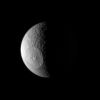
Tethys-PIA09878.jpgOdysseus in the Light54 visiteCaption NASA:"The Cassini spacecraft looks down onto high Northern Latitudes on Tethys, spying the enormous impact basin Odysseus.
Lit terrain seen here is on the anti-Saturn side of Tethys. North is towards the top of the image.
The image was taken in visible light with the Cassini spacecraft narrow-angle camera on March 11, 2008. The view was acquired at a distance of approx. 765.000 Km (such as about 475.000 miles) from Tethys and at a Sun-Tethys-Spacecraft angle of 97°.
Image scale is roughly 5 Km (about 3 miles) per pixel".MareKromium
(2 voti)
|
|

Enceladus-PIA10354.jpgStellar Data on "Enceladus Plume"122 visiteCaption NASA:"New structure, density and composition measurements of Enceladus' water plume were obtained when the Cassini Spacecraft's Ultraviolet Imaging Spectrograph observed the star "Zeta Orionis" pass behind the plume Oct. 24, 2007, as seen in this frame.
Changes in the starlight as it dimmed while passing through the plume allowed the spectrograph to identify the plume's physical and chemical composition.
The spectrograph detected 4 high-density gas streams composed of Water Vapor. The density of the Water Vapor is twice that of the broad plume of gas that surrounds each jet.
This measurement confirms the theoretical analysis performed prior to the flyby that showed it was safe for Cassini to fly very closely past Enceladus, even through part of the plume, during the March 12, 2008 flyby".MareKromium
(2 voti)
|
|

Enceladus-PIA10355.jpgGas and Dust Jets Match Up!56 visiteCaption NASA:"Jets of high-density gas detected by Cassini's Ultraviolet Imaging Spectrograph on Saturn's moon Enceladus match the locations of dust jets determined from Cassini images, labeled here with Roman numerals. The spectrograph pinpointed the locations of individual gas streams in the plume in a "stellar occultation", which involves measuring the light of a star (in this case, Zeta Orionis), as it passed behind the plume from Cassini's viewpoint.
The blue line in this projection shows the path of the starlight through the plume, over the South Polar Region of Enceladus.
The instrument looked at the star across this path in the direction indicated by the short blue lines.
Some of the dust jets appear to merge together in stellar occultation data. The dimming of starlight labeled "a" was caused by dust jets V and VII. The dimming of starlight marked as feature "b" may be associated with dust jet I if the jet is not perfectly vertical.
Dimming of starlight labeled "c" corresponds to dust jet VI, and "d" is dust jet III, with dust jet II in between. The individual jets come from sources with an area of less than 300 by 300 meters (such as about 1000 feet square) - about the size of half a tennis court - probably stretched out rectangularly along the Tiger Stripes.
The new data indicate that the water molecules are blasting off from Enceladus at faster than 600 meters per second (about 1200 mph)".MareKromium
(2 voti)
|
|

Enceladus-PIA10356.jpgWhat's in "Enceladus Plume"?59 visiteCaption NASA:"The lower panel is a Mass Spectrum that shows the chemical constituents sampled in Enceladus' plume by Cassini's Ion and Neutral Mass Spectrometer during its fly-through of the plume on Mar. 12, 2008.
Shown are the amounts, in atomic mass per elementary charge (Daltons [Da]), of Water Vapor, Methane, Carbon Monoxide, Carbon Dioxide, simple organics and complex organics identified in the plume".MareKromium
(2 voti)
|
|

Saturn_Titan-PIA09856.jpgFather and Son (natural colors; credits: NASA)56 visiteCaption NASA:"The Cassini Spacecraft captured this color portrait of Saturn and Titan only a few minutes before the haze-enshrouded moon slipped behind the planet's enormous bulk. The view looks toward the sunlit side of the Rings from about 5° below the Ring-Plane.
The Northern Hemisphere of Titan presently appears darker than the Southern, a feature presumed to be a seasonal effect.
Images taken using red, green and blue spectral filters were combined to create this natural color view. The images were acquired with the Cassini spacecraft wide-angle camera on Jan. 29, 2008 at a distance of approx. 2,3 MKM (such as about 1,4 MMs) from Titan and approx. 1 MKM (about 630.000 miles) from Saturn.
Image scale is roughly 135 Km (about 84 miles) per pixel on Titan and approx. 61 Km (about 38 miles) per pixel on Saturn".MareKromium
(2 voti)
|
|
| 2244 immagini su 187 pagina(e) |
 |
|
|
|
|
159 | |
|
|
|
|





