| Piú votate - Saturn: the "Ringed Beauty" and His Moons |
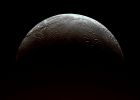
Enceladus-PIA10573.jpgCrescent Enceladus (Natural Colors; credits: Lunar Explorer Italia)59 visiteCaption NASA:"Sunrise uncovers both old and new Enceladus in this image from the Cassini Spacecraft. The lit side of the moon faces Saturn in this view of the Trailing Hemisphere. Old craters still pockmark the Northern Hemisphere while more recent geologic activity has swept them away in the South. North is on the right (Dx) in this image.
Mountain Ranges, a.k.a. "Dorsae", undulate across the moon's surface near the Equator.
From this high northern viewing angle, the South Pole's fascinating "Tiger Stripe Area" lies just out of view. Sulci, a.k.a. "furrows", in that area, are the sources of icy plumes being studied by Cassini scientists.
(See also PIA07800 and PIA09761).
Also near the Tiger Stripes are rift segments that resemble the zigzag patterns seen on Earth of sea-floor spreading from upwelling magma. See PIA11138 for a comparison of the phenomena.
Like outstretched fingers, the Samarkand Sulci reach from the West toward the North Pole, clearing their path of craters and slicing some in half.
This Natural Colors mosaic combines narrow-angle camera images obtained through UltraViolet, Green, and near-InfraRed camera filters. The images were acquired on Dec. 2, 2008 at a distance of approx. 124.000 Km (such as about 77.000 miles) from Enceladus and at a Sun-Enceladus-Spacecraft, or Phase, Angle of 116°.
Image scale is roughly 742 meters (2430 feet) per pixel".MareKromium
(2 voti)
|
|
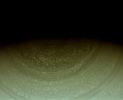
Saturn-PIA10568.jpgNorth Polar Hues (possible Natural Colors; credits: Lunar Explorer Italia)67 visiteCpation NASA:"Cassini imaging scientists have waited years for the Sun to reveal the Hexagonal Wave Pattern (a.k.a.: The Hexagon) in the clouds of Saturn's North Pole, part of which can be seen at the top of this image from the Cassini Spacecraft. This mosaic combines four separate near-InfraRed images to show one full side of the Hexagon and two partial sides cut off by shadow.
When the Spacecraft arrived in 2004, Winter darkened the North Pole. As the Planet continues its 29-year orbit, the Sun sheds more light on northern features and uncovers more of this strange, long-lived formation first observed in Voyager images of the illuminated Northern Pole from the early 1980's.
False color images made from data collected by Cassini's Visual and InfraRed Mapping Spectrometer (VIMS) have previously captured the full six-sided pattern in the IR Light. (See PIA09188)
South of the Hexagon at least five large storm systems can be seen spinning in a sea of smaller storms.
The image was taken with the Cassini Spacecraft wide-angle camera on Dec. 1, 2008 using a spectral filter sensitive to wavelengths of near-iIR Light centered at 752 nanometers. The view was obtained at a distance of approx. 712.000 kilometers (442,000 miles) from Saturn and at a Sun-Saturn-spacecraft, or phase, angle of 69 degrees. Image scale is 39 Km (such as about 24 miles) per pixel".MareKromium
(2 voti)
|
|

Enceladus-PIA11139.jpgAxial Discontinuity on Enceladus56 visiteCaption NASA:"These two side-by-side images compare a "twisted" sea-floor spreading feature on Earth, known as an Offset Spreading Center (OSC), to a very similar looking twisted break, or Axial Discontinuity, in the Damascus Sulcus "Tiger Stripe" on Saturn’s moon Enceladus. The image of Enceladus was acquired by NASA’s Cassini Spacecraft imaging science sub-system during one of its four close targeted flybys of Enceladus in March, August and October 2008.
The image on the left shows a shaded relief map of bathymetry (or sonar-like topography) data along a spreading ridge on the East Pacific Rise near 9,5° North Lat. and 104° West Long.
On Earth, OSC's occur only along fast-spreading ridges - ones that spread faster than about 100 mm (such as 4") per year. They do not occur on slow-spreading ridges, like the famous Mid-Atlantic Ridge where spreading rates are often less than 20 mm (0,7") per year.
The Axial Discontinuity on Enceladus’ Damascus Sulcus, shown in the image on the right, twists in the same helical way that the OSC does on Earth. However, the morphological resemblance is no guarantee that both features are caused by fast spreading.
On Earth OSCs form when two nearly parallel spreading ridges lengthen along their ridge (or long) axes. As the lengthening tips of the ridges pass each other side-by-side in opposite directions, shear forces caused by tectonic spreading between them force the two tips to twist around each other. The twisting tip of each one eventually merges with the "neck" of the other in a "yin-yang" shaped pattern.
The result is an oval shaped basin that is surrounded by the twisted ridge tips.
On Enceladus, the twisted features have not produced an oval basin, but the pattern of the twist is very similar to the terrestrial OSC and probably similar tectonic shear forces, perhaps even tectonic spreading, resulted in this twisted shape. Note that the Enceladus image has been flipped right-to-left to make comparison to the sea-floor feature easier to see".MareKromium
(2 voti)
|
|

Saturn-W00051225-MF.jpgThe colourful Upper Atmosphere of Saturn (True - but enhanced - Colors; credits: Dr M. Faccin)58 visiteUn frame bellissimo, ed incommentabile...MareKromium
(2 voti)
|
|

Helene-N00123958.jpgHelene57 visiteHelene is one of the named Minor Moons of Saturn. Also known as Saturn XII (or S12), Helene is an irregularly shaped (---> nonspherical) body measuring about 22 miles (such approx. 36 Km), by about 20 miles (approx. 32 Km), by about 18 miles (approx. 30 Km).
Helene orbits Saturn at a mean distance of about 234.500 miles (approx. 377.400 Km) and has an Orbital Period of 2,7369 Earth Days — the Rotational Period is unknown but is assumed to be the same as the Orbital Period (meaning that Helene shall always show the same side to Saturn - just like the Moon does to Earth).
Helene was discovered by French astronomers P. Laques and J. Lecacheaux in 1980 during ground-based observations of Saturn.
Another moon, Dione, is co-orbital with Helene: that is, Helene orbits Saturn at the same distance as Dione but precedes Dione by about 60°.
Before the present name was adopted, the moon was referred to as "Dione-B" or also "Electra".MareKromium
(2 voti)
|
|
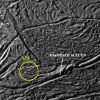
Enceladus-PIA11127.jpgBaghdad Sulcus58 visiteCaption NASA:"This Cassini image was the ninth 'skeet shoot' narrow-angle image captured during the Oct. 31, 2008 flyby of Saturn's moon Enceladus.
The source region for jet VII (see PIA08385) has been identified. The image was taken with the Cassini Spacecraft narrow-angle camera on Oct. 31, 2008, at a distance of approximately 6151 Km (about 3844 miles) from Enceladus and at a Sun-Enceladus-Spacecraft, or Phase, Angle of 75°.
Image scale is roughly 35 meters (115 feet) per pixel".MareKromium
(2 voti)
|
|
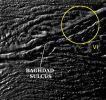
Enceladus-PIA11134.jpgBaghdad Sulcus58 visiteCaption NASA:"Like hunters sighting a clay duck flying fast in the sky, this mosaic of Cassini images was made from 'skeet shoot' narrow-angle images 1, 2, 3 and 4, all captured during the Oct. 31, 2008, flyby of Saturn's moon Enceladus.
The resolution of this mosaic is 12,3 meters (41 feet) per pixel and jet source VI (see also PIA08385) is identified in the upper right".MareKromium
(2 voti)
|
|
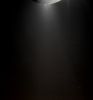
Enceladus-PIA10502.jpgIcy Plume in the Saturnshine! (natural colors; credits: Lunexit)56 visiteCaption NASA:"The active Surface Jets on Enceladus collectively form a brilliant, extended Plume that is made visible as sunlight scatters among the microscopic particles of ice.
The Plume is more easily seen with the Sun directly, or almost directly, behind Enceladus, as is the case here. The moon's surface is lit here by reflected light from Saturn.
The image was taken in visible light with the Cassini Spacecraft narrow-angle camera on Sept. 17, 2008. The view was obtained at a distance of approx. 235.000 Km (such as about 146.000 miles) from Enceladus and at a Sun-Enceladus-Spacecraft angle of 140°.
Image scale is approx. 1 Km (0,6 mile) per pixel".MareKromium
(2 voti)
|
|
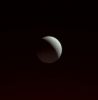
Enceladus-PIA10471.jpgDouble "Space-Lights" on Enceladus! (natural colors; credits: Lunexit)60 visiteCaption NASA:"As the Cassini Spacecraft began its August 2008 flyby of Enceladus, the spacecraft approached over the moon's cratered North Pole. Cassini acquired this view as the icy moon grew ever larger in its field of view.
In addition to the sunlit crescent at upper right, the faint glow at bottom indicates a secondary source of illumination: reflected sunlight from Saturn (a.k.a.: "Saturnshine").
The view looks toward high Northern Latitudes on Enceladus from a perspective of 71° North of the moon's Equator.
The North Pole is in shadow at center.
The image was taken in visible light with the Cassini Spacecraft narrow-angle camera on Aug. 11, 2008. The view was obtained at a distance of approx. 448.000 Km (such as about 278.000 miles) from Enceladus and at a Phase Angle of 113°.
Image scale at maximum resolution is approx. 3 Km (a little less than 2 miles) per pixel".MareKromium
(2 voti)
|
|

Prometheus-PIA08916~0.jpgOrb-at-Work! (natural colors; credits: Lunexit)64 visiteCaption NASA:"Prometheus draws material from the F-Ring along an invisible thread of gravity. Near lower left is an identical feature the moon created on a previous pass near the Ring.
Prometheus (approx. 102 Km, or about 63 miles across) is overexposed in this image, which was taken as part of a sequence designed to help refine scientists' understanding of the orbits of Saturn's small moons. This view looks toward the unlit side of the Rings from about 41° above the Ring-Plane.
The image was taken in visible light with the Cassini spacecraft narrow-angle camera on March 14, 2007 at a distance of approx. 1,8 MKM (such as about 1,1 MMs) from Prometheus.
Image scale is roughly 11 Km (about 7 miles) per pixel". MareKromium
(2 voti)
|
|

Prometheus-PIA08947~0.jpgCosmic "Through-and-Through"!60 visiteCaption NASA:"Prometheus pulls away from an encounter with Saturn's F-Ring, leaving behind a reminder of its passage.
Prometheus (about 102 Km, or 63 miles across) approaches closely to the F-Ring once during each circuit around Saturn, disturbing the orbits of the small particles in the Ring and creating a streamer of material that then shears out, following the moon as it speeds off.
This view looks toward the unilluminated side of the Rings from about 37° above the Ring-Plane. Prometheus is brightly lit by the Sun on one side and lit more modestly by Saturn's reflected light on the other side.
The image was taken in visible light with the Cassini spacecraft narrow-angle camera on April 18, 2007 at a distance of approx. 2 MKM (about 1,2 MMs) from Prometheus and at a Sun-Prometheus-spacecraft, or phase angle of 87°. Image scale is roughly 12 Km (about 7 miles) per pixel".
MareKromium
(2 voti)
|
|

Anthe_Methone-PIA11102.jpgSmall - but VERY bright - Companions: Anthe and Methone56 visiteCaption NASA:"Recent Cassini images show Arcs of Material co-orbiting with the Saturnian moons Anthe and Methone.
Arrows indicate the positions of Anthe, at top left, and Methone, at bottom right. Micrometeoroid impacts on the moons are the likely source of the Arc Material.
Cassini imaging scientists believe the process that maintains the Anthe and Methone arcs is similar to that which maintains the Arc in the G-Ring (see PIA08327). The general brightness of the image (along with the faint horizontal banding pattern) results from the long exposure time of 15" required to capture the extremely faint ring arc and the processing needed to enhance its visibility (which also enhances the digital background noise in the image).
The image was digitally processed to remove most of the background noise. This view looks toward the un-illuminated side of the Rings from about 2° above the Ring-Plane.
The image was taken in visible light with the Cassini Spacecraft narrow-angle camera on Oct. 29, 2007. The view was acquired at a distance of approx. 2,3 MKM (about 1,4 MMs) from Anthe and 2,2 MKM (approx. 1,4 MMs) from Methone.
Image scale is roughly 14 Km (about 9 miles) per pixel on Anthe and 13 Km (approx. 8 miles) on Methone".MareKromium
(2 voti)
|
|
| 2244 immagini su 187 pagina(e) |
 |
|
|
|
|
158 | |
|
|
|
|





