| Piú votate - Saturn: the "Ringed Beauty" and His Moons |

Saturn-PIA11513.jpgSouthern Colors (Natural Colors; credits: NASA/JPL/Space Science Institute)69 visiteCaption NASA:"The Cassini Spacecraft samples a bit of Saturn's Southern Hemisphere along with a spread of the Planet's main Rings.
Working outward from the Planet, the C, B, and A-Rings are visible in this Natural Color image. The Rings have been brightened relative to the Planet to enhance their visibility.
This view looks toward the sunlit side of the Rings from about 59° below the Ring-Plane. Images taken using red, green and blue spectral filters were combined to create this Natural Color view.
The images were acquired with the Cassini Spacecraft wide-angle camera on April 23, 2009 at a distance of approx. 1 MKM (about 621.000 miles) from Saturn.
Image scale is roughly 58 Km (approx. 36 miles) per pixel".MareKromium
(2 voti)
|
|
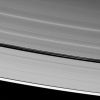
The_Rings-PIA11502.jpgEncke Ringlets57 visiteAlthough Saturn's moon Pan is absent from this image of the A-Ring's Encke Gap, the moon's handiwork is still displayed.
The two ringlets seen in the gap are maintained by the gravitational action of Pan (about 28 Km, or approx. 17 miles across). To learn more about this process, see also PIA07528.
The point of light near the bottom of the image is a star.
This view looks toward the unilluminated side of the Rings from about 41° above the Ring-Plane. The image was taken in Visible Light with the Cassini Spacecraft narrow-angle camera on April 17, 2009. The view was obtained at a distance of approx. 1,3 MKM (about 808.000 miles) from Saturn and at a Sun-Saturn-Spacecraft, or Phase, Angle of 115°.
Image scale is roughly 8 Km (about 5 miles) per pixel.MareKromium
(2 voti)
|
|

The_Rings-PIA11504.jpgGravity-induced "Ondulations"57 visiteCaption NASA:"Saturn's moon Daphnis gives a scalloped look to the edge of the A-Ring as the moon orbits within the Keeler Gap.
Daphnis is the bright spot in the narrow gap near the center of the image. Since the gap is not much larger than the moon, the small moon's gravity is great enough to perturb the particles in the Ring and create the wavelike patterns seen here. See also PIA09850 to learn more.
This view looks toward the unilluminated side of the Rings from about 61° above the Ring-Plane. The image was taken in Visible Light with the Cassini Spacecraft narrow-angle camera on April 30, 2009. The view was acquired at a distance of approx. 1,5 MKM (such as about 932.000 miles) from Daphnis and at a Sun-Daphnis-Spacecraft, or Phase, angle of 73°.
Image scale is roughly 9 Km (a little less than 6 miles) per pixel".MareKromium
(2 voti)
|
|

The_Rings-PIA11498.jpgShadow on the Rings (Natural Colors; credits: Lunar Explorer Italia)56 visiteCaption NASA:"The partial shadow of the moon Tethys demonstrates the variations in density across Saturn's Rings.
As the Cassini Spacecraft looks toward the unilluminated side of the Rings from about 37° above the Ring-Plane, part of Tethys' shadow is seen lying across the A-Ring and Cassini Division. The densest part of the A-Ring and the denser B-Ring let neither sunlight nor the darkness of Tethys' shadow pass through to the Spacecraft's camera, so the moon's shadow appears cut off. The B-Ring instead appears brightly lit here from Saturnshine. Tethys is not shown.
As Saturn approaches its August 2009 Equinox, the planet's moons cast shadows onto the Rings. (...)
The image was taken in Visible Light with the Cassini Spacecraft wide-angle camera on April 17, 2009. The view was obtained at a distance of approx. 1,3 MKM (about 808.000 miles) from Saturn and at a Phase Angle of 120°.
Image scale is roughly 75 Km (about 47 miles) per pixel".MareKromium
(2 voti)
|
|

Saturn-PIA11478.jpgTransparencies (Natural Colors; credits: NASA/JPL/Space Science Institute)63 visiteCaption NASA:"This Natural Color view from the Cassini Spacecraft highlights the myriad gradations in the transparency of Saturn's inner Rings.
The dark shadows of the Rings separate Saturn's Southern Hemisphere in the bottom of the image from the North. The innermost D-Ring is invisible, laid over the Planet's Northern Hemisphere. The translucent C-Ring runs through the middle of the image. The denser B-Ring stretches across the top of the image.
This view looks toward the sunlit side of the Rings from about 48° below the Ring-Plane. Images taken using red, green and blue spectral filters were combined to create this Natural Color view. The images were acquired with the Cassini Spacecraft wide-angle camera on Feb. 28, 2009 at a distance of approx. 1 MKM (about 620.000 miles) from Saturn.
Image scale is roughly 59 Km (approx. 37 miles) per pixel".MareKromium
(2 voti)
|
|

Saturn-PIA11473.jpgThe Northern Region of Saturn (Natural Colors; credits: NASA/JPL/Space Science Institute)65 visiteCaption NASA:"Saturn's Northern Hemisphere is seen here against its nested Rings.
This view from the Cassini Spacecraft looks toward the unilluminated side of the Rings from about 30° above the Ring-Plane. The rings have been brightened relative to the Planet to enhance visibility.
Images taken using red, green and blue spectral filters were combined to create this Natural Color view.
The images were acquired with the Cassini Spacecraft wide-angle camera on Feb. 24, 2009 at a distance of approx. 866.000 Km (about 538.000 miles) from Saturn.
Image scale is roughly 38 Km (about 24 miles) per pixel".MareKromium
(2 voti)
|
|

Pan-PIA11652-1.jpgPan and its Shadow (Natural Colors; credits: Lunar Explorer Italia)55 visiteCaption NASA:"Wendy Darling famously helped Peter Pan catch his shadow, and now Cassini captures the shadow of another Pan: Saturn's 30-kilometer (19-mile) wide moon inhabiting the Encke Gap.
In the center of this image, the shadow of Pan is a short streak thrown over the edge of the A-Ring where Pan travels its path through the Encke Gap. A second version of this image has been included to focus on Pan's shadow. The image has been scaled to three times its original size and cropped as shown in the inset.
One of the happy results of Saturn's 29-year revolution around the Sun is the changing elevation of the Sun seen from the Planet, and the changing elevation of the shadows of the Rings and moons that the Sun's apparent motion brings.
As Saturn approaches Equinox, the angle at which the ringplane is inclined away from the Sun will continue to decrease until August 2009, when Equinox will bring about an alignment of the plane containing the rings with the rays of the Sun. Only around the time of Equinox is a moon's shadow cast on the Rings rather than the Planet. Between now and Equinox in August, the shadows cast by the moons on the Rings will grow longer with time".MareKromium
(2 voti)
|
|

Saturn-HST-2009-12-a-full_jpg.jpgThe Ringed Beauty and (some of) His Companions (Natural Colors; credits: NASA)57 visiteCaption NASA:"On February 24, 2009, the Hubble Space Telescope took a photo of 4 moons of Saturn passing in front of their Parent Planet. In this view, the giant orange moon Titan casts a large shadow onto Saturn's North Polar hood. Below Titan, near the Ring-Plane and to the left is the moon Mimas, casting a much smaller shadow onto Saturn's equatorial cloud tops. Farther to the left, and off Saturn's disk, are the bright moon Dione and the fainter moon Enceladus.
These rare moon transits only happen when the tilt of Saturn's Ring-Plane is nearly "edge on" as seen from the Earth. Saturn's Rings will be perfectly edge on to our line of sight on August 10, 2009, and September 4, 2009. Unfortunately, Saturn will be too close to the Sun to be seen by viewers on Earth at that time.
This "Ring-Plane Crossing" occurs every 14-15 years. In 1995-96 Hubble witnessed the Ring-Plane Crossing Event, as well as many moon transits, and even helped discover several new moons of Saturn.
The banded structure in Saturn's Atmosphere is similar to Jupiter's.
Early 2009 was a favorable time for viewers with small telescopes to watch moon and shadow transits crossing the face of Saturn.
Titan, Saturn's largest moon, crossed (and shall cross) Saturn on 4 separate occasions: January 24, February 9, February 24, and March 12, although not all events were visible from all locations on Earth.
These pictures were taken with Hubble's Wide Field Planetary Camera 2 on February 24, 2009, when Saturn was at a distance of roughly 775 MMs (such as about 1,25 BKM) from Earth. Hubble can see details as small as 190 miles (such as about 300 km) across on Saturn. The dark band running across the face of the Planet slightly above the Rings is the shadow of the Rings cast on the Planet".MareKromium
(2 voti)
|
|

Saturn-PIA10596.jpgSouthern Turbulence (Natural Colors; credits: Lunar Explorer Italia)60 visiteCaption NASA:"Through the Atmosphere of the Southern Hemisphere of Saturn rolls a large storm, seen here as a tight dark circle in the lower left of this image. Horizontal strands of other atmospheric formations give the image the fibrous look of travertine stone.
Prometheus (about 86 Km, or 53 miles across) is a small dark dot in the top left part of the image.
The image was taken with the Cassini spacecraft wide-angle camera on Dec. 30, 2008 using a combination of polarized and spectral filters sensitive to wavelengths of near-InfraRed Light centered at 752 nanometers.
The view was acquired at a distance of approx. 1,2 MKM (about 750.000 miles) from Saturn and at a Sun-Saturn-Spacecraft, or Phase, Angle of 27°.
Image scale is roughly 68 Km (approx. 42 miles) per pixel".MareKromium
(2 voti)
|
|

Dione-N00064211.jpgDione (RAW Natural Colors; credits: Dr M. Faccin)58 visitenessun commentoMareKromium
(2 voti)
|
|

Enceladus-PIA01394.jpgEnceladus, with "Pink" Nuances (by Ted Stryk)58 visitenessun commentoMareKromium
(2 voti)
|
|
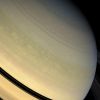
Saturn-PIA10578.jpgThe Northern Hemisphere of Saturn (Natural Colors; credits: NASA/JPL/Space Science Institute)57 visiteCaption NASA:"A chef's bounty of colors is represented in this full color view of Saturn's Northern Hemisphere.
Butternut, peach, and olive hues have replaced the azure blue of Winter. The blue of Saturn's Winter Hemisphere during the early Cassini Prime Mission still remains a puzzle. Over the course of time, the blue color has faded and has been replaced with bands of other hues (see also PIA11141).
This picture is a combination of images taken in red, green and blue light with the Cassini spacecraft wide-angle camera on Jan. 1, 2009. The view was obtained at a distance of approx. 1,1 MKM (such as about 680.000 miles) from Saturn and at a Sun-Saturn-Spacecraft, or Phase, Angle of 28°.
Image scale is roughly 65 Km (about 40 miles) per pixel".MareKromium
(2 voti)
|
|
| 2244 immagini su 187 pagina(e) |
 |
|
|
|
|
157 | |
|
|
|
|





