| |

| Piú votate - Saturn: the "Ringed Beauty" and His Moons |

Enceladus-PIA11678.jpgEnceladus: North Polar Map57 visiteThe Northern and Southern Hemispheres of Enceladus are seen in these Polar Stereographic Maps, mosaicked from the best-available Cassini and Voyager clear-filter images. This image shows the North Polar Regions.
Each map is centered on one of the Poles and surface coverage extends to the Equator. Grid lines show Latitude and Longitude in 30-degree increments. The scale in the full-size versions of these maps is 110 meters (360 feet) per pixel.
These two maps show that the character of Terrains near the North Pole differs strongly from those near the South Pole. Terrain near the North Pole is among the most heavily cratered and oldest on the Surface of Enceladus.
The Northern Hemisphere map shows that a broad band of cratered terrain extends from the Equator on the Saturn-facing side (centered on 0-degrees Longitude), over the Pole and to the Equator on the anti-Saturn side (centered on 180-degrees Longitude). Terrains near the Equator and Mid-Latitudes on the Leading (90° West) and Trailing (270° West) sides of Enceladus are much less heavily cratered and are characterized by intense zones of fracturing and faulting.
As seen in the Southern Hemisphere map, the band of cratered terrain at 0 and 180° Longitude extends southward from the Equator. However, poleward of about 55° South Latitude, the cratered terrain is interrupted and replaced by a conspicuously fractured circumpolar terrain that is nearly devoid of impact craters.
In contrast to the very old North Polar Terrains, the South Circumpolar Terrains are among the youngest on the Surface of Enceladus.
Within the South Circumpolar Region is a group of prominent parallel "Stripes" made up of fractures that are delineated by relatively dark albedo markings flanking the sides of each fracture.
An interesting property of the parallel fracture system is that each appears to turn back at its westernmost segment as if it has been "bent" or "folded" into a hook-like curve. Similar patterns of folded or kinked fractures can be found throughout the region -- a unique feature of the South Polar Terrains.MareKromium
(2 voti)
|
|

Saturnafterthe_Equinox.jpgAfter the Equinox... (Natural Colors; credits: NASA/JPL/Space Science Institute)59 visiteDa "NASA - Picture of the Day" del giorno 10 Novembre 2009:"The other side of Saturn's Ring-Plane is now directly illuminated by the Sun. For the previous 15 years, the Southern Side of Saturn and its Rings were directly illuminated, but since Saturn's Equinox, the orientation has reversed.
Pictured above last month, the robotic Cassini Spacecraft orbiting Saturn has captured the Giant Planet and its majestic Rings soon after Equinox. Imaged from nearly behind, Saturn and its moon Tethys each show a crescent phase to Cassini that is not visible from Earth.
As the Rings continue to point nearly toward the Sun, only a thin shadow of them is visible across the center of the Planet.
Close inspection of Saturn's Rings, however, shows superposed bright features identified as "Spokes" that are thought to be groups of very small electrically charged ice particles. Understanding the nature and dynamics of Spokes is not fully understood and remains a topic of research".MareKromium
(2 voti)
|
|

Tethys-PIA12319.jpgTethys and the Rings (Natural Colors; credits: NASA/JPL/Space Science Institute)60 visiteCaption NASA:"Cassini peers toward the distant, icy plains of Saturn's moon Tethys. The Planet's "A" and "F"-Rings slice across the top of this view.
This view of Tethys represents "Target 2" in the fall 2009 edition of the Cassini Scientist for a Day contest. (See http://saturn.jpl.nasa.gov/education/scientistforaday8thedition/.) The contest is designed to give students a taste of life as a scientist by challenging them to write an essay describing the value of one target choice among three for Cassini to image.
Images taken using red, blue and green spectral filters were combined to create this color view. The images were acquired with the Cassini wide-angle camera on Oct. 11, 2009 at a distance of approx. 1,4 MKM (about 900.000 miles) from Tethys".MareKromium
(2 voti)
|
|

Enceladus-PIA11601.jpgJust like a Pearl... (Natural Colors; credits: Lunexit)58 visiteCaption NASA:"The Cassini Spacecraft looks down at craters near the North Pole of Enceladus.
Cratered surfaces on Solar System moons indicate older terrains, while smooth surfaces are generally younger and therefore indicative of processes which eliminated the craters.
See also PIA08353 to learn more about the true nature of these surfaces and the processes at work on this geologically active moon.
The moon's North Pole lies on the Terminator to the right of the craters seen in this image. Lit Terrain seen here is on the anti-Saturn side and Trailing Hemisphere of Enceladus.
The image was taken in Visible Light with the Cassini Spacecraft narrow-angle camera on July 11, 2009. The view was obtained at a distance of approx. 472.000 Km (such as about 293.000 miles) from Enceladus and at a Sun-Enceladus-Spacecraft (or Phase) Angle of 57°.
Image scale is roughly 3 Km (a little less than 2 miles) per pixel".MareKromium
(2 voti)
|
|

The_Rings-PIA11600.jpgShadows on the Islands...58 visiteCaption NASA:"The shadows cast by Daphnis' attendant edge waves create a dark, jagged pattern on the A-Ring in this image taken as Saturn approached its August 2009 Equinox.
Daphnis (approx. 8 Km, or about 5 miles across) is a bright dot in the Keeler Gap of the A-Ring just below the center of the image. The moon has an inclined orbit, and its gravitational pull perturbs the orbits of the particles forming the Keeler Gap's edges and sculpts both edges into waves having both horizontal (radial) and out-of-plane components. Material on the inner edge of the gap orbits faster than the moon so that the waves there lead the moon in its orbit. Material on the outer edge moves slower than the moon, so waves there trail the moon. (See also PIA11656 to learn more about this process)
The novel illumination geometry that accompanies Equinox lowers the Sun's angle to the Ring-Plane, significantly darkens the Rings, and causes out-of-plane structures to look anomalously bright and cast shadows across the Rings. These scenes are possible only during the few months before and after Saturn's Equinox, which occurs only once in about 15 Earth years. Before and after Equinox, Cassini's cameras have spotted not only the predictable shadows of some of Saturn's moons (see also PIA11657), but also the shadows of newly revealed vertical structures in the Rings themselves (see, for example, the frame PIA11665).
This view looks toward the Northern, unilluminated side of the Rings, from about 36° above the Ring-Plane.
The image was taken in Visible Light with the Cassini Spacecraft narrow-angle camera on July 28, 2009. The view was obtained at a distance of approx. 1 MKM (about 621.000 miles) from Daphnis.
Image scale is roughly 6 Km (a little less than 4 miles) per pixel".MareKromium
(2 voti)
|
|

SaturnDustRing-SST.jpgDust-Ring around Saturn58 visiteWhat has created a large Dust-Ring around Saturn?
At over 200 times the radius of Saturn and over 50 times the radius of Saturn's expansive "E"-Ring, the newly discovered Dust-Ring is the largest planetary ring yet imaged. The Ring was found in IR Light by the Earth-orbiting Spitzer Space Telescope.
A leading hypothesis for its origin is impact material ejected from Saturn's moon Phoebe, which orbits right through the Dust-Ring's middle.
An additional possibility is that the Dust-Ring supplies the mysterious material that coats part of Saturn's moon Japetus, which orbits near the Dust-Ring's Inner Edge. Pictured above in the inset, part of the Dust-Ring appears as false-color orange in front of numerous background stars.MareKromium
(2 voti)
|
|

The_Rings-PIA11664.jpgSpiral Corrugation across the C and D-Rings59 visiteCaption NASA:"Alternating light and dark bands, extending a great distance across Saturn’s D and C-Rings, are shown here in these Cassini images taken one month before the Planet’s August 2009 Equinox.
The C-Ring stretches across the upper left and middle of the image. The D-Ring is barely visible amid the noise in the lower right of the image.
The periodic brightness variations in the Rings have a subtler, narrow appearance in this mosaic of three Cassini images than other larger features of the Rings, such as the Columbo Gap which appears as a black arc on the left of the center frame of the mosaic. These brightness variations are almost certainly caused by the changing slopes in the rippled Ring-Plane, much like the corrugations of a tin roof.
Although previous Cassini observations (see PIA08325) had revealed corrugations in the D-Ring extending over 500 miles (about 800 Km), this image shows these features extending for 6200 miles (about 10.000 Km) into the C-Ring.
Later Equinox images revealed the true dimension of this Corrugation, extending completely across the C ring, right up to the inner B-Ring edge for a total breath of about 17.000 Km (approx. 11.000 miles) -- see PIA11670 and PIA11671.
This and other new imagery supports earlier evidence that something dramatic happened in the early 1980s to initiate this feature.
In 2006, imaging scientists speculated that a collision with a comet or asteroid may have disturbed the D-Ring. That explanation seems less likely now that this and other new images show the effect spread over a much broader radial range, extending right up to the inner B-Ring. Scientists continue to investigate the cause of this disturbance.
Whatever caused the corrugation apparently tilted a vast region of the inner rings relative to Saturn’s gravitational field in a relatively short period of time during the early 1980s. In the intervening years, the natural tendency for inclined orbits to systematically and slowly wobble at different rates, depending on their distance from Saturn, has created a tightly wound spiral corrugation in the Ring-Plane.
This view looks toward the unilluminated side of the Rings from about 24° above the Ring-Plane.
The D-Ring has been brightened relative to C-Ring to enhance visibility.
The images were taken in Visible Light with the Cassini Spacecraft narrow-angle camera on July 11, 2009. The view was acquired at a distance of approx. 470.000 Km (about 292.000 miles) from Saturn and at a Phase Angle of 25°.
Image scale is roughly 2 Km (about 1,25 miles) per pixel".MareKromium
(2 voti)
|
|

The_Rings-PIA11587.jpgSpokes on the B-Ring56 visiteCaption NASA:"Saturn's B-Ring shows off bright Spokes in the middle of this image taken at high phase.
This image was captured at a Phase Angle of 119°. To learn more about these ghostly radial markings, see PIA10567 and PIA11144.
This view looks toward the northern, sunlit side of the Rings from about 10° above the Ring-Plane. The image was taken in Visible Light with the Cassini Spacecraft narrow-angle camera on Aug. 20, 2009. The view was acquired at a distance of approx. 2,3 MKM (such as about 1,4 MMs) from Saturn.
Image scale is roughly 13 Km (about 8 miles) per pixel".MareKromium
(2 voti)
|
|
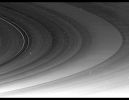
The_Rings-PIA11671.jpgInner B-Ring "Terminus" and Spiral Corrugation58 visiteCaption NASA:"This mosaic of Cassini images, part of a larger mosaic of images captured just hours before exact Equinox at Saturn, shows that the "Spiral Corrugation" in the Planet’s Inner Rings continues right up to the inner B-Ring: an unexpected result that scientists are working to understand.
The inner B-Ring boundary is visible on the right. The C-Ring’s Maxwell Gap, demarcated by two bright arcs in this view, is on the left.
The larger mosaic shows a gently undulating pattern stretching from the D-Ring to inner B-Ring (see PIA11670).
An earlier mosaic, captured in June, showed the corrugation extending only as far as the middle of the C-Ring (see PIA11664).
The periodic brightness variations in this corrugation are most likely caused by the changing slopes in the rippled Ring-Plane, much like the corrugations of a tin roof. Although previous Cassini observations (see PIA08325) had revealed corrugations in the D-Ring extending over 500 miles (about 800 Km), this image now shows these features extending beyond their origin in the D-Ring for 11.000 miles (approx. 17.000 Km) into the C-Ring.
This new imagery supports earlier evidence that something happened in the early 1980s to generate this feature.
In 2006, imaging scientists speculated that a collision with a comet or asteroid may have disturbed the D-Ring. That explanation seems less likely now that this new image shows the effect spread over a much broader radial range, extending completely across the C-Ring, and scientists are continuing to investigate the cause of this disturbance.
Whatever created the corrugation apparently tilted a vast region of the Inner Rings relative to Saturn’s gravitational field in a relatively short period of time during the early 1980s.
In the intervening years, the natural tendency for inclined orbits to systematically and slowly wobble at different rates, depending on their distance from Saturn, has created a tightly wound spiral corrugation in the Ring-Plane.
This view and others like it are only possible around the time of Saturn’s Equinox which occurs every half-Saturn-year (equivalent to about 15 Earth years). Exact Equinox is when the Sun is directly overhead at the Equator. The illumination geometry that accompanies equinox lowers the Sun’s angle to the Ring-Plane, significantly darkens the Rings and causes out-of-plane structures to cast long shadows across the Rings.
Cassini’s cameras have spotted not only the predictable shadows of some of Saturn’s moons (see PIA11657), but also the shadows of newly revealed vertical structures in the Rings themselves (see PIA11665).
This view looks toward the southern side of the Rings from about 4° below the Ring-Plane. Background stars are visible shining through the Rings, and the image has not been cleaned to remove Cosmic Rays, which struck the camera’s detector during the exposures.
The image was taken in Visible Light with the Cassini Spacecraft narrow-angle camera on Aug. 10, 2009. The view was acquired at a distance of approx. 888.000 Km (about 552.000 miles) from Saturn and at a Sun-Saturn-Spacecraft, or Phase, Angle of 157°.
Image scale is roughly 5 Km (a little more than 3 miles) per pixel".MareKromium
(2 voti)
|
|
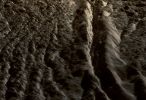
Enceladus-PIA12207.jpgPerspective view of Damascus Sulcus, Enceladus (Natural Colors; credits: Lunexit)58 visiteThis perspective view of Damascus Sulcus was generated using high resolution images of Enceladus acquired in August 2008 at 12 to 30 meters (40 to 100 feet) resolution, together with a new topographic map of the region produced by Dr. Paul Schenk (http://www.lpi.usra.edu/lpi/schenk/) at the Lunar and Planetary Institute in Houston, TX.
Damascus Sulcus is one of several prominent linear structures, dubbed “Tiger Stripes”, within the geologically active South Polar Region of Enceladus. Damascus Sulcus consists of two large parallel ridges separated by a deep V-shaped medial trough. The ridges are each 100 to 150 meters high (325 to 500 feet), while the entire width of Damascus Sulcus is approx. 5 Km (a little more than 3 miles). The medial trough between the ridges is 200 to 250 meters (650 to 820 feet) deep, and may have formed by daily shear (sliding) faulting triggered by tidal forces.
These medial troughs may be the primary source of numerous jets making up the large active water vapor plume over the South Pole of Enceladus. Several small ridges can be seen along the floor of the medial trough. These could be blocks of crust that have slid down the walls of the trough or fractured blocks pushed up from below.
Flanking Damascus Sulcus are repeating sets of broken and disrupted parallel ridges a few tens of meters high. These are typical of the plains that lie between the tiger stripe structures and resemble crumpled or folded rock patterns seen on Earth. Relief has been exaggerated by a factor of ~10 to enhance clarity.
The raw data from which this product was developed were retrieved from the Planetary Data System's Cassini archives. The Cassini-Huygens mission is a cooperative project of NASA, the European Space Agency and the Italian Space Agency. The Jet Propulsion Laboratory, a division of the California Institute of Technology in Pasadena, manages the mission for NASA's Science Mission Directorate, Washington, D.C. The Cassini orbiter and its two onboard cameras were designed, developed and assembled at JPL. The imaging operations center is based at the Space Science Institute in Boulder, Colo. (http://ciclops.org)MareKromium
(2 voti)
|
|

Enceladus-PIA12208.jpgPerspective view of Baghdad Sulcus, Enceladus (Natural Colors; credits: Lunexit)57 visiteThis perspective view of Baghdad Sulcus was generated using high resolution images of Enceladus acquired in August 2008 at 12 to 30 meters (40 to 100 feet) resolution, together with a new topographic map of the region produced by Dr. Paul Schenk (http://www.lpi.usra.edu/lpi/schenk/) at the Lunar and Planetary Institute in Houston, TX. Lower resolution images to either side were acquired at 50 to 80 meter (165 to 260 feet) resolution.
Baghdad Sulcus is one of several prominent linear structures, dubbed “Tiger Stripes”, within the geologically active South Polar Region of Enceladus. This view shows a wedge-shaped area between two prominent branches of Baghdad Sulcus. Each branch consists of two large parallel ridges up to 2 Km (approx. 1,2 mile) across separated by a deep V-shaped medial trough.
The ridges are 80 to 100 meters (approximately 260 to 325 feet) high. The medial troughs between the ridges are 200 to 250 meters (650 to 820 feet) deep. The maximum separation between the two branches is about 12 Km (about 7.5 miles).
Troughs such as those shown here are probably the source of numerous jets making up the large active water vapor plume over the South Pole of Enceladus. The floors of the medial troughs are often broken up into smaller ridges. These could be blocks of crust that have slid down the walls of the trough or fractured blocks pushed up from below. Relief has been exaggerated by a factor of ~10 to enhance clarity.
The raw data from which this product was developed were retrieved from the Planetary Data System's Cassini archives. The Cassini-Huygens mission is a cooperative project of NASA, the European Space Agency and the Italian Space Agency. The Jet Propulsion Laboratory, a division of the California Institute of Technology in Pasadena, manages the mission for NASA's Science Mission Directorate, Washington, D.C. The Cassini orbiter and its two onboard cameras were designed, developed and assembled at JPL. The imaging operations center is based at the Space Science Institute in Boulder, Colo. (http://ciclops.org)MareKromium
(2 voti)
|
|
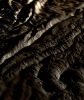
Enceladus-PIA12209.jpgPerspective view of Cairo Sulcus, Enceladus (Natural Colors - credits: Lunexit)58 visiteThis perspective view of Cairo Sulcus was generated using high resolution images of Enceladus acquired in August 2008 at 12 to 30 meters (40 to 100 feet) resolution, together with a new topographic map of the Region produced by Dr. Paul Schenk (http://www.lpi.usra.edu/lpi/schenk/) at the Lunar and Planetary Institute in Houston, TX. Lower resolution images to either side were acquired at 50 to 80 meter (165 to 260 feet) resolution.
Cairo Sulcus is one of several prominent structures, dubbed “Tiger Stripes”, within the geologically active South Polar Region of Enceladus. These structures consist of two large parallel ridges up to 2 Km (approx. 1,2 miles) across separated by a deep V-shaped medial trough. This view highlights one of the wall scarps of the medial trough of Cairo Sulcus, the brightly lit scarp crossing the left-hand side of the view. This wall scarp stands 175 to 250 meters (575 to 820 feet) high. Vertical striations and large boulders tens of meters across clutter the surface of this scarp, evidence of faulting and/or slumping of crustal ices. Troughs such as these are probably the source of numerous jets making up the large active water vapor plume over the South Pole of Enceladus. The parallel sets of rounded mounds and ridges In the foreground are up to 50 meters (165 feet) high. These are typical of the plains that lie between the tiger stripe structures and resemble crumpled or folded rock patterns seen on Earth. Relief has been exaggerated by a factor of ~10 to enhance clarity.
The raw data from which this product was developed were retrieved from the Planetary Data System's Cassini archives. The Cassini-Huygens mission is a cooperative project of NASA, the European Space Agency and the Italian Space Agency. The Jet Propulsion Laboratory, a division of the California Institute of Technology in Pasadena, manages the mission for NASA's Science Mission Directorate, Washington, D.C. The Cassini orbiter and its two onboard cameras were designed, developed and assembled at JPL. The imaging operations center is based at the Space Science Institute in Boulder, Colo. (http://ciclops.org)MareKromium
(2 voti)
|
|
| 2244 immagini su 187 pagina(e) |
|
|
|
|
|
155 | |
|
|
|
|
|
|





