| Piú votate - Saturn: the "Ringed Beauty" and His Moons |

Dione-PIA06611.jpgStreaks on Dione57 visiteCaption NASA originale:"Wispy streaks curl over the horizon on Saturn's moon Dione, caught here in a distant view from Cassini. The streaks were first revealed by NASA's Voyager spacecraft and subsequently were shown by Cassini to be an immense system of linear fractures in the moon's surface. The image was taken with the Cassini spacecraft narrow-angle camera using a filter sensitive to wavelengths of ultraviolet light centered at 338 nnmts. The image was acquired on Feb. 18, 2005, at a distance of approximately 1,3 MKM from Dione and at a phase angle of 118°. The image scale is 8 Km per pixel".
(3 voti)
|
|

Dione-N00030564.jpgA "hat-trick" of Moons!57 visiteAncora un'immagine spettacolare che ci mostra, questa volta, addirittura una "tripletta" di lune Saturniane. Le caratteristiche superficiali ci aiutano a riconoscerne almeno due, cioè quelle più grandi ed - apparentemente - più vicine (diremmo che si tratti di Dione e Rhea). Sapreste individuare la terza?
(3 voti)
|
|

Enceladus-PIA06208.jpgEnceladus (full-disk) - false colors60 visiteCaption NASA originale:"During its very close flyby on March 9, 2005, the Cassini spacecraft captured this false-color view of Saturn's moon Enceladus, which shows the wide variety of this icy moon's geology. Some geological regions on Enceladus are old and retain large numbers of impact craters; younger areas exhibit many generations of tectonic troughs and ridges. Subtle differences in color may indicate different ice properties, such as grain sizes, that will help unravel the sequence of geologic events leading to the current strange landscape. In the early 1980's, NASA's Voyager mission to the outer planets revealed a strikingly similar arrangement of terrains on Miranda, an icy moon of Uranus (see PIA 00141). Miranda is 470-Km-wide (290 miles), nearly as large as Enceladus (504 Km). The similarities in size and tectonic history on these objects may suggest that remarkably similar physical processes have controlled the separate geological evolutions of these bodies. The Sun illuminates Enceladus from the left, leaving part of it in shadow and blocking out part of the view of Saturn. This view shows the anti-Saturn hemisphere, centered nearly on the equator".
(3 voti)
|
|

Enceladus-PIA06206_modest.jpgEnceladus (close-up)58 visiteCaption NASA originale:"Fractures are nearly ubiquitous in this terrain, cutting across each other and across impact craters. Scientists can use the relationships between different features to determine the order in which they formed, thereby unraveling the moon's past. For example, almost all the craters in this mosaic have fractures running through their rims and floors, indicating that the craters formed first. This means that Enceladus has been geologically active relatively recently, especially compared to some of its neighbors in the Saturn system. There is an impressive variety of fractures visible here--from the wide east-west rifts near the upper left of the mosaic to the very fine north-south fractures in the center (which are approximately 100 to 400 meters). Due to the complexity of this terrain, the task of unraveling Enceladus' history promises to be a worthy challenge for planetary scientists".
(3 voti)
|
|

Enceladus-N00030108.jpgEnceladus, from approx. 5.000 Km57 visitenessun commento
(3 voti)
|
|

Enceladus-N00030060.jpgEnceladus, from approx. 26.000 Km57 visitenessun commento
(3 voti)
|
|

Enceladus-N00030055.jpgEnceladus, from approx. 28.000 Km59 visiteAncora un'immagine del bordo di Encelado la quale ci consente di apprezzare, attraverso le ombre che definiscono i rilievi più significativi, una fittissima rete di canyons ed un quantitativo di crateri da impatto non particolarmente elevato (un chiaro segno, quest'ultimo, di una recente - in senso geologico... - ancorchè parziale 'ridefinizione' della superficie di questo corpo celeste).
(3 voti)
|
|

Enceladus-N00030047.jpgEnceladus, from approx. 43.000 Km57 visitenessun commento
(3 voti)
|
|
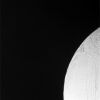
Enceladus-N00030034.jpgEnceladus, from approx. 51.000 Km59 visiteUna sequenza di frames che ci mostrano il rapido passaggio ravvicinato (---> fly-by) della Sonda Cassini accanto al corpo celeste più luminoso dell'intero Sistema Solare. Molto suggestive sono queste prime immagini del bordo (---> limb) di Encelado, ma estremamente interessanti, non solo dal punto di vista scientifico, sono i frames che ci mostrano la superficie di questa gelida luna Saturniana.
Ma andiamo con calma...
(3 voti)
|
|
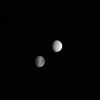
Tethys and Dione-N00029831.jpgTethys and Dione60 visiteUno dei tanti "incroci" fra le lune di Saturno, al quale la Sonda Cassini ha avuto l'onore di assistere da una distanza - per così dire... - ragionevole: in fondo, fra Cassini e Tethys, ci sono solo un milione e mezzo di km...
(3 voti)
|
|

Rhea-N00029094.jpgRhea and Prometheus73 visiteUna nuova istantanea di due dei protagonisti delle "danze planetarie" che si susseguono nello spazio di Saturno e che Sir Stanley Kubrick riuscì ad immaginare molto bene più di 36 anni fa ed a farne un tassello fondamentale del film di fantascienza più famoso (e certamente più suggestivo ed attuale) al Mondo.
(3 voti)
|
|

Saturn-PIA06196.jpgGravitational Anomalies and Interferences59 visiteIn fondo, per quanto ne sappiamo, i Fenomeni Transitori non sono una prerogativa unica della superficie dei pianeti e non si manifestano solamente attraverso 'outgassing', 'annebbiamenti' e/o fenomeni luminosi! Anche i fenomeni gravitazionali possono essere transitori, allorchè ci si trovi in un ambiente - per così dire - "affollato" da corpi celesti, quale può essere un'area di confine di uno degli Anelli di Saturno. Comunque eccoVi una parte della Caption NASA originale al riguardo:"Images taken of Saturn's rings by Cassini immediately after it entered orbit around Saturn have turned up circumstantial evidence that an unseen moon may be orbiting dead center in the narrow Keeler Gap in Saturn's outer A-Ring. Several faint discontinuities, or spikes, in the outer gap edge have been found in 2 narrow-angle camera images of the illuminated side of the Rings. These features are similar to the spikes protruding inward from the core of the F-Ring during Prometheus's passages and it is likely that the features are caused by the passages of a yet-unseen moonlet on an eccentric orbit within the Keeler gap".
(3 voti)
|
|
| 2244 immagini su 187 pagina(e) |
 |
|
|
|
|
147 | |
|
|
|
|





