| Piú votate - Saturn: the "Ringed Beauty" and His Moons |

Dione-PIA07748.jpgThe surface of Dione from about 4486 Km68 visiteThe terrain in this image is located within a 60-Km-wide impact crater along the feature called Padua Linea. The western rim of the encompassing crater runs from the middle left to the upper right. The crater's central peak can be seen at the lower right. Multiple generations of fractures are visible here. Numerous fine, roughly parallel linear grooves run across the terrain from top to bottom and are interrupted by the larger, irregular bright fractures. In several places, fractures postdate some deposits in the bottoms of craters that are not badly degraded by time. Such a fracture, for example, runs from the center toward the upper right. Most of the craters seen here have bright walls and dark deposits of material on their floors. As on other Saturnian moons, rockslides on Dione may reveal cleaner ice, while the darker materials accumulate in areas of lower topography and lower slope (e.g. crater floors and the bases of scarps). This view is centered on terrain near 11° South lat. and 238° West long.
(3 voti)
|
|

Telesto-N00041282.jpgTelesto60 visiteOriginal caption:"N00041282.jpg was taken on October 11, 2005 and received on Earth October 12, 2005. The camera was pointing toward TELESTO at approx. 15.409 Km away; this image was taken using the P0 and GRN filters. This image has not been validated or calibrated".
(3 voti)
|
|

Telesto-N00041294.jpgTelesto58 visiteOriginal caption:"N00041294.jpg was taken on October 11, 2005 and received on Earth October 12, 2005. The camera was pointing toward TELESTO, at approx. 11.408 Km away; the image was taken using the CL1 and CL2 filters. This image has not been validated or calibrated".
(3 voti)
|
|

Dione-N00041239.jpgDione's Fly-By (14): from about 3.300 Km55 visitenessun commento
(3 voti)
|
|

Dione-N00041174.jpgDione's Fly-By (7): from about 32.000 Km57 visitenessun commento
(3 voti)
|
|

Dione-N00041164.jpgDione's Fly-By (6): from about 36.000 Km59 visitenessun commento
(3 voti)
|
|

Dione-N00041147.jpgDione's Fly-By (5): from about 43.000 Km58 visitenessun commento
(3 voti)
|
|

Dione-N00041007.jpgDione and Rhea (4)58 visitenessun commento
(3 voti)
|
|
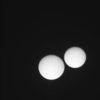
Dione-N00041004.jpgDione and Rhea (1)59 visiteIn questa serie di frames vediamo una splendida eclisse che coinvolge Rhea e Dione (con Dione che eclissa Rhea). Si tratta, come ovvio, di un evento frequente, quando le Lune che orbitano attorno al loro Mondo Genitore sono decine e decine... Ma per noi, abituati a vedere una sola Luna nel nostro cielo, spettacoli come questo costituiscono sempre una sorgente di profonda emozione e di meraviglia: una fusione perfetta fra Natura e Scienza.
(3 voti)
|
|

Dione-PIA07603.jpgDione: the "Aeneidian Moon", from 1,1 MKM57 visiteOriginal caption:"When naming features on other worlds, scientists like to follow themes, and Dione is no exception. Dione possesses numerous features with names from Virgil's 'Aeneid'. The prominent crater showing a central peak below the center is Dido, a 118-Km-wide (about 73-mile) crater named after the supposed founder of Carthage. The crater just above Dido is Antenor, an 82-Km-wide (about 51-mile) impact crater named after the nephew of Priam who founded the Italian city of Padua. At the upper right is the 97-Km-wide (about 60-mile) impact crater Turnus, which lies at the western end of Carthage Linea, a region of bright, fractured terrain. The sunlit terrain seen here shows some of the wispy markings on the Moon's trailing hemisphere. Cassini revealed that these markings are actually a complex system of fractures. North on Dione is up and rotated 25° to the left (...)".
(3 voti)
|
|

Epimetheus-PIA07596.jpgEpimetheus in the darkness...54 visiteOriginal caption:"Small, multi-faceted Epimetheus wanders into Cassini's field of view, while Saturn's dark shadow cuts across the ringplane. Only a sliver of the outer A-Ring is seen here, including the narrow Keeler Gap. Epimetheus is a moon that is 116 kilometers (72 miles) across.
This view is from 10° out of the ringplane, gazing toward the lit face of the Rings.
The image was taken in visible light with the Cassini spacecraft narrow-angle camera on Aug. 31, 2005, at a distance of approximately 2,1 MKM (such as about 1,3 MMs) from Epimetheus and at a Sun-Epimetheus-spacecraft, or phase, angle of 60°. Resolution in the original image was 13 Km (about 8 miles) per pixel".
(3 voti)
|
|

Tethys-N00040113.jpgTethys Fly-By (12)57 visiteSono solo 1860 i Km che ci dividono da Tethys adesso. Questa immagine è sicuramente bella, quanto ingannevole. Noi Vi suggeriamo di guardare, all'interno della cerchiatura grigia (margine superiore del frame, appena a Sx), la striscia di crateri che sembra caratterizzare il lato Nord di un altro cratere più grande ed antico e la chiazza luminosa - che non è un photo-artifact - visibile nella zona in ombra all'interno del medesimo cratere.
Quest'ultimo, a nostro parere, costituisce un dettaglio molto interessante che si colloca ai confini dell'Anomalia di Superficie.
(3 voti)
|
|
| 2244 immagini su 187 pagina(e) |
 |
|
|
|
|
144 | |
|
|
|
|





