| Piú votate - Saturn: the "Ringed Beauty" and His Moons |

The Rings-PIA08036~0.jpgThe Rings, 26 Taurus and reddish Hydrogen54 visiteThis image is a false-color ultraviolet view of Saturn's B-Ring (center) and A-Ring (right), separated by a large gap known as the Cassini Division.
It shows a bright horizontal streak, created by a series of time lapse images involving a star named 26 Taurus.
The image was made over a 9-hour period as the star drifted behind the Rings. The opacity of the outer A-Ring is most pronounced on its inner edge, indicating more ring debris is present there. The Encke Gap, much smaller than the Cassini Division, is visible near the outer edge of the A-Ring. The B-Ring is significantly more opaque than the A-Ring, indicating a greater density of ring material when imaged from above.
The sky behind the Rings glows red in the ultraviolet wavelengths from the hydrogen gas that fills the Solar System.
The images were processed from data taken by the ultraviolet imaging spectrograph aboard the Cassini spacecraft in May 2005.
(3 voti)
|
|

Enceladus&Dione-PIA08150.jpgCrowded Saturnian Skies...56 visiteAs our robotic emissary to Saturn, the Cassini spacecraft is privileged to behold such fantastic sights as this pairing of two moons beyond the Rings. The bright, narrow F-Ring is the outermost ring structure seen here.
In this scene, bright Enceladus begins to slip in front of more distant Dione. Enceladus is closer to Saturn than Dione, and orbits the planet at greater velocity. Thus, the smaller moon eventually passed the larger one, as seen from the Cassini spacecraft, and continued on its way.
The image was taken with the Cassini spacecraft narrow-angle camera on March 3, 2006, using a filter sensitive to wavelengths of ultraviolet light centered at 338 nnmts and at a distance of approx. 2,6 MKM (about 1,6 MMs) from Enceladus and 2,7 MKM (such as about 1,7 MMs) from Dione. The view was taken from a phase angle (Sun-moon-spacecraft angle) of 139°; about the same angle with respect to both moons. Image scale is about 16 Km (roughly 10 miles) per pixel on Enceladus and Dione.
(3 voti)
|
|

Rhea-PIA08146.jpgRhea and the Rings58 visiteCrater-scarred Rhea floats in the distance, peeking out from behind Saturn's partly shadowed Rings. This view looks upward from just beneath the Ring-Plane. The far side of the Rings is masked by Saturn's shadow.
The North Pole of Rhea is obscured by part of the A-ring and the sharply defined F-Ring.
A few bright wispy markings curl around the eastern limb of Rhea.
The image was taken in visible light with the Cassini spacecraft narrow-angle camera on Feb. 22, 2006, at a distance of approx. 2,2 MKM (about 1,4 MMs) from Rhea. The image scale is about 13 Km (roughly 8 miles) per pixel on Rhea.
(3 voti)
|
|

Saturn-PIA08143.jpgThe texture of the Rings and Northern Regions of Saturn56 visiteShadows drape Saturn's Northern Hemisphere, providing a different kind of look at prominent features in the Rings. From the lower left corner upward, the visible features are: the shadow of the outer B-Ring, followed by the wide, bright Cassini Division, then the A-Ring with the embedded thin, bright Encke Gap and finally the dark, narrow, F-Ring.
The image was taken with the Cassini spacecraft narrow-angle camera on Feb. 18, 2006, using a filter sensitive to wavelengths of infrared light centered at 750 nnmts, and at a distance of approx. 2,8 MKM (such as about 1,7 MMs) from Saturn. The image scale is roughly 16 Km (about 10 miles) per pixel.
(3 voti)
|
|
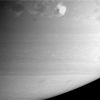
Saturn-PIA08142.jpgSaturnian Super-Storm "Alley"!70 visiteStorm Alley's latest, greatest resident, the recent lightning-producing storm seen by the Cassini spacecraft and Earth-based observers churns away. Turbulent eddies to the West (left) of the storm indicate that it is moving eastward relative to the westward-flowing winds at this latitude on Saturn.
Scientists gave the nickname "Storm Alley" to the area around 35° South Latitude because of the large amount of activity seen there from the beginning of the Cassini spacecraft's approach to Saturn in early 2004. The Region has spawned two large and powerful storms since the Cassini spacecraft began observations.
The image was taken with the Cassini spacecraft narrow-angle camera on Feb. 16, 2006, using a filter sensitive to wavelengths of infrared light centered at 750 nanometers, and at a distance of approx. 3,2 MKM (such as about 2 MMs) from Saturn. The image scale is roughly 19 Km (about 12 miles) per pixel.
(3 voti)
|
|

Rhea-N00056068.jpgDark Rhea and the Rings59 visitenessun commento
(3 voti)
|
|

Dione-N00055940.jpgSaturnshine on Dione55 visiteDione è solo al primo quarto, ma il suo lato in ombra ci appare comunque discretamente visibile - come alle volte accade anche alla nostra Luna - grazie alla luce che arriva dall'immenso disco illuminato di Saturno (il "saturnshine", o "chiaro di Saturno").
(3 voti)
|
|

Rhea-N00055723.jpgMoments of Rhea (2)62 visitenessun commento
(3 voti)
|
|

Saturn-PIA08140.jpgRestless Atmosphere (1)58 visiteThis atmosphere close-up shows bright clouds in Saturn's Northern Hemisphere being sheared apart. The clouds at the bottom of the image are tilted and stretched because the wind at those lower latitudes is moving much faster to the East than the wind at the higher latitudes near the top of the image, hence the shear.
This appearance suggests that these bright eddies are passive tracers of the atmosphere's motion - they appear, probably as a result of upwelling due to convection from below, and then they are sheared apart.
The image was taken in visible light with the Cassini spacecraft narrow-angle camera on Feb. 16, 2006, at a distance of approximately 3,3 MKM (about 2 MMs) from Saturn. The image scale is roughly 19 Km (about 12 miles) per pixel.
(3 voti)
|
|

Saturn-PIA08141.jpgRestless Atmosphere (2)56 visiteSaturn's atmosphere comes alive with a multitude of dark vortices swirling through the Southern Hemisphere.
Vortices are long-lived features that are part of the general circulation of Saturn's atmosphere. Vortices are thought to be caused by the shear between Eastward- and Westward-flowing jets - the alternating bands flowing past each other in the atmosphere. The vortices can last for months or years and probably grow by merging with other vortices until a few dominate a particular zone of wind shear between two jets. The vortex at upper right is one of the largest vortices on Saturn.
The image was taken with the Cassini spacecraft narrow-angle camera on Feb. 16, 2006 at a distance of approximately 3,2 MKM (about 2 MMs) from Saturn. The image scale is about 19 Km (approx. 12 miles) per pixel.
(3 voti)
|
|

The Rings-PIA08129.jpgThe "sharp" G-Ring62 visiteThis contrast-enhanced view of Saturn's faint G-Ring shows its extremely sharp inner edge and more diffuse outer boundary. Using its large high-gain antenna as a shield, the Cassini spacecraft flew through the Region interior to the G-Ring during insertion into Saturn orbit. The spacecraft was struck many times by the fine icy particles that populate the Region between the F and G Rings.
The image was taken in visible light with the Cassini spacecraft narrow-angle camera on Jan. 19, 2006, at a distance of approx. 1,2 MKM (such as about 700.000 miles) from Saturn. The image scale is about 7 Km (approx. 4 miles) per pixel.
(3 voti)
|
|

Rhea-PIA08121.jpgThe incoherent surface of Rhea57 visiteThis intense false-color view highlights and enhances color variations across the cratered and cracked surface of Saturn's moon Rhea.
To create the false-color view, ultraviolet, green and infrared images were combined into a single black and white picture that isolates and maps regional color differences. This "color map" was then superposed over a clear-filter image. The origin of the color differences is not yet understood, but it may be caused by subtle differences in the surface composition or grain sizes making up the icy soil.
This view shows terrain on the trailing hemisphere of Rhea. North is up.
The images were taken using the Cassini spacecraft narrow-angle camera on Jan. 18, 2006, at a distance of approx. 268.000 Km (about 166.000 miles) from Rhea and at a Sun-Rhea-spacecraft, or phase, angle of 115°. Image scale is about 2 Km (roughly 1,2 miles) per pixel.
(3 voti)
|
|
| 2244 immagini su 187 pagina(e) |
 |
|
|
|
|
141 | |
|
|
|
|





