| Piú votate - Saturn: the "Ringed Beauty" and His Moons |
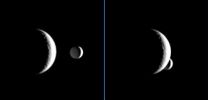
Rhea&Enceladus-PIA08180.jpgHiding...58 visiteCaption NASA originale:"Enceladus briefly passes behind the crescent of Rhea in these images, which are part of a so-called "mutual event" (such as an "eclipse") sequence taken by Cassini.
These sequences help scientists refine our understanding of the orbits of Saturn's moons.
The images were taken one minute apart, as smaller Enceladus darted behind Rhea as seen from the Cassini spacecraft's point of view.
The images were taken in visible light with the Cassini spacecraft narrow-angle camera on April 14, 2006, at a distance of approx. 3,4 MKM (such as about 2,1 MMs) from Rhea and 4,1 MKM (about 2,5 MMs) from Enceladus. The image scale is approx. 20 Km (about 13 miles) per pixel on Rhea and 24 Km (roughly 15 miles) per pixel on Enceladus".
(3 voti)
|
|

Epimetheus-PIA08178.jpgThe "Runners"...again!54 visiteJanus and Epimetheus continue to separate, following their orbital swap in January 2006. Until 2010, Janus will remain the innermost of the pair, whose orbits around Saturn are separated by only about 50 Km (such as approx. 31 miles) on average.
Epimetheus appears just right of the bright A-Ring ansa, or edge, while Janus is seen near the upper right. The faint F-Ring extends across the image and Janus appears directly between its near and far edges.
The image was taken in visible light with the Cassini spacecraft narrow-angle camera on April 16, 2006, at a distance of approx. 3,7 MKM (such as about 2,3 MMs) from Saturn. The image scale is approx. 22 Km (about 14 miles) per pixel on both Janus and Epimetheus.
(3 voti)
|
|
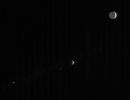
Enceladus&C.-PIA08182.jpgMoons...58 visiteCaption NASA proginale:"Four of Saturn's many and varied moons crowd this single frame from Cassini.
All of the moons are illuminated by the Sun, which is out of the frame to the right. "Saturnshine", or reflected light from the planet (out of frame to the lower left), partly illuminates three of the moons, such as Tethys (1.071 Km, or 665 miles across, at upper right), Janus (181 Km, or 113 miles across, at lower left) and Epimetheus (116 Km, or 72 miles across, below and left of center).
Enceladus (505 Km, or 314 miles across) is much farther in the distance in this view, and shows merely a slim crescent below center.
The image was taken in visible light with the Cassini spacecraft narrow-angle camera on April 17, 2006, at a distance of approx. 3,7 MKM (such as about 2,3 MMs) from Saturn. The image scale is approx. 27 Km (about 17 miles) per pixel on Tethys, 21 Km (13 miles) per pixel on Enceladus, and 22 Km (14 miles) per pixel on Janus and Epimetheus".
(3 voti)
|
|

Saturn&Titan-N00060957.jpgSo close and yet so far...57 visitenessun commento
(3 voti)
|
|

Saturn-PIA08176.jpgThe "night-side" of Saturn (natural colors)57 visiteThis rare color view of Saturn's night side shows how the Rings dimly illuminate the Southern Hemisphere, giving it a dull golden glow. Part of the Northern dark side is just visible at top - the illumination it receives being far less than the South.
The unlit side of the Rings is shown here. The portion of the Rings closest to Cassini is within the dark shadow of Saturn; the bright distant portion is outside the Planet's shadow.
A crescent Tethys appears below the rings at left.
Images taken using red, green and blue spectral filters were combined to create this color view. The images were taken with the Cassini spacecraft narrow-angle camera on April 2, 2006, at a distance of approx. 3,8 MKM (about 2,4 MMs) from Saturn and 3,5 MKM (about 2,2 MMs) from Tethys. The image scale is about 23 Km (14 miles) per pixel on Saturn.
Cerchiatura Rossa: probabile evidenza di una "Luna Pastore" (Pandora?) o di un "clump" di notevoli dimensioni (optiamo per la "Shepherd Moon").
(3 voti)
|
|
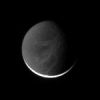
Dione-PIA08174.jpgIn the Light of Saturn...57 visiteCaption NASA originale:"The wispy fractured terrain on Dione is illuminated here by the so-called "Saturnshine", such as the dim reflected light from the planet.
The region pictured on Dione is on the moon's Saturn-facing Hemisphere. North is up.
The image was taken in polarized green light with the Cassini spacecraft narrow-angle camera on March 24, 2006, at a distance of approximately 2,2 MKM (such as about 1,4 MMs) from Dione and at a phase angle of 162°. Resolution in the original image was about 13 Km (approx. 8 miles) per pixel. The image has been magnified by a factor of two and contrast-enhanced to aid visibility".
(3 voti)
|
|

Daphnis-PIA08171.jpgDaphnis54 visiteThis splendid view offers a detailed look at the faint Rings within the Cassini Division as well as a rare glimpse of the "Keeler Gap Moon", Daphnis. The small, ring embedded moon is a bright unresolved speck above center, near the outer edge of the A ring.
Discovered in Cassini images in 2005, Daphnis is a mere 7 Km (a little less than 4 miles) across.
The image was taken in visible light with the Cassini spacecraft narrow-angle camera on March 20, 2006, at a distance of approx. 483.000 Km (such as about 300.000 miles) from Saturn. The image scale on the sky at the distance of Daphnis is about 2 Km (a little more than 1 mile) per pixel.
(3 voti)
|
|

The Rings-PIA08163-1.jpgThe "E-Ring" of Saturn: the "Enceladus Ring" (1)66 visiteThis excellent view of the faint E-Ring - a ring feature now known to be created by Enceladus - also shows two of Saturn's small moons that orbit within the Ring, among a field of stars in the background.
The E-Ring extends from three to eight Saturn radii - about 180.000 Km(such as about 118.000 miles) to 482.000 Km (about 300.000 miles). Its full extent is not visible in this view.
Calypso (22 Km, or about 14 miles across) and Helene (32 Km, or about 20 miles across) orbit within the E-Ring's expanse. Helene skirts the outer parts of the E-Ring, but here it is projected in front of a region deeper within the Ring.
Calypso and Helene are trojan satellites, or moons that orbit 60° in front or behind a larger moon. Calypso is a Tethys trojan and Helene is a trojan of Dione. An interesting feature of note in this image is the double-banded appearance of the E-Ring, which is created because the Ring is somewhat fainter in the Ring-Plane than it is 500-1000 Km (about 300-600 miles) above and below it.
(3 voti)
|
|

Saturn-PIA08162.jpgSaturnian (swirling) clouds60 visiteCaption NASA originale:"The bright whorls and small-scale specks of convective clouds drift through a Region just North of Saturn's bright Equatorial Band. Observers have seen major storms develop in this Region in the past 15-20 years.
The image was taken in visible red light with the Cassini spacecraft narrow-angle camera on March 13, 2006, at a distance of approximately 2,6 MKM (about 1,6 MMs) from Saturn. The image scale is approx. 15 Km (about 9 miles) per pixel".
(3 voti)
|
|

Saturn-PIA08155.jpgRestless Upper Atmosphere...60 visiteCaption originale:"Streamers, swirls and vortices roll across the dynamic face of Saturn.
Unlike Earth, where most of the weather is driven by the Sun, Saturn's storms and circulation are driven in part by internal heating. Amazingly, the Planet is still contracting (ever so slightly) from its formation, more than 4,5 BY (Billion Years) ago. This gravitational contraction liberates energy in the form of heat.
The image was taken in polarized infrared light with the Cassini spacecraft narrow-angle camera on March 7, 2006, at a distance of approx. 2,9 MKM (1,8 MMs) from Saturn.
The image scale is about 17 Km (roughly 10 miles) per pixel".
(3 voti)
|
|
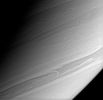
Saturn-PIA08153.jpgSaturnian Clouds57 visiteLong, thin streamers of cloud arc gracefully across this view of Saturn's Southerly Latitudes.
Analysis of images like this should lead scientists to a new understanding of cloud height variations on this complex gas giant world.
The image was taken in polarized green light with the Cassini spacecraft narrow-angle camera on March 7, 2006, at a distance of approx. 2,9 MKM (about 1,8 MMs) from Saturn. The image scale is 17 Km (about 10 miles) per pixel.
(3 voti)
|
|

Saturn-PIA08154.jpgOne "Eye" of Saturn!58 visiteGaseous Saturn rotates quickly - once every approx. 10,8 hours - and its horizontal cloud bands rotate at different rates relative to each other. These conditions can cause turbulent features in the atmosphere to become greatly stretched and sheared, creating the beautiful patterns that the Cassini spacecraft observes. This turbulence and shear is particularly notable at those boundaries where the different bands slide past each other.
Vortices like the one seen here are long-lived dynamical features that are part of the general circulation of Saturn's atmosphere. They are counterparts to the East-West flowing jets and can last for months or years. They probably grow by merging with other vortices until a few dominate a particular shear zone between two jets.
This image was taken in polarized infrared light with the Cassini spacecraft narrow-angle camera on March 7, 2006, at a distance of approximately2,9 MKM (such as about 1,8 MMs) from Saturn. The image scale is 17 Km (about 10 miles) per pixel.
(3 voti)
|
|
| 2244 immagini su 187 pagina(e) |
 |
|
|
|
|
140 | |
|
|
|
|





