| Piú votate - Saturn: the "Ringed Beauty" and His Moons |

Japetus-A-V-Architecture7a~0.jpgThe "Tower" of Japetus111 visiteMa le Singolarità Superficiali di Giapeto non finiscono (anzi...) con il "Muro"! Guardate, per esempio, questo splendido detail mgnf di un altro frame Cassini (sempre elaborato a cura della Enterprise Mission di R. Hoagland): che cosa c'è che si "erge" sul bordo di questa luna misteriosa? Forse una "Torre" simile a quella individuata sulla Luna e chiamata (ci pare) 'Shard'? La forza di queste immagini, a nostro parere, non è solo nel loro semplice contenuto oggettivo (cioè in quello che vediamo), ma nel fatto che, partendo da questo contenuto, possiamo (e riusciamo a) trovare delle similitudini con altre Singolarità Spaziali!
Ora è indubitabile che le caratteristiche esteriori di Giapeto rendano questa luna eccezionalmente "anomala", ma occorre anche dire che sia il "Muro", sia la "Torre" sono razionalmente e scientificamente spiegabili. La "Torre", nella fattispecie, potrebbe benissimo essere un "picco" analogo a quelli che si formano nei crateri da impatto più grandi: pensate a Tycho...
(8 voti)
|
|

Saturn-PIA06177.jpgSaturn's Northern Hemisphere in natural colors56 visiteCaption NASA originale:"Saturn's Northern Hemisphere is presently a serene blue, more befitting of Uranus or Neptune, as seen in this natural color image from Cassini.
Light rays here travel a much longer path through the relatively cloud-free upper atmosphere. Along this path, shorter wavelength blue light rays are scattered effectively by gases in the atmosphere and it is this scattered light that gives the region its blue appearance. Why the upper atmosphere in the northern hemisphere is so cloud-free is not known, but may be related to colder temperatures brought on by the ring shadows cast there.
Shadows cast by the rings surround the pole, looking almost like dark atmospheric bands. The ring shadows at higher latitudes correspond to locations on the ringplane that are farther from the planet - i.e.: the northernmost ring shadow in this view is made by the outer edge of the A-Ring.
Spots of bright clouds also are visible throughout the region. This view is similar to an infrared image obtained by Cassini at nearly the same time".
(8 voti)
|
|

Rhea and Titan-N00027209.jpgRhea (or Tethys?) and Titan: getting closer...71 visitenessun commento
(8 voti)
|
|

Mimas and Saturn-PIA06574.jpgMimas and Saturn57 visiteCaption NASA originale:"In a dazzling and dramatic portrait painted by the Sun, the long thin shadows of Saturn's rings sweep across the planet's northern latitudes. Within the shadows, bright bands represent areas where the ring material is less dense, while dark strips and wave patterns reveal areas of denser material. The shadow darkens sharply near upper right, corresponding to the boundary of the thin C-Ring with the denser B-Ring. A wide-field, natural color view of these shadows can be seen in PIA06164.
The globe of Saturn's moon Mimas (398 Km or 247 miles across) has wandered into view near the bottom of the frame. A few of the large craters on this small moon are visible. The image was taken with the Cassini spacecraft narrow angle camera on Jan. 18, 2005, at a distance of 1,4 MKM (889.000 miles) from Saturn using a filter sensitive to wavelengths of infrared light centered at 752 nanometers. The image scale is 9 Km (approx 5,5 miles) per pixel".
(8 voti)
|
|

Saturn-W00004086.jpgA look at the Saturn's System56 visiteSaturno in compagnia di 4 Lune Maggiori (siamo abbastanza certi che 3 delle 4 lune visibili siano Rhea, Mimas e Dione) ed almeno altre 5 o 6 Lune Minori (non crediamo che i piccoli punti luminosi che circondano gli Anelli di Saturno in questo frame siano degli artefatti fotografici).
Un'immagine sovraesposta ma splendida: da collezione!
(8 voti)
|
|
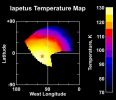
Japetus-temp.2-PIA07005_modest.jpgJapetus Temperature Map54 visiteCaption NASA originale:"Temperatures reach nearly 130 Kelvin (-226 F) at noon on the equator on the dark material that covers most of this side of Japetus, making high noon on Japetus's dark side probably the warmest place in the Saturn System. This is much warmer than temperatures on the moon Phoebe - as measured by the composite infrared spectrometer in June 2004 - which peaked near 112 Kelvin (-258 F). That's because, although Phoebe is almost as dark as Japetus's dark material and absorbs nearly as much sunlight, Phoebe rotates much more quickly (once every 9 hours, compared to 79 days for Japetus). That means the surface has less time to heat up during the day. Temperatures on Japetus' bright material are much colder, peaking near 100 Kelvin (-280 F), both because the bright material absorbs less sunlight and because it is further from the equator on this side of Japetus".
(8 voti)
|
|

Japetus-PIA06171_modest.jpgLandslide on Japetus56 visiteCaption NASA originale:"A spectacular landslide within the low-brightness region of Japetus's surface known as Cassini Regio. The landslide material appears to have collapsed from a scarp 15 Km high that forms the rim of an ancient 600 Km impact basin. Unconsolidated rubble from the landslide extends halfway across a conspicuous, 120-Km diameter flat-floored impact crater that lies just inside the basin scarp. Landslides are common geological phenomena on many planetary bodies, including Earth and Mars. The appearance of this landslide on an icy satellite with low-brightness cratered terrain is reminiscent of landslide features that were observed during NASA's Galileo mission on the Jovian satellite Callisto. The fact that the Japetus landslide traveled many kilometers from the basin scarp could indicate that the surface material is very fine-grained and perhaps was fluffed by mechanical forces that allowed the landslide debris to flow extended distances".
(8 voti)
|
|

Japetus-PIA06167_modest.jpgJapetus in "near-true" color56 visiteCaption NASA originale:"This near-true color view from Cassini reveals the colorful and intriguing surface of Saturn's moon Iapetus in unrivaled clarity. The images taken with different spectral filters and used for this composite were taken at the same time as the clear frames used in PIA06166. The use of color on Iapetus is particularly helpful for discriminating between shadows (which appear black) and the intrinsically dark terrain (which appears brownish). This image shows the northern part of the dark Cassini Regio and the transition zone to a brighter surface at high northern latitudes. Within the transition zone, the surface is stained by roughly north-south trending wispy streaks of dark material. The absence of an atmosphere on Iapetus means that the material was deposited by some means other than precipitation, such as ballistic placement from impacts occurring elsewhere on Japetus, or was captured from elsewhere in the Saturn system".
(8 voti)
|
|

Saturn-PIA06164-br500.jpgSaturn, Titan and Mimas in real colors56 visiteCaption NASA originale:"From its station nearly 1,2 BKMs (or 746 MMs) from Earth, the stalwart Cassini spacecraft sends holiday greetings to Earth with this lovely color portrait of Saturn and two of its moons. This color portrait serves as reminder of the Saturnian places we have already seen and the promise of future discovery at Titan when the European Space Agency's Huygens probe arrives at Titan on Jan. 14, 2005. A grayish, oval-shaped storm is visible in Saturn's southern hemisphere and is easily 475 Km across - the size of some hurricanes on Earth. Titan is visible near lower right with its thick, orange-colored atmosphere, and faint Mimas (398 Km across) appears just right of the rings' outer edge. Images taken in the red, green and blue filters with the Cassini spacecraft wide angle camera on Dec. 14, 2004, were combined to create this color view at a distance of approximately 719.000 Km from Saturn. The image scale is 43 Km (or 27 miles) per pixel".
(8 voti)
|
|

The C-Ring-PIA06537_modest.jpgThe C-Ring in full detail55 visiteCaption NASA originale: "Saturn's inner C-Ring spreads across the field of view, showing the characteristic plateau and wave-like structure for which it is famed.
The center of this image shows an area approximately 75.000 Km from Saturn. The dark gap through the middle of the frame is the Colombo gap which houses the bright, narrow, eccentric Colombo ringlet, in resonance with the moon Titan.
The image was taken with the Cassini spacecraft narrow angle camera on Oct. 29, 2004, at a distance of about 842.000 Km from Saturn. The image scale is 4.7 Km per pixel".
(8 voti)
|
|

The Rings-N00021001.jpgThe "Rings"54 visiteAltissima definizione per questa spettacolare veduta degli Anelli di Saturno: un'immagine - almeno apparentemente - perfetta.
E meno male che, secondo alcuni (le solite "Cassandre"...), la Sonda Cassini-Huygens, su Saturno (oppure in orbita attorno a Saturno) non ci sarebbe mai arrivata...
(8 voti)
|
|

Saturn-N00016178.jpgSaturn: clouds and rings from about 8.400.000 Km56 visitenessun commento
(8 voti)
|
|
| 2244 immagini su 187 pagina(e) |
 |
|
|
|
|
14 | |
|
|
|
|





